
FAQs About Automated Cleaning for Rentals
Automated cleaning syncs bookings, schedules and verifies cleanings, saves time, reduces errors, and boosts guest satisfaction.
Automated cleaning systems simplify managing vacation rentals by syncing with booking platforms like Airbnb and Vrbo. They automatically schedule cleanings, notify cleaners, and provide checklists to ensure properties are guest-ready. Key benefits include:
- Time Savings: Save up to 30 hours per week by eliminating manual scheduling.
- Improved Efficiency: Hosts report over 50% better performance.
- Guest Satisfaction: Cleanliness boosts reviews and repeat bookings.
- Scalability: Manage growing portfolios without extra staff.
These tools also offer features like photo verification, smart lock integration, and real-time updates. Costs vary by property size and features, with monthly fees starting at $7 per property. Whether managing a single rental or hundreds, automated cleaning streamlines operations and reduces errors.
Automate Your Short-Term Rental Cleaning with Turno’s Auto Scheduling Feature 🧹
How Automated Cleaning Systems Work
Understanding how automated cleaning systems function sheds light on the efficiency they bring to property management.
At the heart of these systems lies iCal synchronization - a universal calendar format that bridges your booking platforms (like Airbnb, Vrbo, and Booking.com) with your cleaning software. Using unique iCal URLs, the system constantly monitors reservations, capturing essential details like check-in and check-out times. Typically, these platforms refresh their feeds every 15–30 minutes to ensure updates are reflected promptly.
Task Scheduling and Automation
Whenever a guest books your property, the system identifies the check-out date and automatically generates a cleaning task. If the booking changes - whether it’s extended or canceled - the software adjusts the task accordingly and notifies the assigned cleaner. You can assign a primary cleaner for each property and set up a backup cleaner. If the primary cleaner declines the task, the system seamlessly redirects it to the backup, ensuring no gaps in coverage.
"Calendar sync is the foundation of automated cleaner scheduling." - TurnoverPing Team
To avoid scheduling errors, it’s crucial to set the property’s timezone in your automation tool, as some iCal events don’t include this data. Cleaners should ideally be notified 3–5 days before a check-out to accommodate last-minute changes while providing enough preparation time.
This streamlined task management integrates smoothly with property management systems, creating a cohesive workflow.
Integration with Property Management Systems
iCal integration consolidates calendar feeds from all booking platforms into a single, unified schedule. This eliminates delays caused by manual updates, as bookings from different platforms are synced in real-time. Some systems even take it a step further by integrating with smart locks, generating unique access codes for cleaners that work only during their scheduled shifts.
This level of integration enhances real-time oversight and simplifies task coordination.
Communication and Notifications
Automated systems excel at keeping everyone informed. Notifications are sent through SMS, WhatsApp, or email, eliminating the need for additional app downloads. Cleaners can confirm tasks with a quick "OK" or "YES", which updates your dashboard instantly. If a task is canceled, cleaners are notified immediately, preventing wasted trips. For property managers, a centralized inbox provides an overview of task statuses and streamlines team communication.
These features work together to ensure smooth operations and effective communication across all levels of the cleaning process.
Setting Up Automated Cleaning for Your Rentals
Getting an automated cleaning system up and running involves three main steps: selecting the right software, onboarding your team, and customizing the system to suit your property’s needs. Each step builds on the last, ensuring a smooth and efficient setup.
Choosing the Right Cleaning Automation Tool
Start by focusing on integration capabilities. The software should sync seamlessly with your Property Management System (PMS) or booking platforms through iCal or API connections. This eliminates the need for manual entry of check-out dates. Cleaners should also have access to an easy-to-use mobile app for updates and task completion.
Look for features like customizable checklists that allow you to assign property-specific tasks. Automated messaging options - via SMS, email, or WhatsApp - are essential for notifying cleaners of bookings or last-minute changes. If you use smart locks, consider tools that can generate unique, time-limited access codes automatically, reducing the need for manual coordination.
"Detailed analytics from cleaning management software have allowed us to improve our decision-making by 40%, directly impacting our bottom line." - Joe Host, CEO, CleanFast Inc.
Pricing is often based on a pay-as-you-go model, charging per unit or task, which makes it scalable. For example, in February 2026, a property manager overseeing 50+ premium rentals switched to TurnoverBnB. The platform’s automated notifications, smart lock integration, and photo-verified checklists saved them 3–4 hours of weekly manual work, reduced turnover time by 45 minutes, and completely eliminated cleaner no-shows.
Onboarding Your Cleaning Team
The next step is bringing your cleaning team onto the platform. Start by adding cleaners to the system so they can only access job details relevant to them. Run a test workflow from their perspective to identify and fix any unclear instructions or technical hiccups. Use mobile checklists that include property-specific notes and supply requirements to prevent last-minute issues.
Set up photo verification so cleaners upload before-and-after images - for example, of made beds or stocked bathrooms - before a property is marked as clean. Train your team to report low supplies through the system, which can trigger automated restock alerts. Add backup cleaning teams to ensure tasks are reassigned automatically if your primary cleaner isn’t available.
Once your team is comfortable with the system, you can fine-tune it to better fit your property’s needs.
Customizing Settings for Your Property
To ensure real-time updates, connect your rental platforms or PMS to the cleaning software via iCal. This will automate task assignments when bookings are confirmed or guests check out. For properties with smart locks, set up buffer periods (usually 15–30 minutes before and after turnovers) to prevent lockouts and give cleaners appropriate access.
Create separate automation templates for different types of services, such as standard turnovers, deep cleans, or move-out cleanings. Include a “supplies required” section in each checklist to ensure cleaners arrive fully prepared. Configure notification preferences for task assignments and reminders based on your team’s preferred methods, whether that’s SMS, email, or app notifications.
Before launching the system, test everything - automated messages, lock codes, and task scheduling - by walking through the entire guest and cleaner journey. This ensures that all processes run smoothly and on time.
Costs of Automated Cleaning Solutions
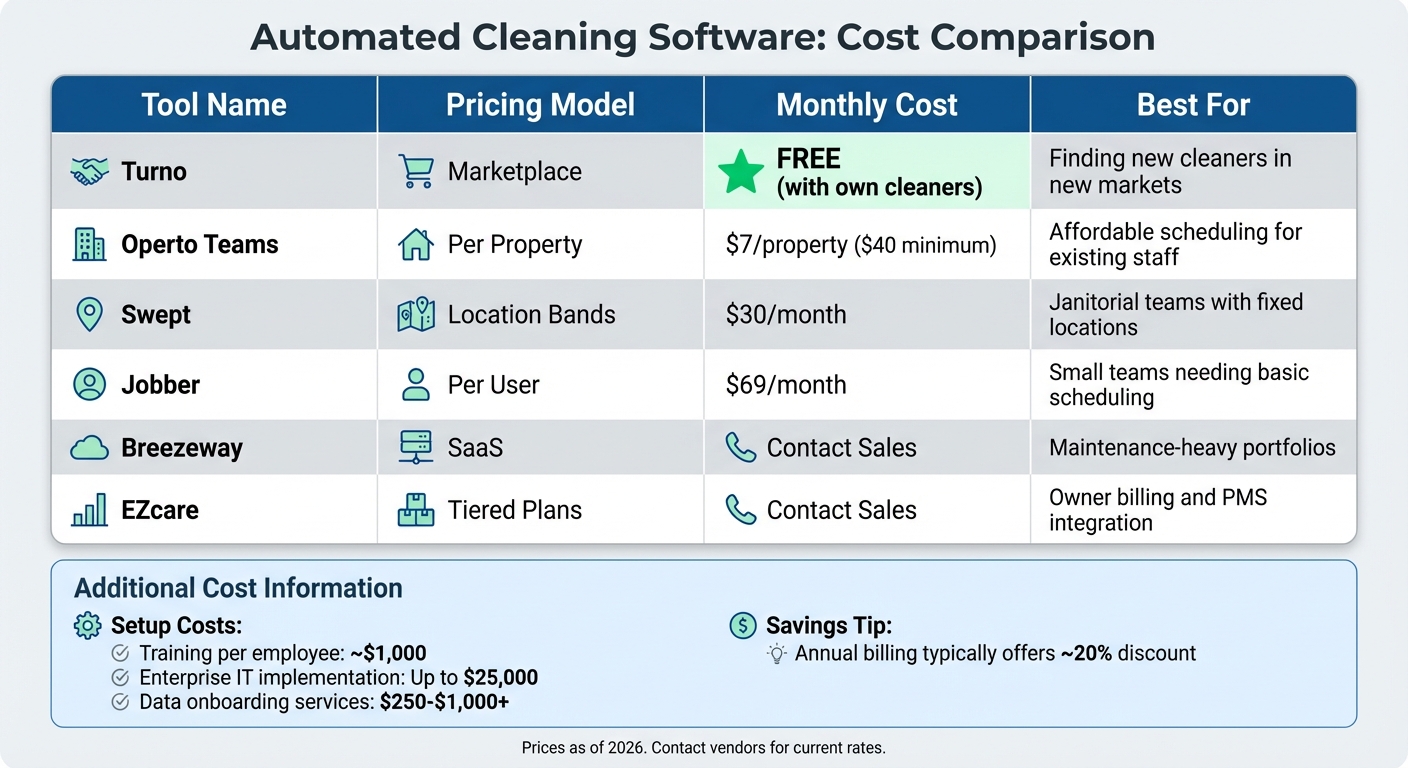
Automated Cleaning Software Pricing Comparison for Vacation Rentals
Automated cleaning solutions come with both startup costs and ongoing monthly fees, which vary based on the size of your portfolio and the features you choose. Understanding these costs is key to ensuring your investment boosts ROI for your vacation rentals. Most platforms follow one of three pricing models: per-property, per-user, or marketplace-based. Below, we’ll break down typical startup fees and monthly subscription costs to help you compare options.
Startup and Setup Fees
While many cloud-based tools skip installation fees, training costs can add up quickly. For instance, if you’re training an internal cleaning team, plan to spend around $1,000 per employee to ensure they’re proficient with the new system. Larger operations may face IT costs of up to $25,000 for enterprise-level implementations.
Enterprise-grade platforms like Flexkeeping often require both a subscription and separate setup fees, particularly for portfolios of 70 or more units. These platforms typically operate on a "contact sales" model, meaning implementation fees aren’t disclosed upfront. If you’re transitioning from an existing system, onboarding services for transferring data - such as customer details, employee info, and service types - can range from $250 to over $1,000, depending on the data volume.
Monthly Subscription Costs
Monthly fees can range widely, from $7 per property to over $500 for plans tailored to agencies. For example, Operto Teams charges $7 per property per month, with a minimum fee of $40, making it a budget-friendly option for smaller portfolios. Turno offers a freemium model - it’s free if you use your own cleaners, but transaction fees apply when hiring through their marketplace.
Mid-tier options include Swept, which starts at $30 per month for 1–15 locations, and Jobber’s Core plan, priced at $69 per month for one user. On the higher end, The Cleaning Software charges $97 per month for three users on its Starter plan, scaling up to $597 per month for its Agency plan. Many providers offer discounts of around 20% for annual billing instead of monthly payments.
"Hostfully and Breezeway are the only two softwares we don't mind the cost. What they give us in terms of ease of mind, reliability, and performance is worth every penny." – Kristi Campbell, Operations Manager, Vanwaw Corporate Rentals
Cost Comparisons Across Popular Tools
To maximize ROI, it’s important to match the platform with your specific needs. For instance, marketplace platforms like Turno are ideal for expanding into new markets where you lack local contacts, while SaaS-only tools like Operto Teams or Breezeway are better suited for streamlining workflows with an established team.
| Tool | Pricing Model | Price | Ideal For |
|---|---|---|---|
| Turno | Marketplace | Free (own cleaners) | Finding new cleaners in new markets |
| Operto Teams | Per Property | $7/property/mo ($40 min) | Affordable scheduling for existing staff |
| Swept | Location Bands | $30/mo | Janitorial teams with fixed locations |
| Jobber | Per User | $69/mo | Small teams needing basic scheduling |
| Breezeway | SaaS | Contact sales | Maintenance-heavy portfolios |
| EZcare | Tiered Plans | Contact sales | Owner billing and PMS integration |
For example, Vanwaw Corporate Rentals in Atlanta integrated Breezeway and Hostfully in 2021 to manage 25 listings. By automating turnover assignments, they eliminated 30 hours per week of manual scheduling, saving between $800 and $1,000 per month in guest relocation and missed cleaning costs. Similarly, Crystal Clean cut its administrative expenses from $55,000 to about $32,000 monthly by using Aspire software, which replaced manual property reporting with real-time profitability tracking.
Keep an eye out for hidden costs, such as payment processing fees for automated cleaner payments or API access restrictions. Some property management systems only allow integrations on higher-tier plans, which can add to your overall expenses.
Benefits of Using Automated Cleaning for Rentals
Time Savings for Property Managers
Automated cleaning software can save property managers handling 10–25 properties up to 30 hours each week by syncing directly with booking calendars. This system automatically generates and assigns cleaning tasks based on guest checkouts, eliminating the need for manual processes like spreadsheets or follow-up calls. Plus, real-time notifications keep managers informed about when cleanings start and finish, all through a centralized dashboard.
Beyond task management, automation simplifies invoicing, payroll data collection, and performance tracking. A great example is Vanwaw Corporate Rentals in Atlanta. After integrating Hostfully with Breezeway in 2021, Operations Manager Kristi Campbell reported her team reclaimed those 30 hours weekly. This allowed them to scale from 10 to 25 properties within a year - without needing additional operational staff.
"With our systems in place, we can focus on delivering luxury experiences instead of fixing mistakes." – Kristi Campbell, Operations Manager, Vanwaw Corporate Rentals
These time-saving benefits directly translate into better guest experiences and operational efficiency.
Improved Guest Satisfaction
Automation ensures properties are always guest-ready by linking directly to platforms like Airbnb and Vrbo. As soon as a guest checks out, a cleaning task is automatically triggered, preventing missed cleanings that can lead to negative reviews or costly guest relocations. Digital checklists with photo verification ensure consistent quality, covering all details - from fresh linens to stocked toiletries.
Automated systems also enhance communication. Features like early check-in notifications and real-time maintenance reporting have been shown to reduce guest complaints by 60% within 90 days of implementation. For example, when cleaners mark a unit as "ready", guests can be notified instantly via text or app. Cleaners can also flag maintenance issues, such as a leaking faucet, through the app, enabling managers to address problems before the next guest arrives.
By maintaining high-quality standards and streamlining communication, automation not only improves guest satisfaction but also supports portfolio growth.
Scalability for Growing Portfolios
For property managers with over 50 properties, automation removes the roadblocks to scaling. A case study from OxMaint highlights a management company that grew from 50 to over 200 properties in just 22 months without increasing operational staff. By replacing manual spreadsheets with automated workflows and onboarding 35+ vendors into a mobile dispatch system, they achieved remarkable results.
Key improvements included turnover rates increasing from 71% to 96%, emergency calls dropping 47%, and per-property maintenance costs decreasing by 31% within six months. A centralized dashboard provided real-time visibility across hundreds of turnovers, while digital checklists ensured consistent quality across diverse properties.
As the short-term rental market is expected to reach $228 billion globally by 2027, automation offers the scalable systems needed to maintain quality while maximizing ROI. By reducing overhead and improving efficiency, property managers can confidently grow their portfolios.
"The scaling ceiling most vacation rental managers hit is not a staffing problem - it is a systems problem." – Mark Strong, OxMaint
Conclusion
Automated cleaning solutions are transforming property management by making turnovers more efficient and ensuring properties remain spotless. These systems connect directly with platforms like Airbnb and Vrbo, automatically scheduling cleanings as soon as guests check out - eliminating the risk of missed tasks. Features like photo-verified checklists and real-time notifications guarantee that each property is always ready for the next guest. On top of that, automated payment systems can save hosts over 40 hours a year on admin work, while detailed analytics help improve decision-making by up to 40%.
"Turno is a great product that is designed to simplify property management and keep his property cleanings scheduled like clock work." – Robert, Host
This solution addresses everything from setup and costs to seamless integration with existing systems. Whether you're managing a single property or an extensive portfolio, automation enhances efficiency, boosts guest satisfaction, and increases profitability. By taking care of time-consuming tasks, these tools let you focus on delivering outstanding guest experiences and growing your business.