Best 30A Nature Trails for Spring Walks
Guide to the best 30A spring walks—paved paths, short loops, birding spots, and wildflower trails.
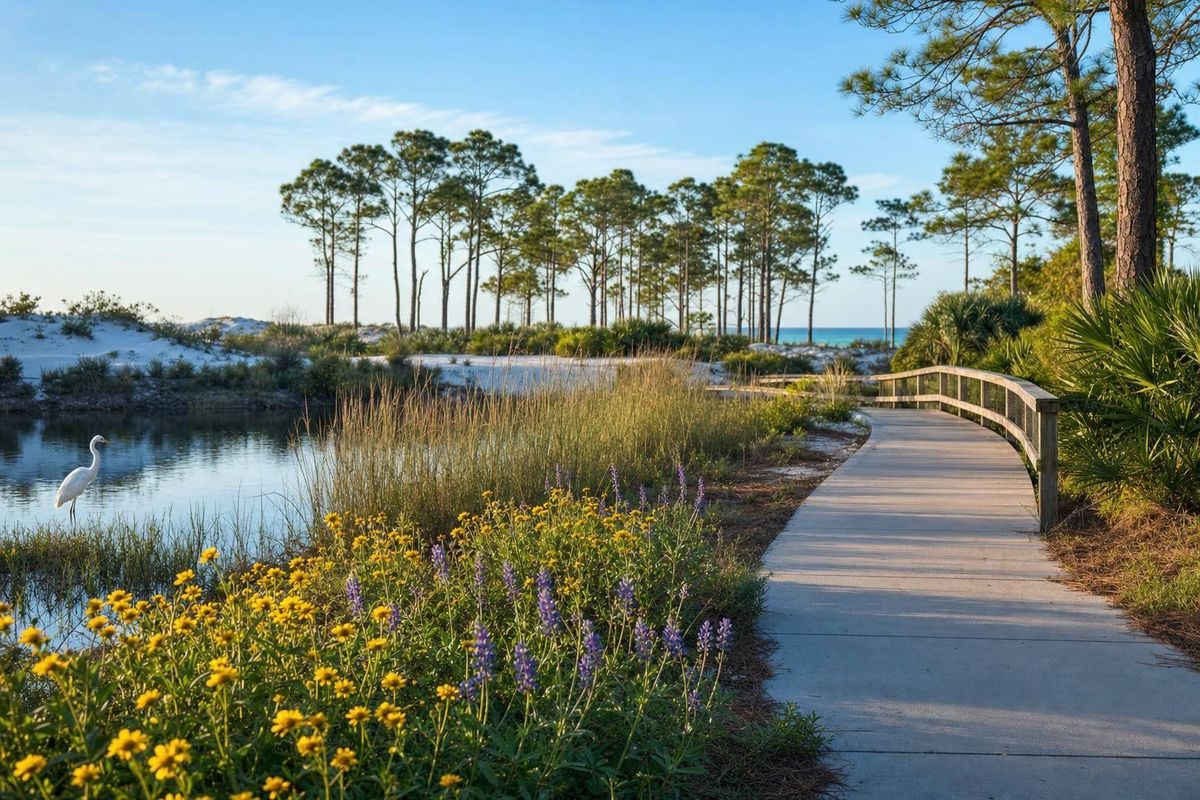
If I want the best spring walk on 30A, I’d pick based on surface, distance, and what I want to see: birds, flowers, forest, or a paved route. In April and May, cooler mornings and lighter crowds make trails easier to enjoy, and the top picks here range from 1-mile loops to a 19-mile paved path. You can also use an itinerary generator to plan your full trip.
Here’s the short version:
- Best for families: Grayton Beach Nature Trail
- Best paved walk: Timpoochee Trail
- Best short wildflower stop: Deer Lake State Park
- Best birding: Grayton Beach and Point Washington State Forest
- Best longer forest walk: Point Washington State Forest
- Best picnic add-on: Eden Gardens State Park and the 30A Trailhead area
I’d also keep these trail facts in mind before I go:
- Shortest options: about 1 mile
- Longest option: about 19 miles
- Best birding window: late March through early May
- Best time of day: early morning for cooler air and more bird activity
- Best stroller option: Timpoochee Trail
- Best beach pairing: Grayton Beach and Deer Lake
Florida Nature Walk // Watercolor 30A (Ep. 4)
sbb-itb-d06eda6
Quick Comparison
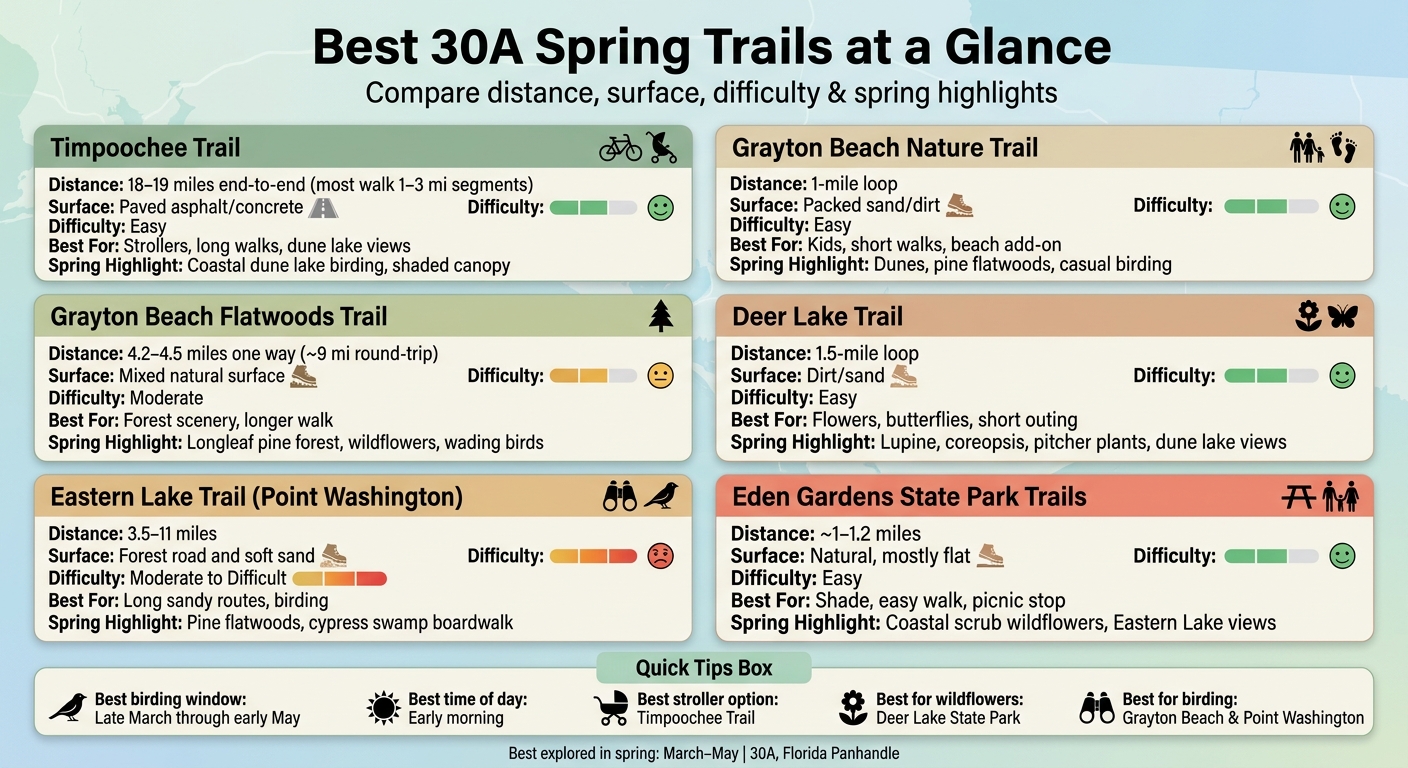
Best 30A Spring Trails: Quick Comparison Guide
| Trail | Distance | Surface | Best For | Difficulty |
|---|---|---|---|---|
| Timpoochee Trail | 18–19 miles | Paved | Strollers, long walks, dune lake views | Easy |
| Grayton Beach Nature Trail | 1-mile loop | Sand/dirt | Kids, short walks, beach add-on | Easy |
| Grayton Beach Flatwoods Trail | 4.2–4.5 miles one way | Mixed natural surface | Forest scenery, longer walk | Moderate |
| Deer Lake Trail | 1.5-mile loop | Dirt/sand | Flowers, butterflies, short outing | Easy |
| Eastern Lake Trail | 3.5–11 miles | Forest road and soft sand | Long sandy routes, birding | Moderate to hard |
| 30A Trailhead Connector | About 1.4 miles round-trip | Natural surface | Short family walk, picnic stop | Easy |
| Eden Gardens State Park Trails | About 1–1.2 miles | Natural surface | Shade, easy walk, picnic stop | Easy |
My takeaway: if I want a no-stress spring walk, I’d go with Grayton Beach Nature Trail or Timpoochee Trail. If I want more quiet and more woods, I’d head to Point Washington. If I want flowers and a short loop, Deer Lake is the pick.
Below, I’d sort each trail by the kind of outing it fits best.
Quick Comparison of the Best 30A Spring Trails
Use this table to line up 30A spring trails by pace, surface, and what stands out most in spring.
| Trail | Length | Surface | Difficulty | Standout Spring Feature | Nearby Beach or Picnic Stop |
|---|---|---|---|---|---|
| Timpoochee Trail (Dune Allen to Inlet Beach) | 18–19 mi end-to-end; most walkers use 1–3 mi segments | Paved asphalt/concrete | Easy – flat, wide, protected | Spring birding along coastal dune lake edges and marshes; shaded canopy stretches | Grayton Beach, Seaside, and Rosemary Beach access points |
| Grayton Beach Nature Trail | 1 mi loop | Natural (packed sand/dirt) | Easy – short interpretive loop | Dunes, pine flatwoods, and scrub oak; good for casual birding | Direct access to Grayton Beach and Western Lake |
| Grayton Beach Hike & Bike / Flatwoods Trail | 4.2–4.5 mi one way; up to ~9 mi round-trip | Mixed natural surface | Moderate – packed sand and dirt | Longleaf pine forest, lake backwaters, spring wildflowers, and wading birds | Connects to Grayton Beach and the paved 30A path |
| Deer Lake Trail | 1.5 mi loop | Natural (dirt/sand) | Easy – mostly flat loop | Wildflowers, butterflies, and views of a rare coastal dune lakes | Near Deer Lake State Park beach access |
| Eastern Lake Trail (Point Washington) | 3.5–11 mi loops | Forest road and soft sand | Moderate to difficult; flat, sandy terrain | Pine flatwoods, cypress swamp boardwalk, and birding | Eastern Lake access nearby |
| 30A Trailhead Connector (Point Washington) | ~1.4 mi round-trip | Natural surface | Easy – flat family connector | Coastal scrub wildflowers in spring; Eastern Lake lakeshore views | Picnic tables at trailhead; Eastern Lake camping area |
| Eden Gardens State Park Trails | ~1 mi (Live Oak loop ~1 mi; Bayou loop ~1.2 mi) | Natural, mostly flat | Easy – minimal elevation gain | Shaded live oaks, bayou views, and garden blooms | Pavilion picnic area at trailhead; historic grounds |
A few quick notes help narrow things down. Paved routes like the Timpoochee Trail work well for strollers and wheelchairs across many sections. The natural-surface loops at Grayton Beach, Point Washington, and Deer Lake are usually a better fit for walkers wearing sturdy shoes.
If you're planning a half-day outing, Eden Gardens and the 30A Trailhead are the easiest picnic-friendly choices. The next sections sort these trails into family walks, birding spots, forest routes, and longer accessible paths.
1. Family-friendly easy walks
For easy spring outings with kids, start with short loops and paved stretches.
Grayton Beach Nature Trail is a nice pick for young children. This 1-mile loop inside Grayton Beach State Park usually takes about 30–40 minutes at an easy pace. It’s short, shaded, and easy to follow, which helps a lot when little legs start to slow down. In spring, you’ll see wildflowers like lupine and false rosemary, and there’s often bird activity near Western Lake.
Day-use access also makes the outing simpler. You’ve got restrooms, beach access, and picnic areas, so it’s easy to turn a short walk into a relaxed half-day trip. Morning tends to be the best time to go, when the air is cooler and the birds are more active.
Timpoochee Trail is the easiest stroller-friendly walk on 30A. If you’re walking with younger kids, pushing a stroller, or just want a flat paved path without surprises, this is the one. The surface is smooth, the route is easy to follow, and you can shorten it into a small out-and-back walk without any hassle.
Spring makes even short sections feel worth it. Mild weather and bird activity near the coastal dune lake edges give the walk a little more to look at, even if you’re only out for a brief stroll. Another plus: you can pair a short walk with nearby shops, restaurants, parks, and beach access points along the route. Trail use is free, and parking is available at many public beach access points and town centers. Early morning or later in the day works best, before the heat and foot traffic pick up.
For more birding and wildlife spots, the next trails trade pavement for quieter habitat.
2. Birding and wildlife viewing
Bird migration peaks here from late March through early May. That’s when songbirds, shorebirds, and raptors push north through the Panhandle. If you go early, you’ll have the best shot at seeing birds while they’re feeding and singing.
If you want more than the easy family loops, these two trails are your best bet for spring birding.
- Grayton Beach State Park: Coastal dune lake birding with beach access
Grayton Beach State Park packs a lot of activities into a short walk. The trails move through pine flatwoods, coastal dunes, and the area around Western Lake, so you get several habitats in one trip. Most routes are sand-and-dirt trails mixed with boardwalks, with only gentle elevation changes.
During migration, the 1-mile trail has recorded 15 wood-warbler species. The park bird list also includes Great Blue Heron, Bald Eagle, Barred Owl, and Brown-headed Nuthatch. Ospreys are a common sight over the lake. And because there are picnic areas and beach access nearby, it’s easy to turn a simple bird walk into a longer morning outside.
- Point Washington State Forest: Quiet pine woods for spring songbirds
For a quieter outing, Point Washington State Forest is hard to beat. Its trail system runs through pine flatwoods, cypress swamps, and sandhill areas, and each habitat brings a different mix of birds. In spring, regular sightings include Red-headed Woodpecker, Pileated Woodpecker, Eastern Bluebird, Pine Warbler, and Red-shouldered Hawk. Wet areas also draw egrets and herons.
The forest is part of the Great Florida Birding and Wildlife Trail, and some routes can link up with Grayton Beach if you want a longer outing. Trails here are unpaved natural-surface paths, mostly sand and packed dirt, so sturdy shoes help. Access points near Santa Rosa Beach are about a 15–20 minute drive from most beach neighborhoods.
Bring binoculars and water, and stay on marked trails so you don’t disturb nesting birds.
3. Wildflowers and forest scenery
If you're after spring color and some shade, these two 30A-area trails are hard to beat. Deer Lake State Park is the better fit for a short walk with lots of blooms. Point Washington State Forest makes more sense if you want a longer stretch through quiet woods.
- Deer Lake State Park: Coastal dunes and spring wildflowers on a short forest loop
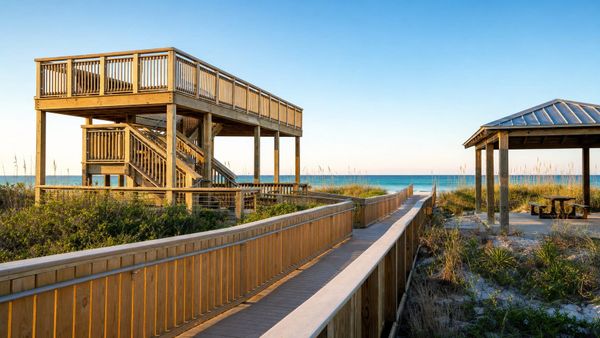
Deer Lake State Park combines a 1-mile Interpretive Forest Loop with a 0.5-mile Lake Trail, and the Lake Trail adds a short overlook of Deer Lake itself. The route moves through dunes, scrub, marsh, and pine, with spring blooms such as lupine, coreopsis, and pitcher plants. There's also an elevated dune boardwalk that runs about 0.3 to 0.4 miles one way to a secluded Gulf beach, so it's easy to pair a flower-filled walk with some beach time in the same trip. Go early if you want cooler weather and fewer people.
- Point Washington State Forest: Longleaf pine forest with spring blooms
The Longleaf Greenway Trail runs about 8 miles east to west through Point Washington State Forest. Along the way, you'll pass longleaf pine flatwoods, sandhills, coastal scrub, and wetlands, all of which can show spring wildflowers during the season. That makes it a good choice for a longer, laid-back forest walk. The trails are mostly packed dirt and sand, so sturdy shoes are a smart call. Trailheads near Blue Mountain Beach also have picnic tables and restrooms.
Stay on marked paths to help protect the flowers, and bring insect repellent on warmer spring days, especially near wet areas.
Pick Deer Lake for a short spring outing, or Point Washington for a longer, quiet walk.
4. Paved or accessible longer routes
- Timpoochee Trail: 19-mile paved route for easy spring walking
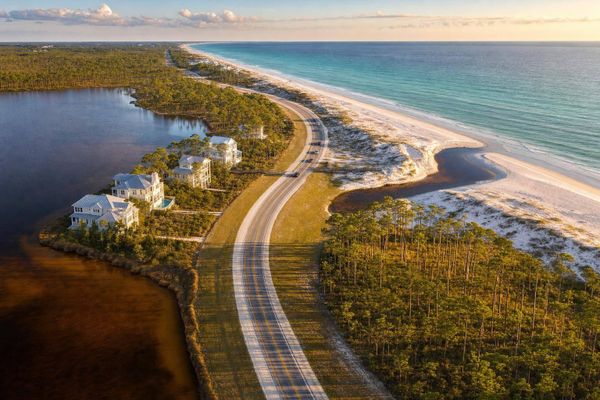
If you want a longer paved walk in spring, the Timpoochee Trail is the top pick on 30A. It stretches about 19 miles from Dune Allen to Inlet Beach along Scenic Highway 30A, and the mild spring weather makes those longer walks much more comfortable. It also fills a nice middle ground between short family-friendly loops and longer dirt or sand trails.
Spring makes this route even better. The trail passes 15 rare coastal dune lakes, so you get plenty of chances to see wading birds and shorebirds during the season. Parts of the trail move through wooded areas, while other sections open up to coastal views, which keeps the walk from feeling repetitive even though the footing stays smooth and easy.
Most people don’t walk all 19 miles in one go. They usually pick a shorter segment or do an out-and-back, then stop at a beach access point or take a picnic break. A few access points also have parking and restrooms, including the picnic area at Grayton Beach State Park.
A heads-up: road crossings near town centers need extra care, and it’s smart to head out early with water and sunscreen. Open sections can warm up fast, even in spring. That’s why this trail works so well when you want a long walk without dealing with rough ground.
How to Choose the Right Spring Trail for Your Group
If you’ve already narrowed down your options, use a few simple filters to pick the best trail for your group. Start with pace, surface, and what you want to do after the walk. On 30A, a short walk followed by beach time or a picnic often goes over better than a long hike. From there, pick based on your main goal: easy walking, birding, or spring color.
If you’re going with young kids or older family members, Grayton Beach Nature Trail is a smart pick. It has a 1-mile loop, plus beach access and picnic pavilions close by.
If birdwatching is the main draw, head toward wetlands and coastal dune lakes, especially the Western Lake area at Grayton Beach. Go early, stay quiet, and bring binoculars.
If your group wants more shade and spring blooms, look at Point Washington State Forest or the flatwoods at Grayton Beach.
The main thing is to match the trail to your group’s pace, the kind of surface they like, and the spring payoff you want most: flowers, birds, or shade.
Conclusion
Spring is one of the easiest times to explore 30A on foot. March and April usually bring mild weather, which makes it a good time for birding, wildflowers, and easy family walks.
Choose your trail based on your pace and what you want from the day. If you want something simple, go with a paved walk or a short loop. If your group has more energy, a shady forest route or the paved Timpoochee Trail can give you more time outside. A short loop works well for young kids or slower days. Longer routes fit the days when you want to stretch things out a bit.
A little planning goes a long way. Sort out parking, food, or beach access ahead of time, and the whole outing feels smoother. It also helps to end near a picnic area, beach access point, or café so the walk turns into an easy half-day trip. You can use sowal.co to find nearby food stops and beach access points.
Pick one trail, pack water, wear comfortable shoes, and enjoy the spring scenery.
FAQs
Which 30A trail is best for wheelchairs?
The most reliable wheelchair-friendly spots on 30A are the paved trails at Topsail Hill Preserve State Park. The best picks are the 1.1-mile Salamander Pond Trail, Campbell Lake Bird Trail, and Beach Tram Trail.
Grayton Beach State Park has accessible features too, including a 1-mile trail near the beach with flat boardwalk sections. You can also use the paved Walton County bike-and-walk path along 30A. Both parks offer Mobi-Mats and beach wheelchairs that you can reserve.
Are dogs allowed on these 30A trails?
Yes. Dogs are allowed on these trails, but they must stay on a leash at all times.
Leashed pets are welcome on designated trails and boardwalks. But they aren't allowed on the beaches in these areas, which helps protect sensitive wildlife and nesting shorebirds.
What should I bring for a spring walk on 30A?
Bring the basics for sun, bugs, and uneven terrain:
- SPF 30+ sunscreen, a hat, and sunglasses
- plenty of water and a small backpack
- insect repellent and sturdy closed-toe shoes
- binoculars and a downloaded or paper trail map
You’ll want these for exposed dune stretches, wooded sections, and trails that get wet or sandy.