Best Dance Styles for South Walton Seniors
Line dancing is the simplest start for South Walton seniors; ballroom boosts cognition, low-impact eases joints, socials maximize connection.
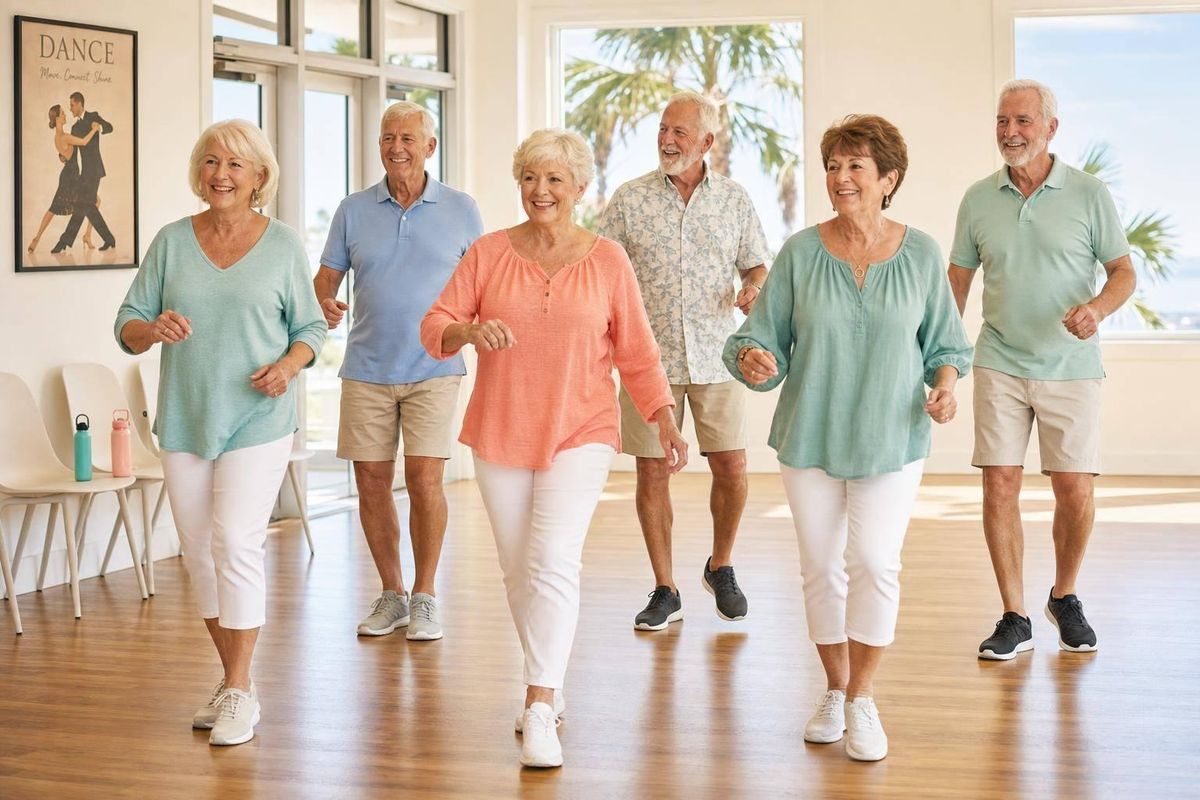
If I had to give the short answer first: line dancing is the easiest place for most South Walton seniors to start, ballroom adds more brain work and partner time, low-impact dance fitness is best for easy movement with less joint stress, and partner socials are best if meeting people matters most.
Dance can do more than get you moving. In older adults, dance-based programs have been linked with 37% lower fall risk, and one long-term study found regular dancing was tied to a 76% lower risk of dementia. It can also help with balance, mood, memory, and social connection.
If I were choosing a class in South Walton, I’d look at just four things first:
- Balance support: line dancing or slow ballroom
- Joint comfort: low-impact, silver, gentle, or chair-based classes
- Social time: partner socials or group line dancing
- Brain challenge: ballroom or line dancing with changing routines
I’d also keep the local setup in mind:
- Go for indoor A/C spaces
- Look for nearby parking and non-slip floors
- Try classes before 9:00 a.m. or after 6:00 p.m. in hotter months
- Drink 16–20 oz of water before class
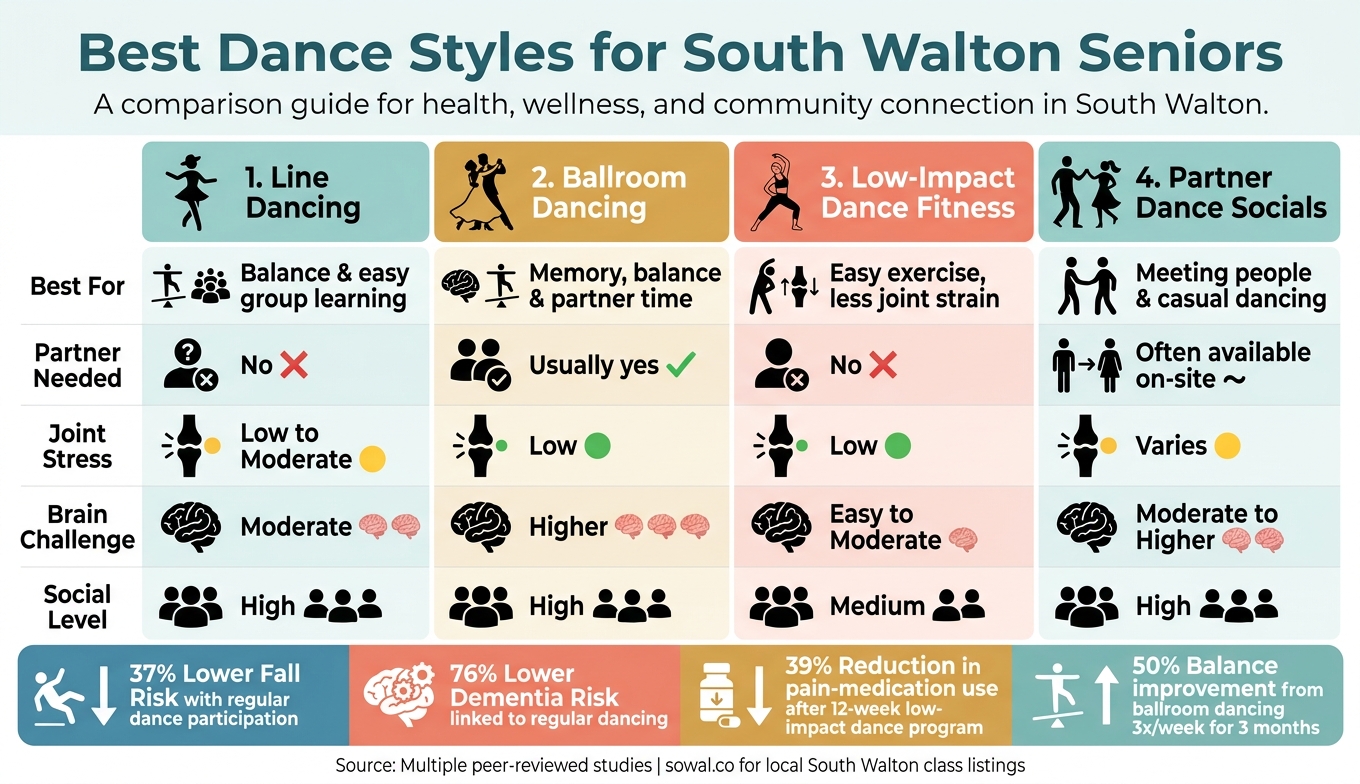
Best Dance Styles for South Walton Seniors: Side-by-Side Guide
20 Minute Dance Workout for Seniors | SilverSneakers
sbb-itb-d06eda6
Quick Comparison
| Dance Style | Best For | Partner Needed | Joint Stress | Brain Work | Social Level |
|---|---|---|---|---|---|
| Line Dancing | Balance, easy group learning | No | Low to moderate | Moderate | High |
| Ballroom Dancing | Memory, balance, partner time | Usually yes | Low | Higher | High |
| Low-Impact Dance Fitness | Easy exercise, less joint strain | No | Low | Easy to moderate | Medium |
| Partner Dance Socials | Meeting people, casual dancing | Often available on-site | Varies | Moderate to higher | High |
So if you want the plain answer: pick the style that matches your body, comfort level, and how social you want the class to be. From there, the rest is just finding a beginner-friendly local option that feels safe and easy to keep doing.
Why Dance Works Well for Older Adults
Dance works so well for older adults because it does more than train muscles. It works the body and the brain at the same time, and it comes with a social side built in.
The physical upside is hard to ignore. A meta-analysis of 29 trials found that dance-based movement cut fall risk by 37% in older adults. Regular dance participation is also linked to better leg strength, joint mobility, balance, and coordination - all key parts of staying steady and independent day to day.
There’s a mental side too. A 21-year longitudinal study from the Albert Einstein College of Medicine found that older adults who danced regularly had a 76% reduced risk of developing dementia compared with non-dancers. That finding makes sense when you think about what dance asks of you. You’re learning and recalling step sequences, staying on beat, and reacting to cues from the instructor or group. It’s exercise, memory work, and timing practice all rolled into one. For many people, that makes dance feel a lot more engaging than a standard workout.
Music helps too. It can shift the whole feel of a class. What might seem like exercise on paper often feels more like an activity people want to come back to. Studies show older adults in dance programs report lower stress, reduced depressive symptoms, and better quality of life. That’s a big deal. Sticking with movement is often the hardest part, and dance tends to make that easier.
Then there’s the group factor. Face-to-face connection matters, especially for retirees and seasonal residents in South Walton. Regular dance classes can help reduce isolation, and that social routine can be just as meaningful as the movement itself.
For South Walton seniors, a few practical details matter more than people think. Summers in South Walton are hot and humid, so early morning sessions - before 9:00 a.m. - or evening sessions - after 6:00 p.m. - can help keep heat exposure lower. Hydration matters too. Aim to drink 16–20 oz of water in the hour or two before class, then sip during class as needed.
When looking at local options in South Walton, it helps to focus on classes that check a few simple boxes:
- Indoor, air-conditioned space
- Nearby parking
- Non-slip floors
- Beginner-friendly pacing
Those details can be the difference between a class that sounds good on paper and one that feels comfortable enough to keep attending. That’s what makes the styles below easy to enjoy - and easy to stick with.
1. Line Dancing
Line dancing takes those general perks and puts them into a format that feels simple and easy to follow. For many older adults, it’s one of the most approachable ways to get moving in a group. Everyone faces the same direction, follows the same pattern, and there’s no need to find a partner.
Balance and Fall-Prevention Support
The movement pattern does a lot of the heavy lifting here. Stepping forward, backward, and side to side, plus adding gentle turns, helps train balance in a steady, repeatable way. A 12-week "silver line dance" program for older adults showed measured gains in walking steadiness, and researchers said the results may help lower fall risk. Another 12-week study in elderly women found clear drops in concerns about walking steadiness and a lower fall-risk score than the control group.
If you’re learning a new routine, a little backup can help. Standing near a wall or sturdy chair gives you something to reach for during side steps or turns.
Joint-Friendly Intensity
Line dancing is low impact, and it’s easy to scale down when needed. Small changes can make a big difference:
- Use soft taps instead of hard stomps
- Take smaller steps
- Skip full pivots and do step taps instead
- Trade high kicks or fast spins for gentle marches and toe touches
Those swaps can ease stress on the knees and hips without changing the feel of the class.
Social Comfort Level
There’s also a social upside that makes line dancing easier to stick with. Since everyone does the same steps at the same time, the format takes some of the pressure off. No one person is on display, and if someone joins late or steps out for a moment, it doesn’t throw off the group.
Studies of older women in line-dance groups point to less loneliness, more community involvement, and a stronger sense of belonging. In South Walton, community halls and recreation centers make line-dance nights a simple part of local social life.
Cognitive Engagement
Line dancing gives the brain a workout too. You have to remember the steps, stay with the beat, and adjust when the routine changes. A scoping review titled "5, 6, 7, 8: The Many and Interrelated Benefits of Line Dancing" found that line dancing supports memory, executive function, and mental well-being in older adults.
A small trick can help here: count the beats out loud as you move. That can sharpen attention and make the steps easier to remember. Familiar routines with a few simple changes can keep the mental challenge steady without making the class feel hard to follow.
2. Ballroom Dancing
If you want a partner-based style instead of a group pattern, ballroom is a natural next step. It blends movement with partner work, which makes it a strong pick for older adults who want exercise and face-to-face social time.
Balance and Fall-Prevention Support
Ballroom helps train balance through controlled forward, backward, and side steps, along with partner timing and smooth-floor footwork. One study found that ballroom dancing three times per week for three months improved balance by about 50% and lowered fall risk. A broader meta-analysis of dance-based mind-motor activities found a 37% drop in fall risk and a 31% drop in fall rate for healthy adults age 65 and older, especially when classes ran at least three times per week for 12–24 weeks.
A good place to begin is with waltz basics, slow foxtrot, or a simple rumba. These styles use smooth, walking-style steps with gentle changes in direction. That makes ballroom a smart fit for seniors who want steadier movement without high impact.
Joint-Friendly Intensity
You can keep ballroom low-impact by taking shorter strides, doing fewer spins, and dancing at a slower tempo. If you have arthritis or a past joint injury, you can also ask for less rise-and-fall in waltz. Closed-toe shoes with non-skid soles are a good idea.
Social Comfort Level
Most senior ballroom classes feel relaxed and easy for beginners. Rotating partners helps people who come alone join in without awkward pressure. In South Walton, ballroom socials fit well into community center schedules and evening events. For older adults who want movement built into a social setting, that setup can make a big difference.
Cognitive Engagement
This is where ballroom has a clear edge. You’re not just moving. You’re remembering step patterns, matching the music, and staying in sync with a partner. That asks a lot from the brain in a good way.
A 2025 network meta-analysis found that ballroom dance led to the largest improvement in cognitive function among all dance styles tested in older adults, with a standardized mean difference of 0.89. A randomized controlled trial comparing six months of social ballroom dancing with treadmill walking found that ballroom led to greater improvement on a digit symbol substitution test and less hippocampal atrophy than walking alone. For seniors who want social time and mental work at the same time, ballroom offers both.
3. Low-Impact Dance Fitness
Low-impact dance fitness is often the easiest place to start for seniors who want to move without needing a partner or memorizing a set routine. It uses steady, rhythmic movement with music, but skips jumping and hard landings. Classes like Zumba Gold and SilverSneakers-style sessions usually stick to simple, low-impact steps. Chair-based dance gives a seated choice for people who want extra support. If ballroom feels a bit too structured, this style gives you room to move with fewer steps to track and less pressure overall.
It’s a good fit for days when the main goal is exercise, and the social part comes after.
Balance and Fall-Prevention Support
Steady weight shifts, side steps, and changes in direction help train balance in a gentle, repeatable way. A randomized controlled trial of a "Senior Dance" program found that participants improved standing balance by 3.7 seconds and finished a sit-to-stand test 3.1 seconds faster than the control group. To build those gains, it helps to aim for 2–3 sessions per week for at least 12 weeks.
Joint-Friendly Intensity
This is where low-impact dance fitness often stands apart. A Saint Louis University study of adults with an average age of 80 found that a 12-week low-impact dance program cut pain-medication use by 39%. For seniors with arthritis, or for anyone with a hip or knee replacement, classes labeled "gentle", "gold," or "chair-based" are usually the best bet. Instructors can slow the music, shorten the movement range, or offer chair support so you can stay in a pain-free range.
Social Comfort Level
You don’t need a partner, and beginners can move at their own pace. No one gets put on the spot, which makes the class feel low-pressure for first-timers. In South Walton, drop-in classes at community centers, churches, and beach clubs are often the main way people join in, especially tourists and new residents who want something casual instead of a long commitment.
Cognitive Engagement
Short routines work your rhythm, memory, and coordination all at once. Research shows that dance can improve global cognition and executive function in older adults, with effect sizes around SMD ≈ 0.39 for overall cognition. A small change can keep things interesting:
- Rotate the music
- Reverse the sequence
- Add a clap or simple hand pattern
That little bit of variety gives your brain something to do while your body keeps moving.
4. Partner Dance Socials
If you want more social energy than a class can give, partner dance socials are the next step. These are relaxed gatherings where seniors rotate partners and enjoy movement without formal instruction. In South Walton, they often run in the early evening - around 5:00–7:30 PM - when the pace is easy and attendance stays casual. That timing works well for many seniors. These events are a good fit if you want exercise with built-in social time. And going solo is common. In rotation-based formats, everyone can switch partners after each song.
Balance and Fall-Prevention Support
A light ballroom frame or even a held hand can give outside support and help seniors feel steadier. Some analyses link ballroom-style partner dancing with lower fall risk in older adults. In senior-focused socials, hosts often keep floors clear, lighting bright, and steps short to make the space safer.
Joint-Friendly Intensity
Social dancing can stay low-impact if you shorten your steps, skip fast songs, and avoid deep turns. Partners can talk openly, and in a senior-friendly setting, nobody expects you to dance through discomfort. In one Brazilian study, twice-weekly ballroom sessions over one year led to significant improvements in flexibility, coordination, emotional well-being, and social interaction for older adults.
Social Comfort Level
Partner socials make it easier for newcomers and seasonal residents to meet people without signing up for a full class. Many events start with a short group lesson. That gives everyone something to do right away and takes some pressure off beginners. If you’d rather sit and watch a few songs first, that’s normal too. Most hosts plan for it and keep seating along the floor for that exact reason.
Cognitive Engagement
Partner dancing asks more of your mind than solo movement. You’re reading your partner’s cues, remembering step patterns, and keeping up with the music at the same time. A randomized controlled trial of international ballroom dancing in older adults with mild cognitive impairment found significant improvements in global cognition, memory, executive function, visuospatial skills, processing speed, learning, and mood compared with a non-dancing control group.
For many seniors, the best choice comes down to how much structure and social time they want.
How to Pick the Right Dance Style in South Walton
Use four filters: balance support, joint impact, social setting, and cognitive challenge. For each one, decide whether it's a must-have, nice-to-have, or not important. Then take the styles above as your shortlist and match them against those four priorities. In South Walton, the class schedule and where the class takes place can matter just as much as the dance style itself.
Here’s a simple way to think about it:
- Balance: Start with line dancing near a wall or chair, or try slow ballroom styles like waltz.
- Joint pain: Look for classes labeled low-impact, silver, or gentle, and ask what kind of floor the class uses.
- Social preference: If you want more people around you, go with partner socials or group line dancing. If you want less social pressure, low-impact fitness classes may be a better fit.
- Cognitive challenge: Line dancing and ballroom are good picks if you want more memory work.
Pick the style that fits your body, your comfort level, and how much social time you want.
Quick guide:
| Your Priority | Best Starting Style |
|---|---|
| Improving balance and stability | Line dancing or slow ballroom (waltz, foxtrot) |
| Reducing joint stress | Low-impact dance fitness or modified line dancing |
| Meeting new people | Partner dance socials or group line dancing |
| Sharpening memory and focus | Line dancing or ballroom with changing routines |
Before your first class, call the instructor and share any mobility limits, medical concerns, and moves you need to avoid. That small step can make a big difference. Many instructors in South Walton can shorten sequences, slow the tempo, or point you toward a chair - but only if they know what you need ahead of time.
South Walton class schedules shift by season, so check local calendars on sowal.co for current senior-friendly options. The comparison below breaks the styles down side by side.
Side-by-Side Comparison of Senior-Friendly Dance Styles
Use this quick reference to compare partner need, joint impact, step complexity, and the main upside before you sign up.
| Dance Style | Partner? | Joint Impact | Step Complexity | Primary Benefit |
|---|---|---|---|---|
| Line Dancing | No partner; group format | Low to moderate | Moderate, repeated patterns - good for beginners | Social connection and coordination |
| Ballroom Dancing | Partner required; instructors may pair you up | Low impact | Moderate to higher, best with basic lessons | Balance, posture, and partner connection |
| Low-Impact Dance Fitness | No partner, follow the instructor | Low (highly modifiable) | Easy to moderate, follow-along - highly modifiable | Cardiovascular fitness with joint-friendly movement |
| Partner Dance Socials | Partner recommended, often available on-site | Varies by style and pace | Variable; often beginner-friendly | Community engagement and light exercise |
The easiest way to narrow your options is to start with the Joint Impact and Step Complexity columns. That matters even more if you're dealing with arthritis, a heart condition, or balance concerns.
A simple rule of thumb: begin with styles marked low impact and easy to moderate complexity. Once the movements feel comfortable, you can branch out. If you have health limits, this table helps you skip styles that move too fast or ask for too much stepping.
South Walton hosts line dancing nights, ballroom classes, low-impact sessions, and partner socials. Check sowal.co for current South Walton dance listings.
Conclusion
The best dance style is the one you’ll keep coming back to. Maybe that’s line dancing. Maybe it’s ballroom, low-impact fitness, or a partner social. What matters most isn’t picking the “perfect” option. It’s choosing something that fits your routine and feels doable week after week.
Research shows that dance can improve strength, balance, and functional fitness in older adults. It may also help support heart health, cognition, and mood at a pace that feels comfortable. For many seniors, that lines up with what matters most: safety, comfort, and consistency.
If you feel a little unsure, start small. Try one beginner, silver, or senior-friendly class. Wear supportive shoes. Keep your focus on safety, not on doing everything perfectly. And if you have joint, heart, or balance concerns, talk with your doctor first.
If you live in South Walton, check sowal.co for local dance listings and community schedules. Pick one style, add one class to your calendar within the next two weeks, and go. Then check South Walton’s local listings and start this week.
FAQs
How do I choose the right dance style for my mobility level?
Start with your own comfort and movement needs. Think about what your body handles well and what kind of support helps most. That could mean using a walker or cane, choosing seated options, sticking with low-impact movement, or having extra support when moving from one position to another.
From there, look into local classes and check whether they can meet those needs. A quick call or email can save you a lot of guesswork. Ask if the class offers seating, help with transitions, or room for mobility aids.
For more information on accessible activities and community resources in South Walton, check sowal.co.
What should I bring or wear to a senior dance class?
Prioritize comfort and safety. Wear lightweight, breathable clothing that lets you move freely, and pick supportive shoes that match the dance style.
For outdoor or active sessions, bring sunglasses and sunscreen to help protect against the sun.
How often should seniors dance to see benefits?
The available information doesn’t say how often seniors should dance to get health benefits.
If you want ideas for staying active and involved near home, check local community resources and event calendars on sowal.co for South Walton and 30A.