Best Funding Sources for Coastal Conservation Projects
Federal, state, and nonprofit grants for wetlands, living shorelines, and coastal habitat restoration — eligibility, matching rules, and application tips.
Coastal conservation requires funding from diverse sources to address challenges like wetland loss, rising sea levels, and severe storms. Key funding programs include:
- National Coastal Wetlands Conservation Grant Program: Provides $18–$20M annually for wetland restoration and protection, requiring a 50% non-federal match (25% for certain states/territories).
- National Coastal Resilience Fund (NCRF): Focuses on nature-based solutions, offering grants up to $10M for projects like living shorelines and wetland restoration.
- EPA National Estuary Program (NEP): Supports 28 estuaries with grants requiring a 1:1 match, leveraging $17 for every $1 in EPA funding.
- NOAA Coastal Zone Management Grants: Offers $200K–$6M for habitat restoration, land conservation, and resilience projects, with a 1:1 federal-to-state match.
- State Coastal Conservancy Grants: State-level programs like California’s and Florida’s provide tailored funding for restoration, public access, and climate resilience.
- USFWS Coastal Program Grants: Focuses on habitat restoration and conservation with grants up to $500K, emphasizing nature-based solutions.
Each program has specific eligibility, timelines, and application processes. Collaborating with state agencies or local organizations can improve access to these funding opportunities.
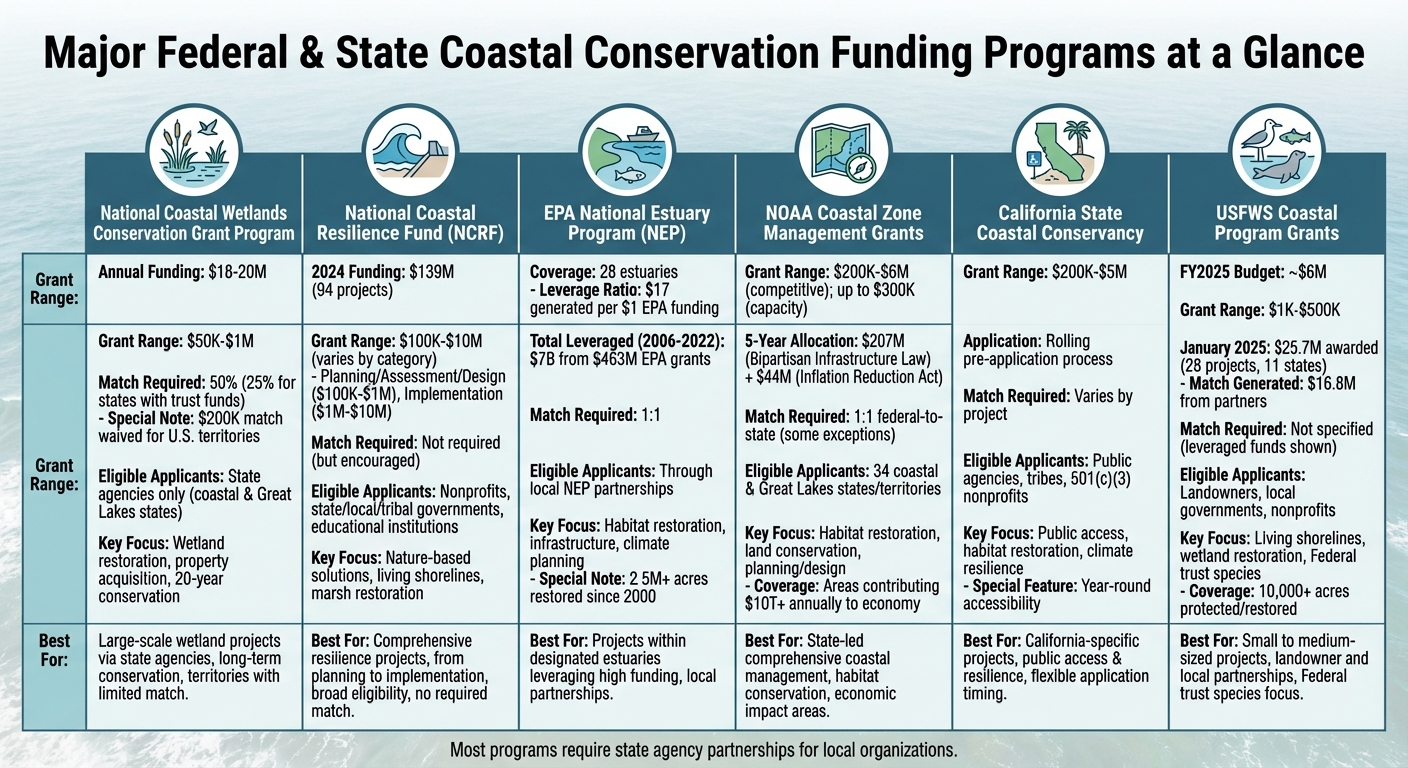
Coastal Conservation Funding Programs Comparison: Amounts, Requirements, and Eligibility
Navigating the National Coastal Resilience Fund
National Coastal Wetlands Conservation Grant Program
The National Coastal Wetlands Conservation Grant Program plays a key role in protecting and restoring the nation’s coastal ecosystems. Created under the Coastal Wetlands Planning, Protection, and Restoration Act of 1990, this program is managed by the U.S. Fish and Wildlife Service alongside the Office of Conservation Investment. Since its first awards in 1992, it has distributed over $530 million to safeguard wetlands across the United States.
Funded through excise taxes on fishing gear and boat fuels, the program allocates approximately $18–$20 million annually. For example, in FY2021, 33 grants - ranging from $50,000 to $1,000,000 - helped protect or enhance nearly 28,000 acres of wetlands. This program is a cornerstone of federal coastal conservation efforts, providing critical support to protect these vital ecosystems.
Program Purpose and Goals
The program is dedicated to the long-term conservation, restoration, and protection of coastal wetlands, benefiting fish, wildlife, their habitats, and surrounding communities. Projects funded must guarantee conservation benefits for at least 20 years, ensuring lasting impacts. By focusing on habitat preservation, this program works in tandem with other state and federal initiatives to strengthen coastal resilience. Eligible activities include acquiring property interests (such as conservation easements or fee titles) and restoring or managing existing wetlands.
"Coastal wetlands are vitally important in protecting us from floods, filtering our water, supporting recreation and local economies, and providing habitat for fish and wildlife." – U.S. Fish and Wildlife Service
Projects are ranked higher if they support endangered species, involve public–private partnerships, or conserve maritime forests on coastal barrier islands. However, the program does not fund the creation of new wetlands or projects focused primarily on navigation, irrigation, or flood control.
Who Can Apply
Only state agencies in coastal and Great Lakes states are eligible to apply directly for these grants. This includes states along the Atlantic, Gulf (excluding Louisiana), Pacific, and Arctic coasts, as well as the Great Lakes states - Illinois, Indiana, Michigan, Minnesota, New York, Ohio, Pennsylvania, and Wisconsin. U.S. territories also qualify, with specific eligibility details available in the program guidelines.
While local governments, Tribes, conservation groups, and private landowners cannot apply directly, they are encouraged to collaborate with eligible state agencies to develop proposals. For instance, in 2025, the Washington State Department of Ecology partnered with the Stillaguamish Tribe to protect and restore 537 acres of coastal wetlands using program funds.
The program typically requires a 50% non-federal match for project costs. However, states with a dedicated trust fund for acquiring coastal wetlands or open spaces see their federal share increase to 75%, lowering the state match to 25%. Additionally, for U.S. territories like American Samoa, Guam, the Northern Mariana Islands, and the U.S. Virgin Islands, the first $200,000 of the non-federal match is waived.
How to Apply
Interested applicants should reach out to their state’s natural resource or fish and wildlife agency between February and March to discuss potential projects. For the fiscal year 2027 cycle, pre-proposal discussions and site visits typically occur during this time. Draft applications are generally due in early May, with final submissions by early June. State agencies then forward proposals to the U.S. Fish and Wildlife Service by the end of June. A national ranking meeting takes place in October, and awards are announced early the following year.
Applicants must provide documentation of existing or historical wetlands using resources like the National Wetlands Inventory and address the 13 ranking criteria outlined in 50 CFR 84.32. Required forms include the SF-424 Application, SF-424B/D Assurances, a project statement, budget, and maps. Submissions are made through Grants.gov or GrantSolutions. This structured process helps guide coastal communities through the funding application effectively.
National Coastal Resilience Fund
The National Coastal Resilience Fund (NCRF) represents a collaboration between the National Fish and Wildlife Foundation (NFWF) and NOAA, with added backing from the Department of Defense and private organizations. This initiative is designed to help coastal communities better withstand climate-related risks. In 2024, the fund distributed $139 million across 94 projects, with $96 million sourced from the Bipartisan Infrastructure Law.
"This funding... offers communities a transformational opportunity to take steps to prepare for the impacts of climate change by using nature-based infrastructure."
- Rick Spinrad, Ph.D., NOAA Administrator
The application process for NCRF funding is structured in two stages. First, applicants must submit a pre-proposal. If selected, they are invited to submit a full proposal. For the 2026 funding cycle, pre-proposals are due by March 31, 2026, at 11:59 PM ET, and full proposals must be submitted by June 24, 2026. Applications are handled through NFWF’s "Easygrants" online system.
What Gets Funded
NCRF prioritizes projects that use nature-based strategies to protect coastal areas while improving habitats for fish and wildlife. Eligible efforts include marsh and wetland restoration, floodplain reconnection, dune reconstruction, living shorelines, and reef restoration.
Projects must be located within coastal HUC-8 watersheds, including those linked to the Great Lakes, U.S. territories, and Tribal lands. Funding is divided into four categories: Community Capacity Building and Planning, Site Assessment and Preliminary Design, Final Design and Permitting, and Restoration Implementation. Each application must focus on a single category, as the fund does not support combined design and construction requests.
For example, in November 2024, the North Carolina Coastal Federation received $1,020,600 to design a living shoreline to protect critical infrastructure and estuarine habitats. In another case, the Coral Bay community in the U.S. Virgin Islands used $800,000 in 2022 to implement watershed and coral reef protection measures.
All Restoration Implementation projects are required to include at least one year of post-construction monitoring to evaluate their impact. While non-federal matching funds are not mandatory, they are strongly encouraged to showcase community support and strengthen an application’s competitiveness.
Funding Amounts
Grants are awarded based on the project category:
| Project Category | Typical Grant Range | Focus Area |
|---|---|---|
| Community Capacity Building & Planning | $100,000 – $1,000,000 | Developing risk reduction strategies and building local expertise |
| Site Assessment & Preliminary Design | $100,000 – $1,000,000 | Feasibility studies and 30–60% project design work |
| Final Design & Permitting | $100,000 – $1,000,000 | Advancing to near-final design and securing permits |
| Restoration Implementation | $1,000,000 – $10,000,000 | Construction activities paired with at least one year of monitoring |
Priority is given to "pipeline projects", which aim to advance work previously funded in an earlier NCRF category. For restoration-focused grants, projects that are "implementation-ready", with 90–100% design completion and permits nearly finalized, are more likely to be selected. Additionally, projects near Department of Defense installations may qualify for extra funding through the REPI Program.
Eligible applicants include 501(c) non-profits, state and territorial government agencies, local and municipal governments, Tribal governments (both federally and non-federally recognized), educational institutions, and commercial organizations.
EPA National Estuary Program
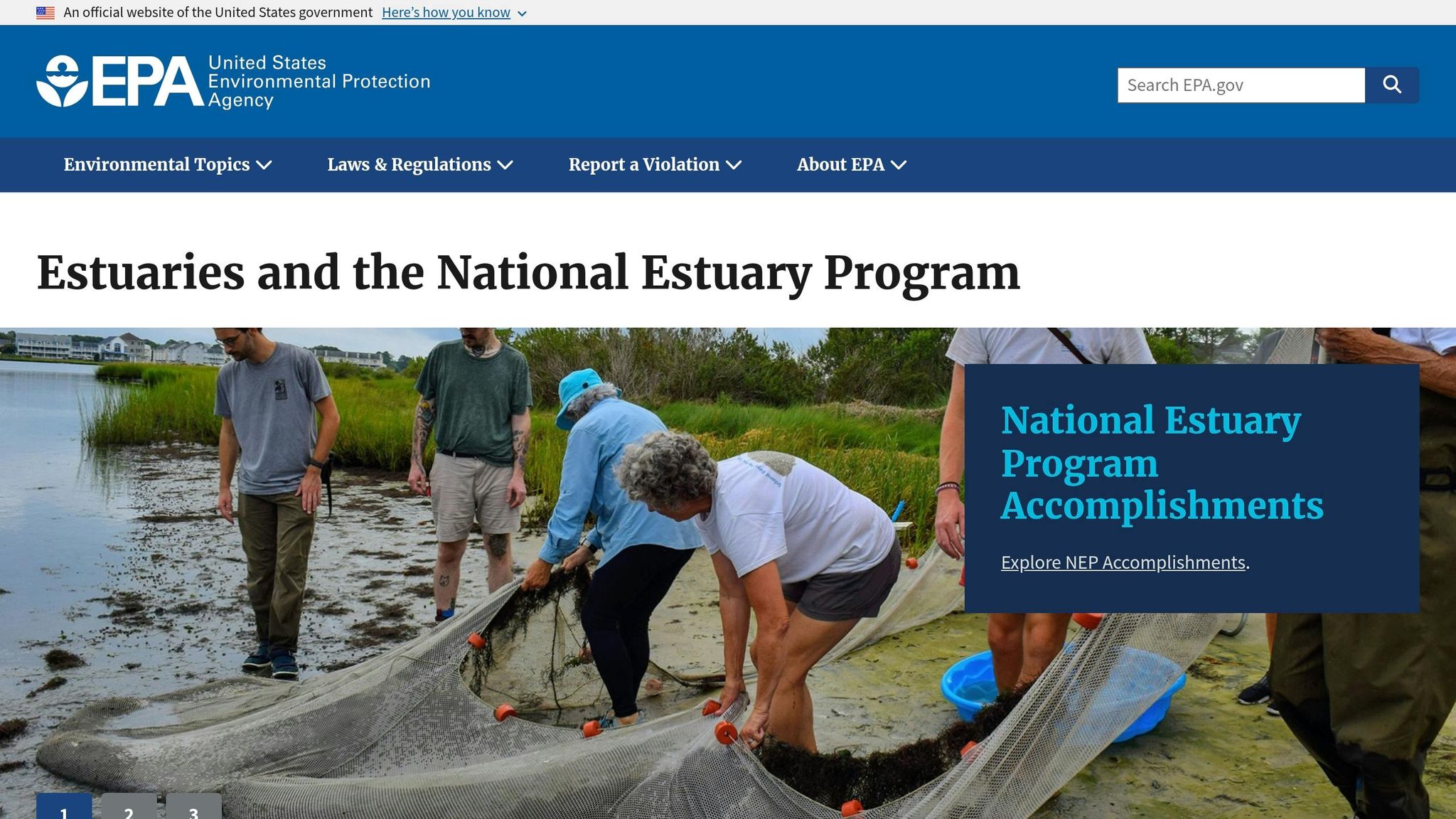
The EPA's National Estuary Program (NEP) focuses on preserving 28 estuaries across the Atlantic, Gulf, and Pacific coasts, as well as Puerto Rico, by fostering local collaboration. Instead of a traditional top-down approach, the NEP uses a "Management Conference" model. This method unites local, state, and federal agencies with private and non-profit organizations to ensure projects align with local needs and priorities. It’s a great example of how federal resources can work hand-in-hand with local efforts to protect coastal ecosystems.
For every $1 the EPA provides, NEPs generate $17 in additional funding. From 2006 to 2022, the program leveraged over $7 billion from $463 million in EPA grants. Thanks to the Bipartisan Infrastructure Law, the EPA is allocating $132 million between 2022 and 2026 to expand these efforts.
"The NEPs successfully leverage federal seed money by developing finance plans, building strategic alliances, and demonstrating environmental results." - US EPA
Each NEP creates a Comprehensive Conservation and Management Plan (CCMP) to identify specific actions for restoration and protection. This ensures federal funds directly support community-driven goals. The collaborative nature of the program allows for diverse and locally focused conservation work.
Funded Project Areas
NEP funding supports a range of initiatives, including habitat restoration (like living shorelines, seagrass recovery, and wetland projects), infrastructure improvements (stormwater management, pollution control, and water reuse systems), climate planning (vulnerability assessments and resilience strategies), research (carbon storage studies and water quality tracking), and education efforts.
Some stand-out projects include:
- The Morro Bay National Estuary Program, which installed rainfall storage tanks to conserve creek water and protect steelhead trout habitats.
- The Galveston Bay Foundation, which created stormwater treatment wetlands to filter runoff before it reaches the estuary.
- The Casco Bay Estuary Partnership, which tested living shoreline designs to protect coastlines with large tidal ranges and winter ice.
- The Peconic Estuary Partnership, which developed a shoreline model to reduce storm-driven wave energy, helping to prevent erosion and safeguard habitats.
- The San Juan Bay Estuary Program, which devised a hazard mitigation plan to address natural disaster risks and establish long-term strategies.
Working with Local Organizations
Local organizations can tap into NEP funding through annual program grants (requiring a 1:1 match) provided directly to the 28 NEPs or through competitive Watersheds Grants administered by Restore America’s Estuaries in partnership with the EPA. Competitive grants typically range from $200,000 to $500,000, with a four-year completion timeline.
To maximize funding opportunities, organizations are encouraged to participate in their regional NEP’s Management Conference. This ensures their projects align with the CCMP’s goals. Many NEPs have also developed creative funding strategies. For example:
- The Tampa Bay Estuary Program generates $415,000 annually through an Interlocal Agreement with local governments.
- The Indian River Lagoon NEP raises $400,000 yearly via a specialty license plate program.
- The Peconic Estuary Partnership supported a Real Estate Transfer Tax that raised $169 million for land preservation by January 2004.
- The Coastal Bend Bays & Estuaries Program secured $1.5 million for land acquisition and habitat restoration through a Supplemental Environmental Project.
Since 2000, NEPs and their partners have restored or protected over 2.5 million acres of habitat. The program’s success lies in its ability to bring together diverse stakeholders, coordinate restoration efforts, and provide both financial and technical support.
NOAA Coastal Zone Management Grants
NOAA's Coastal Zone Management (CZM) grants provide critical support for projects that safeguard coastal areas. Through partnerships with 34 coastal and Great Lakes states and territories, NOAA's CZM program, established under the Coastal Zone Management Act of 1972, allows states to tailor solutions to their unique coastal challenges while adhering to federal guidelines. These efforts protect areas that contribute over $10 trillion annually to the economy.
Recent funding initiatives, such as the Bipartisan Infrastructure Law, have significantly boosted the program. This law allocated $207 million over five years for habitat protection and restoration, supplemented by $44 million from the Inflation Reduction Act. In April 2024 alone, NOAA announced $59.8 million for state and territory coastal management programs, focusing on habitat restoration and land conservation. Competitive grants range from $200,000 to $6 million, while non-competitive capacity funds provide up to $300,000 annually for each coastal zone management program. These funds support a variety of activities, from planning and design to large-scale restoration efforts.
Grant Categories
NOAA's CZM grants are divided into several categories, each addressing different stages of coastal conservation:
- Planning, Engineering, and Design grants: These grants fund the initial phases of projects, including modeling, permitting, and creating detailed design plans. For example, in April 2024, Wisconsin received $500,000 to develop 90% design plans for restoring a 1.8-mile urban riparian corridor in Port Washington.
- Implementation and Restoration grants: These grants support hands-on projects like dam removals, habitat restoration, and culvert upgrades. In April 2024, the Massachusetts Executive Office of Energy and Environmental Affairs was awarded $4,666,515 for restoring 57 acres of former cranberry bogs by removing a dam and replacing an undersized culvert. Similarly, New Jersey's Coastal Management Program received $1,271,506 to expand oyster reef habitats in the Mullica River-Great Bay Estuary by 10 acres, using shell recycling and planting efforts while involving local schools in the process.
- Land Conservation grants: These grants focus on acquiring undeveloped coastal properties to prevent development. In April 2024, Manatee County Government in Florida was awarded $5,000,000 to purchase the 68-acre Crooked River Ranch property, protecting native habitats and creating a connected wildlife corridor.
- Section 309 Enhancement Program: This program targets nine key areas, including wetlands, coastal hazards, public access, and marine debris. States are required to develop multi-year strategies for improvement, reviewed every five years.
Each grant category addresses a specific phase of coastal restoration, ensuring a comprehensive approach to conservation and resilience.
State Partnerships
State CZM programs play a central role in applying for and managing these grants. They often pass funds to local governments or universities to implement projects. Every five years, states conduct program reviews to identify priorities and collaborate with NOAA on multi-year strategies for improvement.
One significant advantage of this partnership is "federal consistency," which allows states to influence federal decisions impacting their coastal zones. To apply, potential applicants can search Grants.gov under federal assistance listing number 11.419 for Coastal Zone Management Administration and Projects of Special Merit. Most coastal management grants require a 1:1 federal-to-state funding match, though some restoration grants funded by the Bipartisan Infrastructure Law may waive this requirement. For land conservation grants, states must submit documentation such as appraisals, title evidence, and federal consistency reviews.
State Coastal Conservancy Grants
State-level grants play a key role in filling gaps left by federal programs, offering funding that aligns with local priorities and comes with more adaptable criteria. States like California and Florida stand out with well-developed funding mechanisms, while other coastal states have also crafted programs tailored to their unique shoreline needs.
The California State Coastal Conservancy is one of the most robust programs in the country. It provides grants ranging from $200,000 to $5 million and uses a rolling pre-application process, making funding accessible throughout the year. Eligible applicants include public agencies, tribes, and 501(c)(3) nonprofits. To streamline applications, the Conservancy encourages applicants to consult with a Regional Manager - covering the North Coast, SF Bay Area, Central Coast, or South Coast - before applying.
In Florida, the Coastal Partnership Initiative (CPI) focuses on smaller grants for the state’s 35 coastal counties. These grants are awarded annually, with the next cycle for FY 2026–27 running from September 1 to October 31, 2025. Funding ranges from $10,000 to $30,000 for planning and design projects and up to $60,000 for construction, restoration, and land acquisition. CPI grants require a 1:1 non-federal match, which can be in cash or in-kind contributions. Nonprofits and universities must collaborate with an eligible coastal local government to apply.
Regional Programs
Florida provides a strong example of state-level investment in coastal management. Since 1998, the Florida Legislature has allocated over $1.55 billion for beach management, restoring 264.6 miles of critical coastline, alongside $315 million for hurricane recovery efforts. These programs cover up to 50% of beach project costs and up to 75% for inlet projects, but funding is limited to beaches classified as "critically eroded" by the Florida Department of Environmental Protection.
Regional navigation districts also expand funding options. Organizations like the Florida Inland Navigation District (FIND) and the West Coast Inland Navigation District (WCIND) offer grants for projects related to public navigation, boater access, environmental education, and shoreline stabilization. Communities in areas like the 30A coastline and South Walton can benefit significantly by identifying which regional programs align with their needs.
Project Types
State conservancy grants support a wide array of coastal conservation efforts. In California, funding spans the entire project lifecycle, covering feasibility studies, property acquisition, planning, design, environmental review, permitting, construction, and monitoring. However, operation and maintenance activities are not eligible. Projects often focus on improving public access (such as parks, beaches, and trails), restoring habitats, enhancing climate resilience, or conserving working lands.
Florida’s CPI program emphasizes four priority areas: Resilient Communities, Public Access, Working Waterfronts, and Coastal Stewardship. Additionally, the Resilient Florida Program offers grants to counties and municipalities for vulnerability assessments, adaptation plans, and projects addressing flooding and sea level rise. The Florida Communities Trust further supports conservation and recreation through Parks and Open Space grants and Stan Mayfield Working Waterfronts grants, which help acquire land for public and environmental purposes.
These state-driven programs provide essential resources to bolster coastal conservation efforts and address regional challenges effectively.
USFWS Coastal Program Grants
The U.S. Fish and Wildlife Service (USFWS) Coastal Program takes a collaborative and voluntary approach to conserving coastal habitats. Unlike regulatory programs, it offers both financial assistance and technical expertise to landowners, local governments, and nonprofits, aiming to protect habitats without imposing legal requirements. The program focuses on Federal trust species, such as migratory birds, threatened and endangered species, interjurisdictional fish, and marine mammals, across coastal watersheds - from headwaters to nearshore areas.
In January 2025, the program awarded $25.7 million to fund 28 coastal projects spanning 11 states. These projects are set to protect or restore over 10,000 acres of wetlands and eight miles of shoreline. Additional contributions from state, local, and Tribal partners brought in $16.8 million in matching funds. For Fiscal Year 2025, individual grants range between $1 and $500,000, with an overall program budget of about $6 million.
Partnership Approach
The Coastal Program relies on cooperative agreements, ensuring significant involvement from USFWS staff throughout each project. Field staff collaborate closely with partners, offering expertise in planning, restoration design, surveys, and monitoring. This hands-on approach is particularly effective in areas where land ownership is split between public and private entities.
"Working on both public and private lands with diverse partners is essential for a successful coastal habitat conservation strategy, especially in coastal watersheds where land ownership is often a mix of private and public entities."
- U.S. Fish and Wildlife Service
To get started, applicants are encouraged to contact a local Coastal Program office for pre-application consultations. This ensures that projects align with biological principles and regional strategic plans. This collaborative process supports the program's focus on nature-based solutions.
Conservation Focus
Nature-based solutions are central to the program's mission, especially the use of "living shorelines." These methods employ native plants, sand, oyster reefs, and seagrass to stabilize coastlines while creating habitats. Eligible projects include wetland restoration, habitat protection through conservation easements, and efforts to improve ecological functions.
"Living shorelines offer the most environmentally friendly options for doing something... a more natural approach to shoreline stabilization is preferable to shoreline hardening."
- U.S. Fish and Wildlife Service
Certain activities, however, are not eligible for funding. The program does not support projects that create compensatory mitigation credits, fulfill legal requirements, or involve direct land acquisitions. That said, it can assist with third-party acquisitions by funding title searches and real estate appraisals. Coastal areas supported by the program are vital ecosystems, hosting 40% of the National Wildlife Refuge System and 40% of federally listed endangered species. Coastal wetlands alone support around 30% of North America's wintering waterfowl.
Wrapping It Up
The funding options we've explored underscore how vital local involvement is in safeguarding our coastal landscapes. Together, these programs create a toolkit aimed at preserving coastal areas that are crucial to both the economy and the environment.
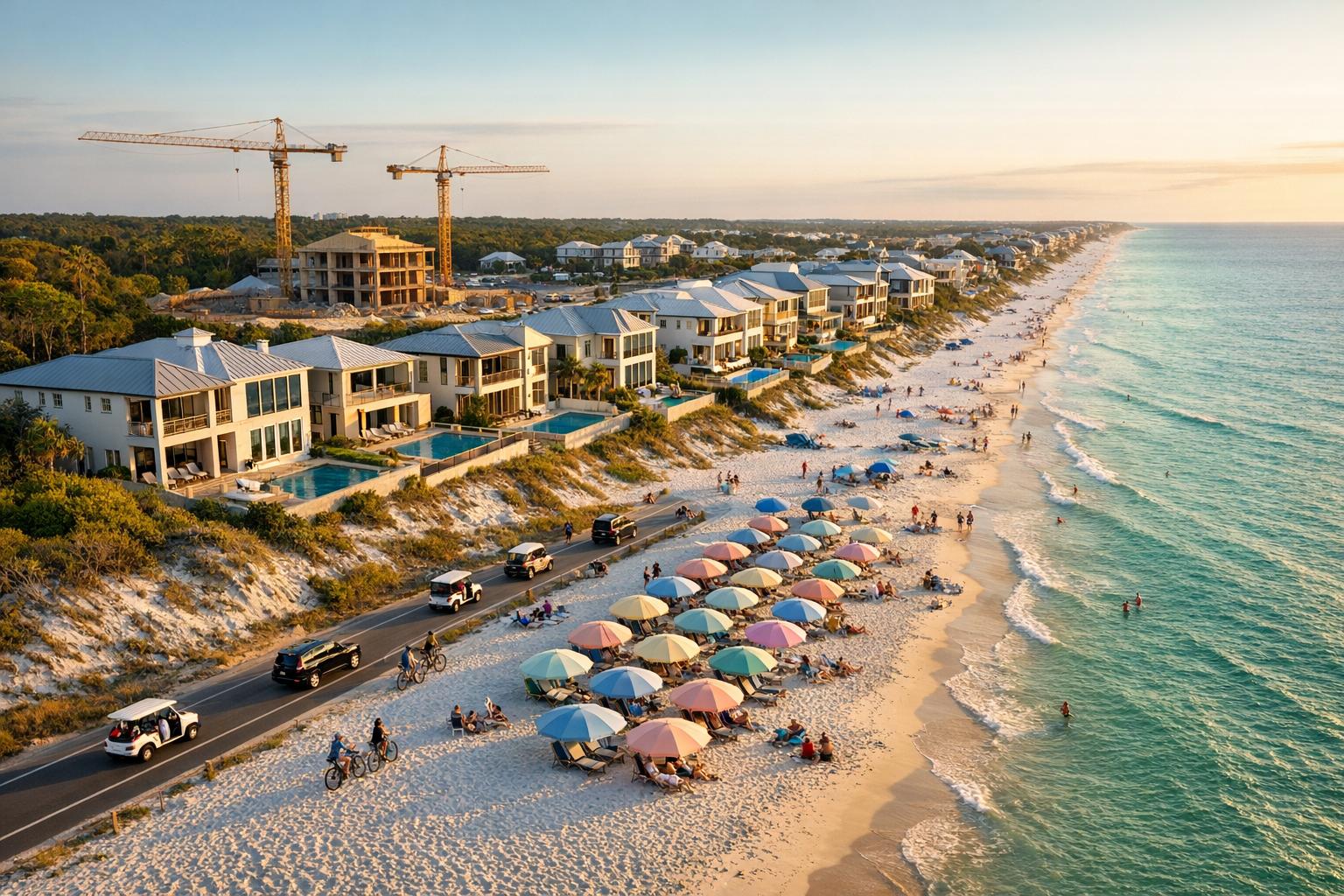
For communities along South Walton and the 30A coastline, these opportunities are within reach. Local groups can leverage programs like the Coastal Partnership Initiative and the Resilient Florida Program by working closely with state agencies - especially since many federal grants require state-level applicants.
The urgency is clear. Wetland loss is accelerating, and climate-related disasters continue to threaten coastal ecosystems and infrastructure. Nature-based solutions, such as living shorelines and dune restoration, offer powerful, long-term resilience against these challenges.
Whether you're a government official, nonprofit leader, or concerned resident, diving into these funding opportunities can create real change. Pinpoint where your project stands, secure matching funds (even in-kind contributions can help), and collaborate with state agencies. Advocate for initiatives that safeguard both natural habitats and the communities that rely on them.
The future of coastal regions like 30A depends on taking action now. These funding sources, when combined, lay the groundwork for a resilient strategy to protect the 30A coastline and other coastal areas. For more details and local guidance on conservation and funding in South Walton and 30A, check out sowal.co.
FAQs
Which coastal conservation grant best fits my project stage?
When it comes to selecting the right grant, it all boils down to your project's goals and its current stage. For projects aimed at boosting long-term ecosystem resilience, the National Coastal Resilience Fund 2025 could be a great fit. If your focus is specifically on wetlands, the National Coastal Wetlands Conservation Grant Program might be the better choice.
For early-stage habitat restoration, the NOAA Coastal Resilience Grants align well with such efforts. On the other hand, if your project involves large-scale restoration, consider the Transformational Habitat Restoration and Coastal Resilience Grants. The key is to match your project's scope and funding requirements to the grant that best supports your objectives.
How can I meet the match requirement if I lack cash funds?
If you're short on cash, in-kind contributions can be a great alternative. This could include volunteer labor, donated materials, or technical support. Many funding programs allow these to count toward your match. Another option is teaming up with local organizations, government offices, or businesses to gain access to resources or services for free or at a reduced cost. Getting community members involved as volunteers or asking local businesses for donations are practical ways to fulfill match requirements without needing cash.
Can nonprofits or residents apply, or must a state agency lead?
Nonprofits and local residents have opportunities to secure funding for coastal conservation efforts. Programs such as the National Coastal Wetlands Conservation Grants and NOAA grants frequently provide financial support to community groups and organizations focused on protecting and restoring habitats. Interestingly, these initiatives don’t always require state agencies to take the lead, allowing grassroots efforts to play a significant role.