Top 5 Bird Species Migrating Through 30A
Five migratory birds to watch on 30A — when, where, and how to spot Prothonotary Warblers, Semipalmated Plovers, Ospreys, Barn Swallows, and Bobolinks.
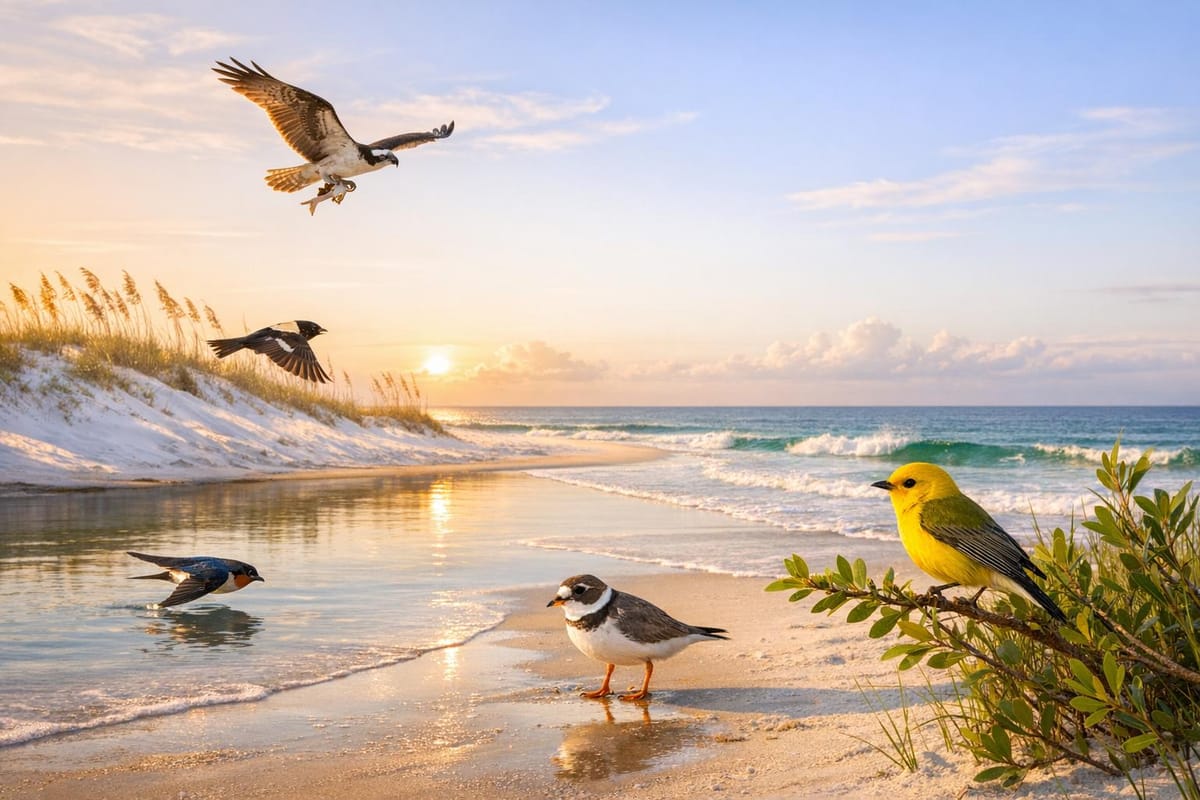
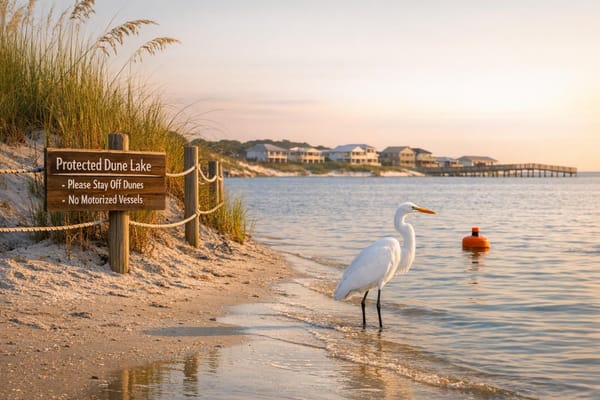
30A in South Walton, Florida, is one of the top birdwatching spots, with over 200 migratory bird species passing through each year. This area’s mix of beaches, coastal dune lakes, and forests makes it a major stopover along North American migratory pathways. Here are the top 5 bird species you can spot during migration seasons:
- Prothonotary Warbler: Bright yellow birds found in swampy woodlands during spring and fall.
- Semipalmated Plover: Small shorebirds with a dark breast band, often seen on sandy beaches in August.
- Osprey: Large raptors with a 5-foot wingspan, frequently hunting near coastal lakes and bays.
- Barn Swallow: Agile flyers with forked tails, seen in open fields and near water from July to October.
- Bobolink: Long-distance travelers with a “backwards tuxedo” look, passing through in fall and spring.
Quick Tips:
- Best Time: Early mornings during fall (September–October) and spring (March–May), especially after cold fronts.
- Top Locations: Grayton Beach State Park, Deer Lake State Park, and Western Lake.
With nearly 40% of its land preserved, 30A offers unmatched opportunities to observe these birds in their natural habitats.
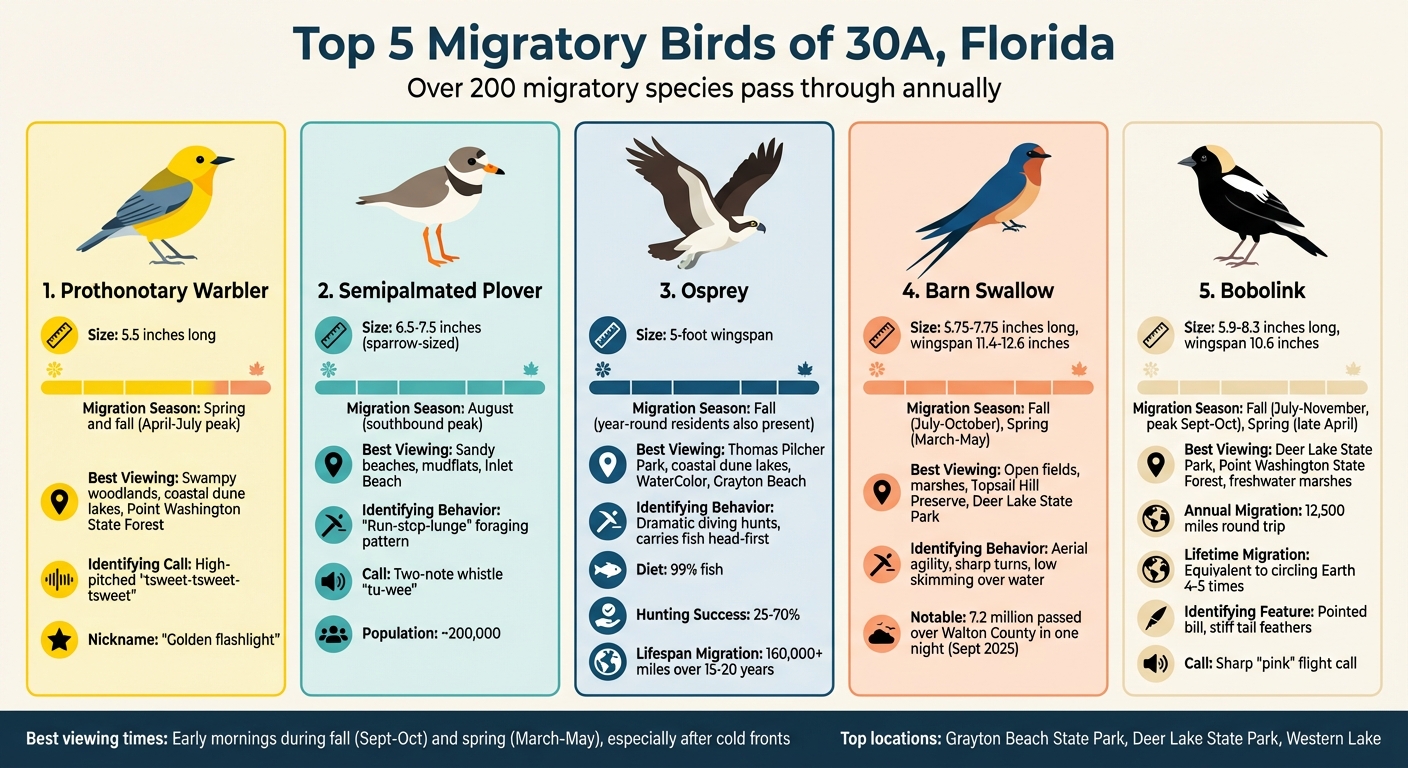
Top 5 Migratory Bird Species of 30A Florida: Identification Guide
Birds of the Emerald Coast
1. Prothonotary Warbler
Nicknamed the "golden flashlight", the Prothonotary Warbler is one of the most striking migratory birds along 30A. Its bright yellow head and chest, paired with blue-gray wings and a black eye, make it a standout in the region's swampy landscapes. Walt Spence from the Choctawhatchee Audubon Society describes them perfectly:
"Prothonotary Warblers are beautiful little birds. They hang around swamp areas and look like little canaries."
Migration Patterns
These warblers are long-distance travelers, migrating between their breeding grounds in the Eastern U.S. and their wintering areas in Central and South America. 30A serves as a critical pit stop for them to rest and refuel during their journey.
Best Viewing Times
Your best chance to spot Prothonotary Warblers is during their spring and fall migrations. For more tips, see our guide on how to spot rare birds in South Walton. Across the U.S., sightings are most common from April to July, but along 30A, early mornings during these periods offer the clearest views. For a complete overview of the hobby locally, check out our guide to birdwatching in South Walton.
Identifying Features
Male Prothonotary Warblers are known for their vivid yellow heads and breasts, while females display more subdued coloring. These birds measure about 5.5 inches long, with olive-colored backs and blue-gray wings. Their presence is often revealed by their high-pitched "tsweet-tsweet-tsweet" song, which echoes through dense vegetation.
Habitat Preferences
Look for these warblers in swampy woodlands and areas near coastal dune lakes, where they forage above water or along shorelines. A great spot to find them is the cypress swamps in Point Washington State Forest. However, they tend to avoid smaller forest patches under 250 acres. Unfortunately, their population has seen a 31% decline since 1966.
2. Semipalmated Plover
This small, round shorebird is a familiar visitor to the beaches along 30A, and one of several common birds in South Walton. Measuring about 6.5–7.5 inches - roughly the size of a sparrow - it’s easy to recognize by its single dark breast band, bright orange legs, and a two-toned bill with an orange base and black tip. Its name comes from the partial webbing on its toes, a unique feature among shorebirds.
Migration Patterns
Semipalmated Plovers are true long-distance travelers. They migrate from their Arctic breeding grounds to wintering areas as far south as southern South America. Their southbound migration usually peaks in August, often coinciding with cold fronts that help carry them along. While many continue their journey, some choose to stay as winter visitors along Florida’s Gulf Coast, making early August an ideal time for birdwatching.
Best Viewing Times
The best time to spot these plovers is during early mornings in August, particularly as they pass through during their fall migration. Walt Spence of the Choctawhatchee Audubon Society highlights this period:
"Fall is one of the best times to see migrating birds. The birds ride down with the cold front as it moves through."
Identifying Features
When identifying the Semipalmated Plover, look for its distinct foraging behavior. These birds often run a few steps, pause, then peck at the ground in what’s been described as a "run-stop-lunge" pattern. Another fascinating behavior is their habit of shuffling one foot rapidly over the sand to flush out tiny crustaceans and insects. Their call is a high-pitched, two-note whistle that sounds like "tu-wee". If you’re comparing them to the similar-looking Killdeer, note that the Killdeer has two breast bands, while the Semipalmated Plover has just one.
Habitat Preferences
Semipalmated Plovers thrive in open, sandy spaces like broad beaches and mudflats, steering clear of areas with dense marsh vegetation. Walt Spence suggests a quiet spot for observation:
"Head to the quiet shores of a beach neighborhood like Inlet Beach to watch the Semipalmated Plover scurry through sand and pick out tiny crustaceans and insects to eat."
With an estimated population of around 200,000, your chances of spotting one during migration season are excellent. Whether you’re on a quiet stretch of beach or a wide-open mudflat, these plovers are a delightful sight for bird enthusiasts.
3. Osprey
Among 30A's avian highlights, the Osprey is a standout. This striking raptor, with its impressive 5-foot wingspan and dramatic hunting style, is a year-round resident in the area. During migration season, their numbers swell, offering even more opportunities to observe these fascinating birds.
Migration Patterns
South Walton sits at a key intersection of the Northern and Western flyways, making it a natural route for migrating Ospreys. While Florida's resident Ospreys stay put throughout the year, northern populations head south during fall and return in spring. One tracked Osprey covered an incredible 2,700 miles from Massachusetts to South America in just 13 days. Over its lifetime - typically 15 to 20 years - a single Osprey can log over 160,000 miles of migration.
Best Viewing Times
Fall is the ideal season to spot migrating Ospreys. You can use a South Walton itinerary generator to plan your birdwatching stops. Early mornings following a cold front are particularly active times, as these birds use the fronts to aid their southward journey. For the best views, head to Thomas Pilcher Park or the coastal dune lakes near WaterColor and Grayton Beach, which double as excellent hunting grounds.
Identifying Features
Ospreys are easy to recognize. Their white heads are accented by a bold dark stripe running through the eye, contrasting with their dark brown backs and white chests. When in flight, their long, narrow wings form a distinctive M-shape when seen from below, with dark patches near the wrists. Their high-pitched, whistling chirp is a familiar sound along South Walton's beaches. Unlike the larger Bald Eagles, which lack the eye stripe, Ospreys have bright yellow eyes - juveniles, however, sport orange eyes.
Habitat Preferences
Ospreys are almost always found near water, relying on fish for 99% of their diet. Their nests, made of sticks, are often perched atop telephone poles, channel markers, or specially built platforms. Walt Spence of the Choctawhatchee Audubon Society sums up their appeal perfectly:
"The most entertainment I get from any bird here is from the Ospreys. They're fascinating to watch hunt. They circle overhead until they find something; and then they dive. They dive straight down and directly into the water." - Walt Spence, Choctawhatchee Audubon Society
To witness their hunting prowess, look for Ospreys hovering over Choctawhatchee Bay, Western Lake, or other coastal dune lakes before they plunge feet-first into the water. They're highly skilled hunters, successfully catching fish in at least 25% of their dives, with some achieving success rates as high as 70%. When they fly off with their catch, you'll notice they carry the fish head-first to reduce wind resistance.
4. Barn Swallow
Barn Swallows, recognized as the most common swallow globally, make their presence known along 30A's diverse neighborhoods during their biannual journey between North America and Argentina.
Migration Patterns
These birds follow a fascinating looped migration path. In the fall, they take over-water routes to benefit from favorable tailwinds, while their spring return shifts westward, crossing the Yucatán and the Gulf of Mexico. This highlights 30A's importance as a critical link in major migratory pathways. Unlike many other migratory birds that travel under the cover of night, Barn Swallows migrate in flocks during daylight. Their southward migration typically begins by mid-August, and in late September 2025, an astonishing 7.2 million birds passed over Walton County in a single night. Their predictable movements make them a favorite for birdwatchers.
Best Viewing Times
The best chances to spot Barn Swallows are during their fall migration (July–October) and spring migration (March–May). Early mornings at dawn are ideal, especially after a cold front, as birds tend to linger longer during the slower-paced fall migration compared to the quicker spring journey.
Identifying Features
Barn Swallows are easy to recognize by their long, deeply forked tails - a hallmark feature. Their upper feathers shimmer with cobalt blue, while their underparts range from pale tawny to a warm cinnamon hue. They also sport a rusty-red throat and forehead. These slender birds measure about 5¾ to 7¾ inches in length, with a wingspan of roughly 11.4 to 12.6 inches. Known for their aerial agility, they perform sharp turns and dives, often skimming low over water or land in search of insects.
Habitat Preferences
Barn Swallows are often found in open fields, marshes, and near coastal dune lakes along 30A. They’re particularly drawn to areas like Topsail Hill Preserve State Park and Deer Lake State Park, where they can forage low over water. They also adapt well to human-made structures, frequently building their mud-and-grass cup nests under bridges, eaves, and culverts. During late summer and fall, they gather in large communal roosts in wetlands to prepare for their long migration south.
5. Bobolink
The Bobolink is a true endurance traveler, completing one of the most impressive migrations of any songbird. Each year, it flies about 12,500 miles round trip between the northern U.S. and southern Canada to southern South America. Over its lifetime, this adds up to a distance equivalent to circling the Earth four or five times.
Migration Patterns
As part of their journey, Bobolinks pass through the 30A area, making South Walton an essential pit stop before their trans-Gulf flight. Here, they build up fat reserves to fuel the next leg of their migration. These birds rely on the Earth's magnetic field - thanks to iron oxide in their nasal cavities - and the night sky for navigation. While they usually forage during daylight hours, they’ve been observed feeding at night under bright moonlight. This behavior makes early mornings ideal for spotting them.
Best Viewing Times
Bobolinks begin their fall migration through the 30A area as early as July, with the activity stretching into late November. Peak sightings typically occur in September and October. During spring migration, most of them return to the area in late April. Your best chance to see them is in the early morning after a cold front, as the birds often linger in the area during these times. Listen for their sharp "pink" flight calls to help locate these travelers.
Identifying Features
Breeding males are unmistakable with their "backwards tuxedo" look - white backs, black underparts, and a straw-colored nape patch. During migration, they swap this striking attire for a warm buffy-brown plumage with dark streaks. Bobolinks measure between 5.9 and 8.3 inches long, with a wingspan of about 10.6 inches. Look for their pointed bills and stiff tail feathers, which are key identifying traits.
Habitat Preferences
During migration, Bobolinks leave their breeding grasslands for freshwater marshes, coastal zones, and agricultural fields. In South Walton, they are often seen in places like Deer Lake State Park and Point Washington State Forest, foraging for seeds. Their scientific name, oryzivorus, means "rice eating", reflecting their preference for rice and grain fields. With nearly 40% of South Walton's land preserved, the coastal scrub and pine forests here provide crucial stopover habitats for these long-distance travelers.
Where and When to See These Birds
The 30A corridor is a haven for birdwatchers, offering an array of state parks and nature preserves, each with habitats that attract different migratory species. Grayton Beach State Park is a standout spot, boasting 2,000 acres of diverse landscapes. Among its highlights is Western Lake, a rare coastal dune lake that’s perfect for watching Ospreys as they dive for fish. Access to the park is affordable at just $5 per day. Since each park caters to specific species, your destination should depend on the birds you’re hoping to see.
For those seeking Prothonotary Warblers, the swampy areas of Deer Lake State Park or Point Washington State Forest are ideal during the fall and spring migration seasons. Deer Lake’s 1.5-mile nature trail winds through pine forests, offering great opportunities to spot these vibrant yellow birds, often referred to as "little canaries." If Semipalmated Plovers are on your list, head to the quiet shores of Inlet Beach, where they forage for crustaceans along the waterline during migration.
Understanding bird migration patterns on 30A and timing plays a crucial role in birding success. Early mornings in the fall often provide the best sightings, while spring brings additional opportunities as birds begin their journey northward.
Beyond the beaches, other parks offer unique habitats that draw a variety of species. Topsail Hill Preserve State Park is a favorite for spotting migratory warblers and Barn Swallows in both spring and fall, thanks to its three coastal dune lakes and varied ecosystems. For water birds, Thomas Pilcher Park provides excellent access to Choctawhatchee Bay, an area near Camp Helen State Park where over 180 bird species have been documented.
To make the most of your birding adventure, pack lightweight binoculars, a birding app like Merlin or Audubon, and bug spray for wooded trails. If you’re exploring Grayton Beach for an extended period, renting a canoe or following a kayaking and paddleboarding guide is a great option. Rentals cost $15 for five hours or $25 for a full day, giving you a closer view of waterbirds on Western Lake.
Why 30A Is Part of Major Migration Routes
South Walton sits at a key intersection of the Northern and Western migratory flyways, making it a hotspot for bird migration. On just one night in September 2025, over 7.2 million migrating birds flew over Walton County alone.
30A’s geography is perfectly suited for long-distance migrants traveling between Arctic breeding grounds and wintering areas in Central and South America. With the Gulf of Mexico to the south and Choctawhatchee Bay to the north, the area offers an ideal mix of freshwater and saltwater resources. One standout feature is its rare coastal dune lakes and biodiversity, which are found in only a few places worldwide. These lakes provide essential freshwater right next to the Gulf, creating a critical rest and refueling point for waterfowl and wading birds.
The range of habitats along 30A - white-sand beaches, cypress swamps, pine forests, coastal scrub, and sandhills - offers tailored environments for different bird species during migration. Fall migration is especially active, as birds take advantage of cold fronts that act like natural conveyor belts, helping them move southward.
With nearly 40% of its land preserved, 30A’s unique combination of location, diverse ecosystems, and protected areas supports over 450 North American bird species during migration. This makes it an indispensable part of the continental migration network.
Conclusion
From the vibrant Prothonotary Warbler to the agile Barn Swallow, these five species are just a small sample of the over 200 migratory birds that pass through 30A each year. Whether you're marveling at Ospreys diving into Choctawhatchee Bay or watching Semipalmated Plovers darting along tranquil beaches, each bird offers a fascinating glimpse into their incredible journeys across continents. These migrations create unforgettable birdwatching opportunities, especially during peak seasons.
For the best experience, grab a pair of binoculars and head to spots like activities at Grayton Beach State Park, Deer Lake State Park, or Western Lake during fall migration. Dawn visits in September and October, particularly after cold fronts, provide the perfect chance to witness birds as they continue their southward trek.
30A's prime location along migratory flyways, coupled with its rare coastal dune lakes and extensive preserved lands, makes it one of the top birdwatching destinations in the country. The area's diverse landscapes - from pristine beaches to serene cypress swamps - ensure that every outing reveals something new. These natural features not only amplify the region's beauty but also create ideal conditions for observing migratory birds.
Experience the wonder of 30A's migration season, where every visit adds another layer to nature's extraordinary story. South Walton’s preserved habitats play a vital role in supporting these awe-inspiring journeys.
FAQs
Why is 30A a top destination for bird migration?
30A stands out as a prime spot for bird migration thanks to its diverse ecosystems, which include coastal dunes, wetlands, pine forests, and rare coastal dune lakes. These habitats are crucial, offering birds the food, shelter, and nesting spaces they need. Positioned along the Gulf Coast, 30A also serves as a natural migration route for birds journeying between northern breeding grounds and southern wintering areas, particularly during the spring and fall seasons.
Protected areas like Grayton Beach State Park and Topsail Hill Preserve State Park play a vital role as rest stops for migrating birds. These safe havens allow them to recharge before continuing their journey. With over 200 bird species passing through - ranging from shorebirds to raptors and songbirds - 30A has become a go-to destination for birdwatching enthusiasts.
What are the best times to see migratory birds along 30A?
The prime times to spot migratory birds along 30A are during the spring and fall migration seasons. Fall migration usually peaks in September and October, while spring migration is most active from March through May. These seasons provide an excellent chance to witness a diverse array of bird species passing through South Walton on their journey.
For the best birdwatching experience, visit nature preserves, coastal dune lakes, or quiet beach areas early in the morning, when birds are most active. Don’t forget to bring a pair of binoculars and a bird guide to help identify the fascinating species that make 30A a haven for bird enthusiasts!
What’s the best way to spot a Prothonotary Warbler while visiting 30A?
The Prothonotary Warbler stands out with its brilliant golden-yellow feathers, especially noticeable on its head, chest, and belly. Males are particularly eye-catching, with olive-colored backs, gray wings, and dark, glossy eyes. Females share the same general appearance but with slightly more subdued tones. You’ll often find these birds in swampy woodlands, flooded forests, or wetlands, perched on branches or darting through thick vegetation.
As cavity nesters, they typically select dead trees or nest boxes close to water. During migration, they frequent areas like coastal marshes and mangroves. Their quick, lively movements as they hunt for insects in the foliage make them easier to spot. By paying attention to their vibrant coloring, preferred habitats, and energetic behavior, you’ll increase your chances of seeing this striking bird during your visit to 30A.