Community Concerns Over 30A Growth
30A's rapid growth is raising prices, stressing roads and habitats, and prompting zoning changes as locals push for balanced development and conservation.
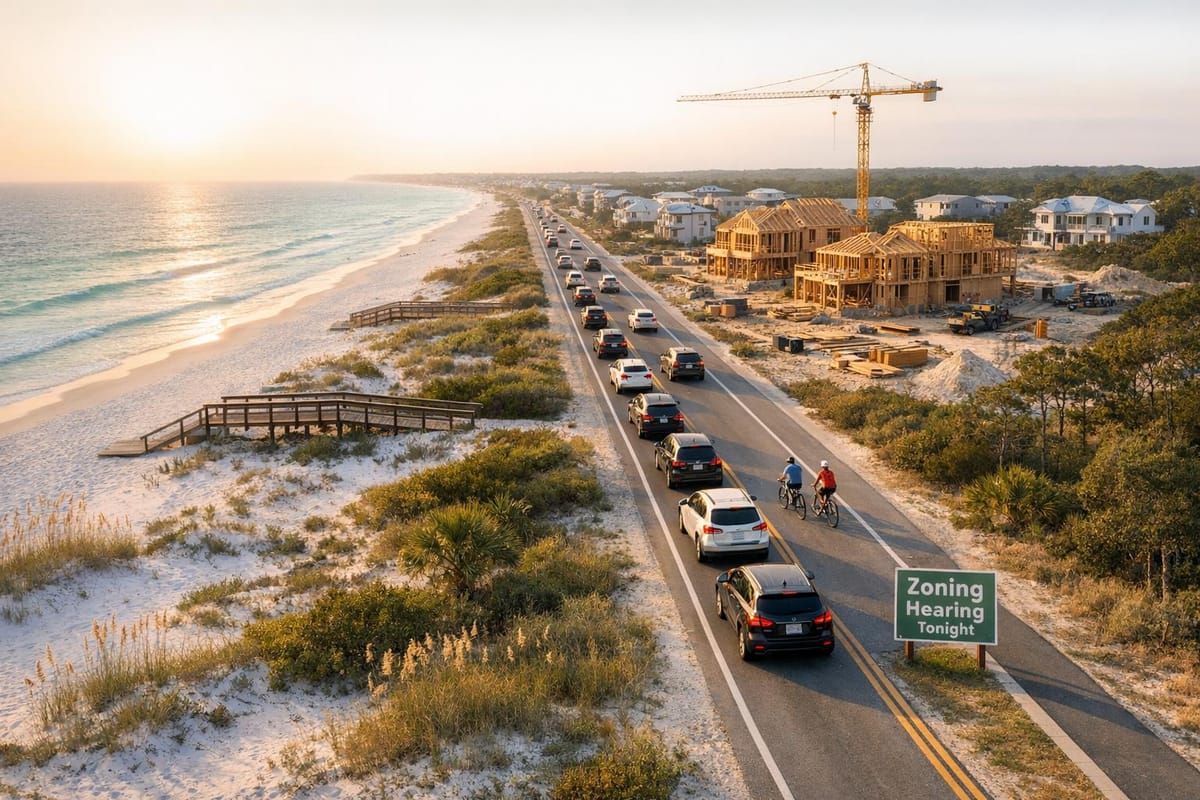
South Walton's 30A is growing fast, but not everyone is happy about it. Here's what you need to know:
- Population Boom: Walton County's population grew by 20,000 between 2010 and 2019, now exceeding 70,000.
- Real Estate Spike: Home prices along 30A average $1.62 million, with limited land available for development (only 22% is buildable).
- Infrastructure Strain: Rapid development has led to traffic issues, environmental stress, and concerns over the area's small-town charm.
- New Projects: Parking facilities, beach access points, and road upgrades aim to manage growth but face delays and legal challenges.
- Environmental Impact: Construction threatens coastal habitats, wildlife, and water quality, prompting stricter conservation measures.
- Zoning Changes: New state laws allow higher-density housing, sparking debates over balancing growth with community preservation. This shift also impacts the luxury rental market, where demand for high-end properties continues to rise.
Locals are urging for thoughtful planning to protect 30A's natural beauty while accommodating its growing popularity. The key challenge? Finding a balance between development and conservation.
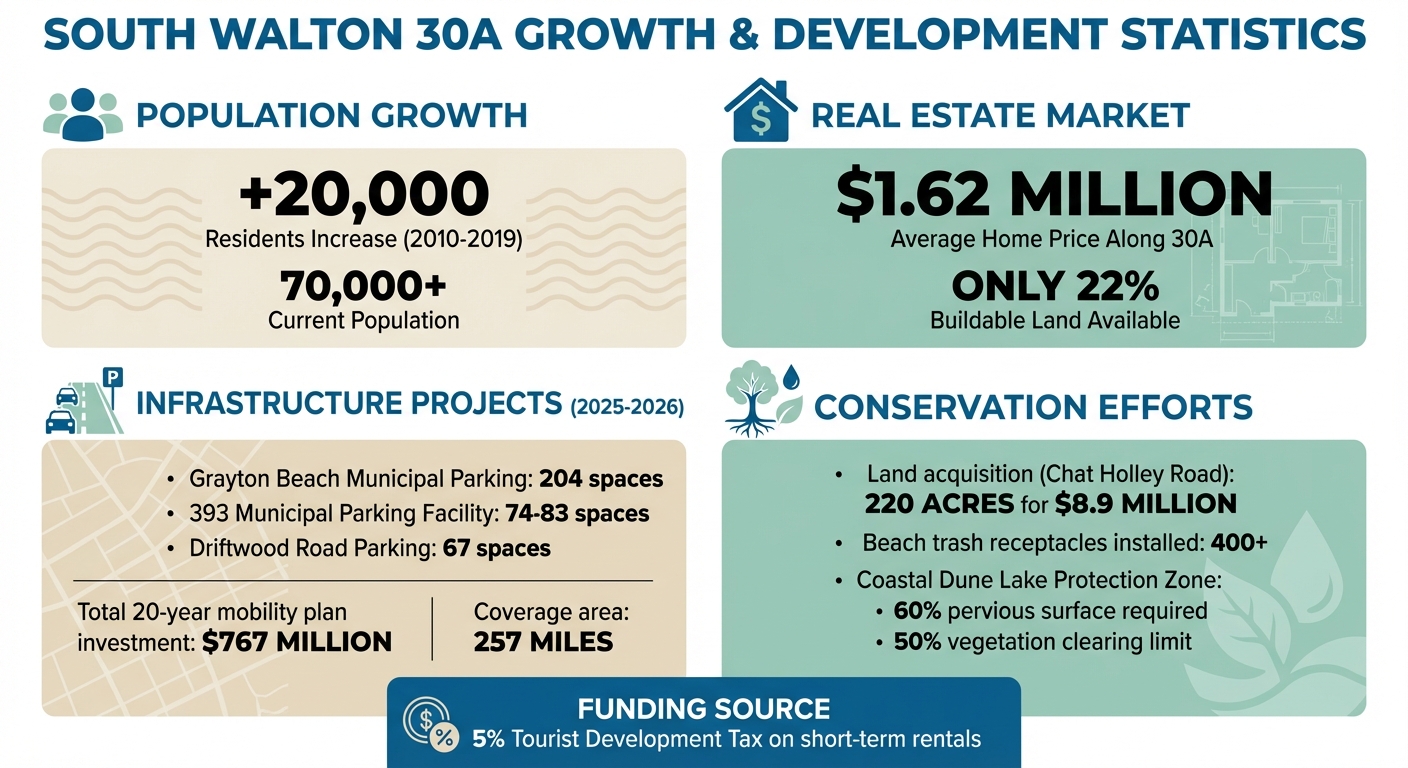
30A Growth Statistics: Population, Real Estate, and Development Impact 2010-2026
BIG CHANGES Coming to Santa Rosa Beach? | Major Real Estate & Development Updates | Sept 2025
Current Construction Projects and Their Effects
South Walton is tackling a series of infrastructure projects to address its rapid growth. As of February 2026, efforts include new parking facilities, community centers, and enhanced beach access points - all aimed at accommodating the millions of visitors who flock to the area each year.
The investment is no small feat. The Grayton Beach Municipal Parking Facility now offers 204 parking spaces, including spots for electric cars, low-speed vehicles (LSVs), and bicycles. Similarly, the 393 Municipal Parking Facility, located just a quarter-mile from the Ed Walline Regional Beach Access, adds 74 to 83 parking spaces and will serve as a hub for a new beach tram service launching March 1, 2026. Brian Kellenberger, Director of Beach Operations, highlighted the broader vision: these facilities will not only support popular beach access points but also play a role in a future public transportation system designed to ease congestion along scenic corridors.
Road Improvements and Access Changes
Road upgrades are another critical piece of the puzzle, helping to improve mobility and manage the influx of visitors. One example is the South Walton Lakeshore Drive Phase II project, which began in October 2025. This initiative includes new sidewalks, LSV parking, and crosswalks to enhance access to beach points, while also connecting to the 30A multi-use path and top bike trails to encourage walking and cycling over driving.
Stormwater management is being incorporated into these road projects, addressing flooding concerns while improving pedestrian safety. For instance, the Headland Street Neighborhood Beach Access now integrates stormwater features, blending infrastructure improvements with environmental considerations.
Beach Access and Recreation Expansions
To further disperse visitor traffic, new beach access points and recreational facilities are in the works. The Grayton Beach Community Center, set to open in the summer of 2026, will feature a 1,600-square-foot building with restrooms, an observation deck, and a boardwalk leading to the beach. Another key project, the Kellogg Park Nature Center, began construction in May 2025 and is expected to open by March 2026. This 1,800-square-foot facility will include kayak access and other amenities.
Meanwhile, the Driftwood Road Municipal Parking project in Miramar Beach is adding 67 parking spaces and an air-conditioned transit stop, with completion expected by May 2026. Funding for these developments comes from a 5% tourist development tax applied to short-term rental rules, ensuring that local residents aren't directly footing the bill unless they participate in the rental market.
However, not all projects are progressing smoothly. The Walton Dunes Regional Beach Access remains stalled due to a Zoning Board of Adjustments appeal, leaving planned features like ADA-compliant boardwalks, restrooms, and 14 parking spaces in limbo. Additionally, some projects, such as the Grayton Beach Community Center, are facing legal challenges from residents concerned about the pace and scale of development.
Residential Zoning and Housing Changes
As public amenities grow, state-led zoning reforms are reshaping the residential landscape. The Florida Starter Homes Act (SB 948), effective in early 2026, imposes new rules that limit local governments' ability to restrict small-scale housing. This means single-family homes, duplexes, triplexes, and quadruplexes can now be built "by right" if they meet specific criteria, bypassing public hearings and discretionary approvals. The act also prevents local governments from requiring lot sizes larger than 1,200 square feet for properties connected to public utilities, and limits parking requirements for smaller lots.
The Live Local Act (SB 1730) takes things a step further, allowing developers to sidestep local zoning rules for affordable and workforce housing. This legislation permits higher density and taller buildings, provided they meet the highest density allowed within a one-mile radius. Miami Beach Commissioner Alex Fernandez voiced concerns about the potential impact, stating:
"This would transform South Beach into Manhattan, there's no other way of putting it. Low-scale apartment buildings ... by legislation transformed into 50-story towers" - Alex Fernandez, Miami Beach Commissioner
Locally, Walton County is advancing its Plan for Walton 2040, which includes a "Sector Map" and "Place Types" to guide growth. Proposed updates could allow for up to 12–16 dwelling units per acre in designated areas. At the same time, the county is considering measures to limit oversized short-term rental properties - often referred to as "monster houses" - to preserve the area's character. The tension between state mandates for increased housing and local efforts to maintain the community's identity is creating challenges for both residents and developers.
| Project Name | Location | Key Features | Expected Completion |
|---|---|---|---|
| Grayton Beach Community Center | 44 Hotz Avenue | Observation deck, boardwalk | Summer 2026 |
| Driftwood Road Parking | 76 Driftwood Rd | 67 spaces, transit stop | May 2026 |
| Kellogg Park Nature Center | 855 Nursery Rd | Assembly building, kayak access | March 2026 |
| Lakeshore Drive Phase II | S. Walton Lakeshore Dr | Sidewalks, LSV parking | Ongoing (Started Oct 2025) |
| Walton Dunes RBA | 258 Beachfront Trail | ADA boardwalk, restrooms | On Hold (Appeal) |
Environmental and Ecological Effects
Development along 30A is putting South Walton's fragile ecosystems under stress. Increased construction and tourism are taking a toll on local wildlife and natural habitats, including the rare coastal dune lakes and sea turtle nesting areas. These challenges highlight the need for strict protective measures.
Protecting Coastal Habitats
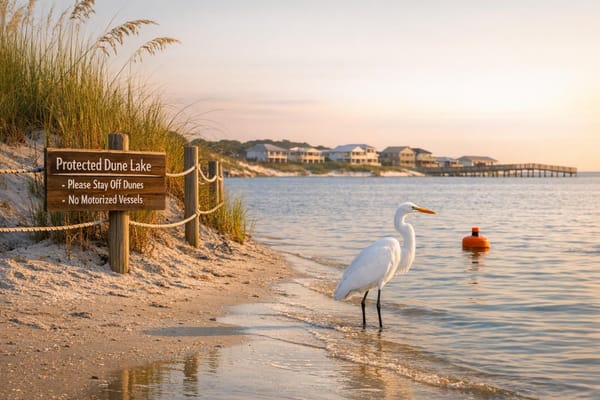
Removing coastal vegetation can lead to dune blowouts, while stormwater runoff and onsite sewage systems are degrading water quality near the coast. This issue is especially pronounced around South Walton's coastal dune lakes.
Development near these lakes poses a double threat - stormwater runoff and potential sewage contamination. These factors compromise water quality in these sensitive environments. Shorebirds, which rely on these areas for resting and foraging, are particularly at risk. The densest shorebird populations are found around the outfalls of lakes like Stallworth, Draper, Big Redfish, Western, and Camp Creek.
Sea turtles also face serious challenges. Construction debris, beach furniture left out overnight, and increased human activity create physical barriers that prevent nesting turtles from reaching the sand. These obstacles also block hatchlings from making their way to the Gulf. Adding to the problem, higher residential density attracts predators like raccoons, foxes, and feral cats that prey on sea turtle eggs and the endangered Choctawhatchee beach mouse. To help address these issues, Walton County has installed over 400 trash receptacles along the beach.
Managing Growth and Conservation
To balance development with conservation, local officials are taking action. Regulations and strategic land acquisitions are key components of their approach. For example, the Coastal Dune Lake Protection Zone (CDLPZ) mandates that parcels within 300 feet of a lake must maintain at least 60% pervious surface and limit vegetation clearing to 50% within the protection zone. Additionally, a 50-foot undisturbed vegetated buffer is required around each lake's natural outlet.
In February 2021, Walton County made a significant move by purchasing 220 acres along Chat Holley Road for $8.9 million. This prevented the construction of hundreds of homes and safeguarded the water quality of Choctawhatchee Bay. The funding came from $2 million in county land preservation reserves and $6.9 million from Tourist Development Council reserves. County Commissioner William "Boots" McCormick explained the decision:
"Who do you think would be the better steward, the developer or the county? God knows how many (residential) units would be thrown up there. I just think the county would be a better steward in doing the development".
Community involvement has also played a critical role. In May 2021, residents successfully pressured developer D.R. Horton to scale back the Bluewater Landing project at Draper Lake. Originally, the plan called for 186 residential units and a large commercial building on 36 acres. After strong community opposition, the final plan was reduced to 31 single-family homes, and the developer agreed to donate the lake and surrounding property to the county for preservation through a land trust. South Walton advocate Barbara Morano reflected on the outcome:
"The evolution of the Draper Lake project showed the results of time, negotiation, compromise, sensitivity to the community and caring... I hope it becomes a model for you going forward".
Traffic and Transportation Issues
As construction reshapes the landscape along 30A, transportation challenges have become a pressing issue for locals and visitors alike. Ongoing projects are leading to lane closures, detours, and work zones - short-term hurdles in the broader effort to improve South Walton's infrastructure.
Construction-Related Traffic Delays
One of the most impactful projects is the Western Lake Bridge replacement on County Road 30A, which is causing daytime stoppages between 6 a.m. and 5 p.m. Flaggers are managing these zones, with delays averaging about 15 minutes.
Meanwhile, U.S. 331, a key route supporting 30A traffic, is undergoing nighttime resurfacing. From 7:30 p.m. to 5:30 a.m., drivers should expect intermittent lane closures and be cautious of workers and equipment. Phillip Gainer, FDOT District 3 Secretary, acknowledged the inconvenience:
"If we are working in a residential area, people don't like all the banging of the tailgates and the equipment noise when they are trying to sleep, but we ask for their patience and remind them that resurfacing occurs only once every 12 or 15 years".
Since construction schedules depend on weather conditions, residents are encouraged to check weekly FDOT traffic advisories for the latest updates on closures and detours.
Future Transportation Plans
Fixing today’s delays is just one part of Walton County’s long-term vision for better mobility. The county is rolling out a 20-year mobility plan stretching through 2040, which includes an estimated $767 million in transportation improvements across 257 miles. Instead of simply widening roads, the plan emphasizes multimodal solutions, such as expanding walking, biking, and transit options to reduce reliance on cars along the two-lane coastal route.
One key strategy is creating a "park-once" system, where visitors park at inland hubs and use shuttles to access the beaches. The recently opened 393 Transit Hub is an example of this approach, offering 74 standard parking spaces alongside areas for low-speed vehicles (LSVs) and bicycles. This $5 million facility was fully funded by Tourist Development Taxes. Brian Kellenberger, Walton County Administrator, shared the broader goal:
"By centralizing parking and connecting key destinations through transit, we can improve quality of life for everyone - from lifelong locals to first-time visitors".
To fund these improvements, Walton County is transitioning to a "mobility fee" system for new developments. Vacation rental properties, for instance, could face fees ranging from $3,850 to $8,302 per room, while industrial developments may pay $1,415 to $3,044 per square foot. These fees are designed to support regional transportation upgrades, not just projects near the developments themselves.
Getting Involved in Local Planning
With the rapid growth along 30A, it's more important than ever for residents to get involved in shaping the future of South Walton. Whether you've lived in the area for years or are thinking about moving here, your voice can influence decisions on everything from building heights to traffic flow. Active participation ensures that development aligns with the community's needs and values.
Ways to Share Your Input
There are several ways to make your voice heard. Attending Board of County Commissioners (BCC) meetings, community workshops, and visioning charrettes is a direct way to contribute. These meetings, held at the South Walton Annex Board Room in Santa Rosa Beach, allow for public comments and even sworn testimony on specific projects. For instance, in February 2025, residents voiced concerns about traffic safety at U.S. Highway 98 and County Road 30A during discussions on the 30A Surf Club development (Project MAJ24-000012). Their input led to the BCC unanimously denying the project.
Long-term planning efforts, like the "Plan for Walton 2040" initiative, also offer opportunities for involvement. Community workshops and visioning charrettes allow participants to review preliminary sector maps and provide feedback on "Place Types", which shape how different areas will develop. Online tools and surveys are another way to share your input.
For neighborhoods aiming to establish stricter local controls, the Neighborhood Plan process is an option. This begins with a 20% interest ballot and requires a 66% favorable vote from residents before being presented to the BCC for adoption. A recent example is the Old Seagrove Neighborhood Plan, which passed with an 85% favorable vote in February 2025. The BCC adopted the plan (Option B) by a 3-2 vote, setting regulations for building setbacks, reduced heights, and tree protection.
Staying informed is crucial. The South Walton Community Council (SWCC), a nonpartisan nonprofit established in 1995, shares updates on county workshops, town halls, and meetings through newsletters and social media. For those new to the area or considering a move, resources like sowal.co provide updates on local events and developments along the coast.
Working with Local Officials
Collaborating with local officials is another effective way to influence planning decisions. Early organization and clear communication have proven successful in past cases. For example, during the August 2025 Seascape controversy, homeowners opposed a proposed 125-room hotel by hiring legal counsel, organizing a petition, and securing a meeting continuance to prepare a formal response.
Residents also use email to express their opinions to County Commissioners and sometimes show solidarity by wearing a unifying color at meetings. Consultant Kristen Shell, who contributed to the Old Seagrove plan, highlighted the balancing act officials face:
"How do we change as a community and grow, but still support what is there. How do we manage all the changes the best without staying static".
The best time to engage is during the early planning stages. By the time a project reaches a final vote, most technical reviews are already completed. Participating in visioning sessions or initiating a Neighborhood Plan early on ensures your input has the greatest impact on South Walton's future development.
Conclusion: Finding Balance in South Walton's Growth
With only 22% of Walton County available for development, careful planning is essential to safeguard its natural beauty and maintain its unique character. The challenge lies in steering growth toward suitable areas while protecting established neighborhoods and sensitive environments.
Recent examples show that this balance is possible. For instance, community collaboration reshaped the Bluewater Landing project from a proposed 186-unit development into a plan for 31 homes, along with designated conservation land. Similarly, the Old Seagrove Neighborhood Plan, adopted in February 2025 with 85% resident approval, introduced localized regulations to prevent oversized "monster houses". The unanimous rejection of the 30A Surf Club project in the same month highlighted the importance of prioritizing public safety and respecting resident concerns.
The "Plan for Walton 2040" framework provides a clear path forward by dividing the county into Protected, Maintained, and Growth sectors. Strategic moves, like the $8.9 million land acquisition, demonstrate how proactive measures can align development with conservation goals. This plan, combined with active community participation, keeps the focus on sustainable growth.
"The goal should be that '20 years from now, people still want to come here and live here.'"
– Susan Lucas, Long-time Resident
Maintaining South Walton's charm will require ongoing vigilance and involvement from the community. With increasing growth and visitation, now is the time to stay informed by using our South Walton itinerary generator and reading our local guides. Participate in planning workshops, voice your opinions, and keep an eye on rezoning proposals to ensure development complements the area's natural beauty and small-town feel.
FAQs
What impact are the new zoning laws having on housing and development along 30A?
Recent zoning changes along 30A are reshaping how housing and development are approached, aiming to address concerns about large-scale construction while maintaining the area's distinct character. These updated regulations allow for higher housing density in certain zones, but they also impose size limits and stricter rules to curb the spread of oversized homes, often called "monster houses."
The primary objective is to strike a balance between accommodating growth and safeguarding the charm that defines South Walton. These efforts ensure that new developments not only fit the area's coastal aesthetic but also meet the needs of both locals and visitors.
How is the coastal environment being protected from new development?
Walton County has taken thoughtful steps to manage growth while safeguarding its coastal environment. The Walton County Land Development Code outlines resource protection standards aimed at conserving critical natural features such as wetlands, coastal dune lakes, and wildlife habitats. These standards encourage development practices like clustering buildings, maintaining setbacks, and using elevated structures to reduce environmental harm.
The county also partners with federal and state agencies through its Habitat Conservation Plan, which prioritizes protecting endangered species and their habitats from the effects of development. On top of that, programs like Florida Forever have played a key role in preserving sensitive areas, including dunes and wetlands, by restricting construction in these crucial ecosystems.
By combining smart planning with conservation initiatives, Walton County strives to balance growth with the protection of South Walton’s unique natural resources, tackling challenges like habitat loss, coastal erosion, and overall environmental well-being.
What is Walton County doing to address traffic issues caused by rapid growth?
Walton County is stepping up to address traffic challenges brought on by the area’s rapid development. To improve mobility, the county is focusing on alternative transportation options, including buses, bike lanes, and pedestrian pathways. These improvements are particularly targeted at high-traffic areas like County Road 30A and Scenic Gulf Drive.
Another key project is the South Walton Connector Road, which is designed to improve connectivity between County Road 30A and US Highway 98. This new route aims to alleviate bottlenecks and streamline traffic flow. The county is also considering creative measures, such as adding dedicated passing lanes for golf carts and low-speed vehicles, to reduce congestion on scenic roads.
These efforts highlight Walton County's dedication to finding practical ways to manage growth while enhancing transportation options for residents and visitors alike.