Top Community Resources for Senior Meals in 30A
Overview of home-delivered meals, community lunches, food pantries, and in‑home meal services in 30A, with eligibility details and local contacts.
Seniors in the 30A area have access to various meal services designed to support their health, independence, and social connection. These programs include home-delivered meals, hot lunches at community centers, grocery assistance, and in-home care services. Here's a quick overview:
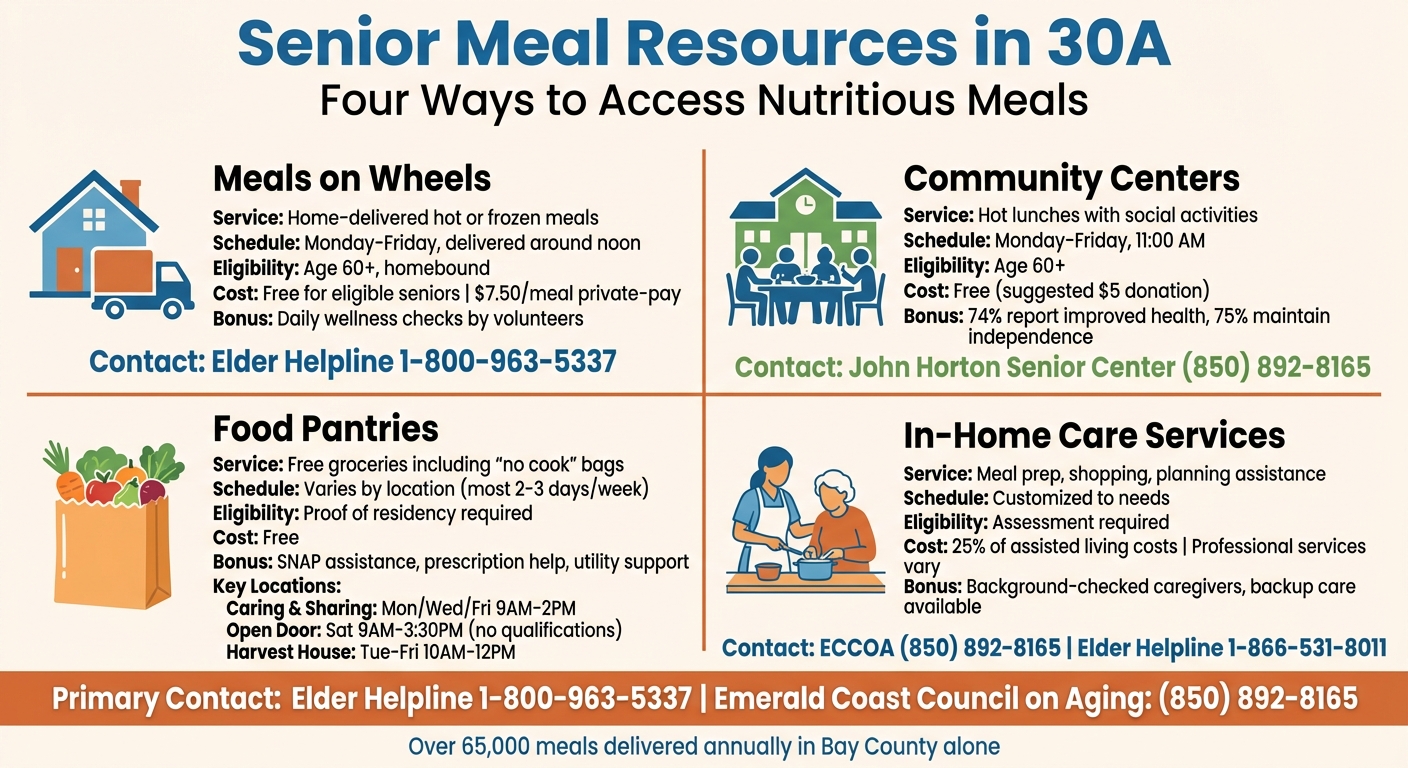
- Meals on Wheels: Delivers hot or frozen meals to homebound seniors Monday through Friday. Meals meet dietary standards and include daily wellness checks by volunteers. Free for eligible seniors aged 60+, with private-pay options at $7.50 per meal.
- Community Centers: Locations like the John Horton Senior Center offer weekday lunches and social activities. Meals are free for eligible seniors, with a suggested $5 donation.
- Food Pantries: Options like Caring & Sharing of South Walton provide free groceries, including "no cook" bags for seniors with limited kitchen access. Proof of residency may be required.
- In-Home Meal Services: Volunteer and professional services assist with meal prep, shopping, and other daily tasks. Costs are often lower than assisted living facilities.
For assistance, contact the Elder Helpline at 1-800-963-5337 or the Emerald Coast Council on Aging at (850) 892-8165. These resources help seniors stay nourished, connected, and independent.
Senior Meal Services in 30A: Programs, Eligibility, and Contact Information
Meals on Wheels volunteers deliver more than food to Bay County seniors
Meals on Wheels Programs in 30A
Among the senior meal services available in 30A, Meals on Wheels stands out for providing both nutritional support and meaningful human connection to older adults.
How Meals on Wheels Works
Meals on Wheels delivers ready-to-eat meals to seniors who are unable to shop or cook for themselves. Operating Monday through Friday, the program ensures hot meals arrive around noon. In some areas, frozen meals are delivered every two weeks, offering added flexibility for participants.
Each meal is approved by a dietitian and meets at least one-third of the Recommended Dietary Allowance (RDA) for older adults, following guidelines set by the Florida Department of Elder Affairs. To qualify, individuals must generally be 60 years or older and unable to manage meal preparation or grocery shopping on their own. Eligibility is determined through an initial assessment, which can be scheduled by contacting the Northwest Florida Area Agency on Aging at (850) 494-7101 or the Elder Help Line at (850) 494-7100.
Volunteers play a crucial role, not only delivering meals but also conducting daily wellness checks. As the Bay County Council on Aging explains:
"The volunteers who deliver meals often provide the only contact with these homebound senior adults. It serves as a daily check to ensure that everything is okay."
This combination of nutritional and social support helps seniors maintain their health and well-being.
Benefits of Meals on Wheels for Seniors
Meals on Wheels offers more than just food - it provides a lifeline for many seniors. The program helps combat isolation by ensuring that homebound seniors have daily interaction with volunteers, who often serve as their only point of contact. This social connection can make a significant difference in their emotional and mental health, while also providing a safety net through regular wellness checks.
The program has a broad reach across the Florida Panhandle. In Bay County alone, over 65,000 hot meals are delivered each year to more than 275 seniors. For those who qualify, meals are government-funded and provided at no cost, although voluntary donations are welcomed. For individuals who don't meet the eligibility criteria for free meals, private-pay options are available at about $7.50 per meal (including delivery). A $50 nonrefundable deposit is required when applying for the private-pay program.
Community Centers Offering Hot Meals
Seniors living in the 30A area have access to hot meals at local community centers and churches. These gatherings go beyond just providing food - they create spaces for connection and camaraderie.
Weekly Meal Services at Local Churches
The John Horton Senior Center, also known as the South Walton Senior Center, is a key spot for seniors in Santa Rosa Beach and the broader 30A area to enjoy regular meal services. Managed by the Emerald Coast Council on Aging, the center ensures meals are both nutritious and welcoming.
Meal sites typically operate Monday through Friday, with lunch served around 11:00 AM. Seniors need to place their meal orders by noon the day before. Meals are prepared to meet state nutritional guidelines and are offered free of charge to eligible seniors aged 60 and older. While there’s no requirement to pay, a voluntary contribution of about $5 is suggested. For more information or to enroll, seniors can contact the Elder Help line at (850) 494‑7100.
Community Lunches and Social Gatherings
In addition to regular meal services, many centers host activities designed to bring people together and foster a sense of belonging. These programs aim to reduce social isolation while promoting overall well-being. For instance, the Administration for Community Living reports that 74% of participants in congregate meal programs feel their health has improved, and 75% credit these programs with helping them maintain their independence.
Beyond meals, centers often organize activities like arts and crafts, social games, and group fitness classes. Health screenings and technology workshops are also available to keep seniors engaged and active. According to the Administration for Community Living:
"Beyond nutrition, congregate meals reduce social isolation while providing access to health screenings, transportation, and enrichment activities."
Seniors can request a monthly activity calendar from their local center to stay informed about upcoming programs. For those needing help with transportation, assistance may also be available upon inquiry.
Food Pantries and Grocery Assistance for Seniors
For seniors who prefer cooking at home, food pantries in the 30A area provide a lifeline, offering free groceries to help meet their needs. Between 2022 and 2024, the demand for these services nearly doubled, highlighting their importance. These resources complement senior meal programs by enabling individuals to prepare meals independently using essential groceries.
Food Pantries in the 30A Area
Caring & Sharing of South Walton serves over 1,100 families each month. Located at 112 Lynn Drive, the pantry operates a drive-through service on Mondays, Wednesdays, and Fridays from 9:00 AM to 2:00 PM. To access services, seniors need to bring a photo ID, proof of Walton County residency (such as a utility bill), and a completed TEFAP form. For seniors with mobility challenges, a representative can pick up food on their behalf. Beyond groceries, this organization also helps seniors apply for SNAP benefits and Medicaid.
Open Door Food Pantry, at 24388 US HWY 331S, offers a no-barrier option, requiring no qualifications to receive assistance. Open on Saturdays from 9:00 AM to 3:30 PM, it welcomes anyone in need. Emergency boxes with about a week's worth of non-perishable food are also available during the week for urgent situations. Seniors near Miramar Beach can turn to Harvest House, located at 300 Mountain Dr., Destin. Open Tuesday through Friday from 10:00 AM to 12:00 PM, this pantry requires a photo ID and proof of residency.
Grocery Box Programs for Seniors
For seniors with limited mobility or meal preparation capabilities, organizations in the 30A area offer pre-packed grocery boxes. For instance, Caring & Sharing of South Walton provides "no cook" food bags tailored for individuals who may not have access to a full kitchen or who find meal preparation physically challenging.
Many food pantries also extend additional support, such as assistance with prescriptions, clothing vouchers, and help with utility bills - services that can be crucial for seniors living on fixed incomes. Seniors are encouraged to call ahead to verify hours, eligibility criteria, and any income guidelines, including those based on United Way ALICE thresholds.
In-Home Care and Meal Preparation Services
In the 30A area, seniors can opt for either volunteer or professional in-home meal services, often at a fraction of the cost of Assisted Living Facilities - sometimes as low as 25% of the expense. These services not only ensure proper nutrition but also support seniors in maintaining their independence at home.
Volunteer-Based Meal Prep Assistance
The Emerald Coast Council on Aging (ECCOA) plays a key role in providing in-home support for seniors in Walton County. Through its Homemaker Services program, ECCOA offers help with meal planning, preparation, and shopping. These services are funded by state and federal initiatives, such as the Community Care for the Elderly and the Older Americans Act Title III-B, ensuring eligible seniors can access assistance at minimal or no cost.
"Homemaker service is defined as the accomplishment of specific home management duties by a trained homemaker. Duties may include, but are not limited to... meal planning and preparation; shopping assistance; and routine house-hold activities."
- Emerald Coast Council on Aging
Seniors interested in these services can call the Elder Helpline at 1-866-531-8011 to begin the assessment process. Eligibility is determined by evaluating the senior's ability to manage daily tasks, including meal preparation. Additionally, Coastal Seniors of South Walton, a volunteer-led group based at 70 Logan Lane in Santa Rosa Beach, connects seniors with local volunteers and offers monthly workshops focusing on nutrition and health.
For those needing more tailored care, professional services are also available.
Professional Senior Care Services
For seniors requiring more specialized or consistent in-home care, licensed agencies throughout the 30A area provide paid meal preparation services. Panhandle Assistant Care, serving areas like Seaside and Seacrest, offers customized homemaker services, including grocery shopping and meal preparation. Home Instead, located in Fort Walton Beach, supports seniors in Santa Rosa Beach and Sandestin with meal prep and care tailored to conditions like diabetes. Visiting Angels, based in Santa Rosa Beach, provides non-medical assistance, covering meal preparation and errands.
These professional services work alongside volunteer programs to create a comprehensive care network for seniors in the 30A region. Each agency provides a free consultation to develop personalized nutritional and care plans. Unlike hiring a private caregiver, professional agencies handle background checks, insurance, and tax obligations. They also ensure backup care if a regular caregiver is unavailable. ECCOA, licensed as a Homemaker and Companion Services Provider (License #237957), helps coordinate both volunteer and professional services through its South Walton Center Manager.
How to Access Senior Meal Services in 30A
Contact Information for Local Services
For meal assistance in Walton County and the 30A area, start by calling the Elder Helpline at 1-800-963-5337. Another key resource is the Emerald Coast Council on Aging (ECCOA), which operates the South Walton Senior Center located at 194 North Co. Road 393 in Santa Rosa Beach. You can reach the center manager at (850) 892-8165 to inquire about meal programs.
If you're looking for grocery support through SNAP, call 1-866-762-2237 or visit www.myflorida.com/accessflorida. For broader questions about state-level programs, contact the Florida Department of Elder Affairs at 850-414-2059. These direct lines make it easier to navigate the available nutritional support options.
Eligibility and Enrollment Process
Once you’ve reached out using the contacts above, seniors will need to complete a short eligibility assessment to enroll in meal services. Government programs typically require participants to be 60 or older and demonstrate a need, such as challenges with grocery shopping or meal preparation. You can start the process with a phone assessment through the Northwest Florida Area Agency on Aging at 850-494-7101. Be sure to have your ID, proof of residency, and income details on hand.
"Meals on Wheels is a government funded program and an assessment is required." - Council on Aging of West Florida
For seniors enrolled in Medicaid-managed care, contact your case manager to arrange home-delivered meals. If you don’t qualify for government programs, there are private-pay options available, costing approximately $7.50 per meal with a one-time $50 deposit. For congregate meal sites, meals typically need to be ordered by 12:00 PM the day before.
Wrapping Up
In the 30A area, seniors have access to a variety of meal services that promote both healthy aging and independence. Whether it's through home-delivered meals provided by ECCOA or group dining experiences at local community centers, these programs offer more than just nutrition - they provide daily check-ins, opportunities for social interaction, and reassurance for families.
The impact of these services is clear in personal stories, like this one from a veteran:
"ECCOA has truly changed my life. Thanks to their incredible team, I'm proud of my home again. The support, from assurance calls to HDMF deliveries, has made daily life so much easier. I feel heard, cared for, and connected in a way I never did before." - K.W., Veteran
If you're supporting an aging loved one or know a senior who could benefit, sharing this information can make a real difference. These programs are designed to help seniors remain at home with dignity and comfort. And for those who don’t qualify for government assistance, private-pay options ensure that nutritious meals and meaningful connections are available to all who need them.
FAQs
Can I get meals if I’m under 60 but disabled?
Individuals under 60 with disabilities might be eligible for meal assistance through programs such as Congregate Meal Sites or home-delivered meal services. While these programs are primarily aimed at those aged 60 and older, they also accommodate individuals with specific needs. To determine if you qualify, reach out to local providers for detailed eligibility criteria.
What diets can Meals on Wheels or meal sites accommodate?
Meals on Wheels and meal sites offer a variety of meal options to cater to different dietary needs. These include low-sodium, diabetic-friendly, heart-healthy, low-cholesterol, and low-fat meals. For individuals who have trouble chewing or swallowing, textured-modified meals are also available. These tailored options ensure seniors receive proper nutrition while respecting their specific dietary requirements.
What should I do if I need meals right away?
If you're in urgent need of meals, consider contacting local programs such as Meals on Wheels or nearby community food distribution services. Another helpful option is dialing the senior resource helpline at 2-1-1, where you can get referrals for emergency food assistance. These services are specifically set up to offer prompt support to seniors facing food insecurity.