New Urbanism Along 30A: Style Comparison
Same planning rules yield four very different daily experiences in walkability, porches, parking, and town-center life.
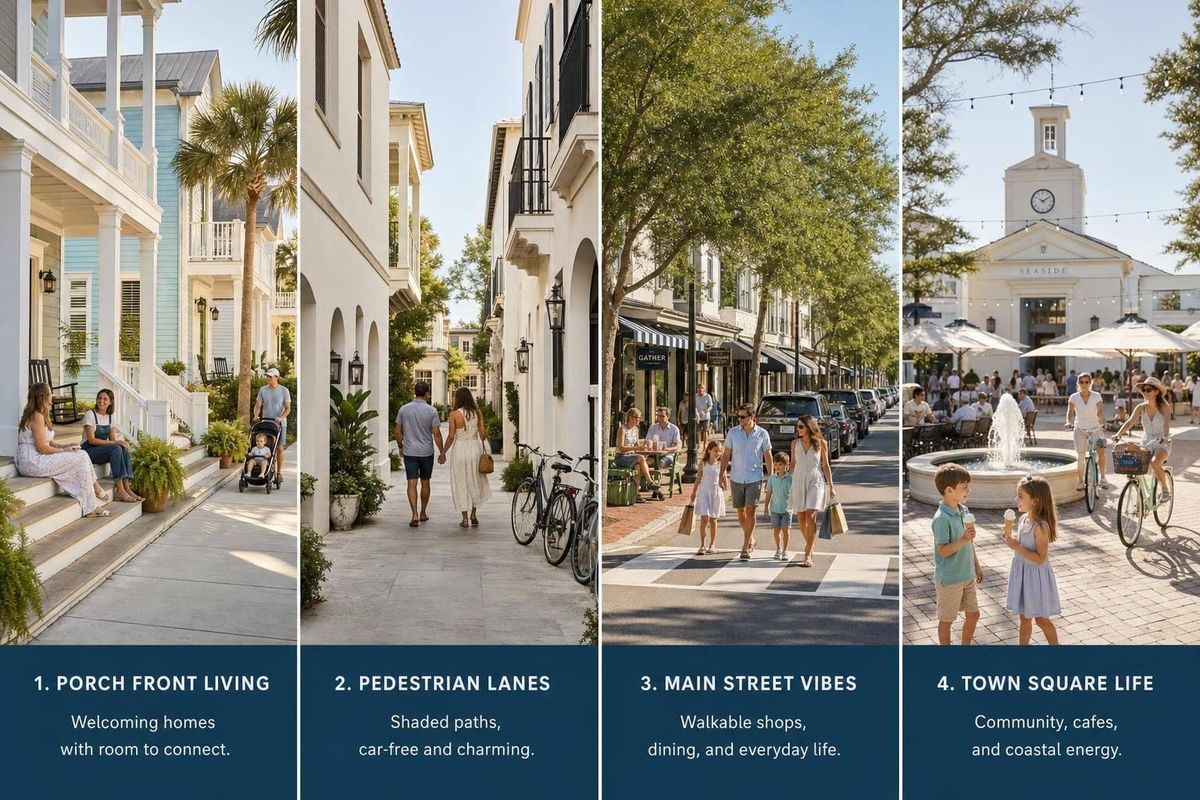
The short answer: these four 30A communities use the same planning idea, but they feel very different once you’re walking through them.
If I had to sum it up fast, I’d put it this way:
- Seaside feels social and street-facing.
- Rosemary Beach feels most centered on a walkable town core.
- WaterColor feels more open and less tight-knit.
- Alys Beach feels quiet, controlled, and inward-facing.
That comes down to a few things the article tracks closely:
- walkability
- porches vs. courtyards
- garage and parking location
- lot spacing
- mixed-use town center activity
One fact drives much of the setup in Rosemary Beach: the plan was built around a “five-minute walk” rule, with daily spots kept close enough to reach on foot. In practice, that means shorter walks, fewer front-facing cars, and more focus on buildings, paths, and public space.
If you’re picking where to stay, buy, or live full-time, this comparison is less about style labels and more about daily use: How far will you walk? How private will the street feel? How much activity will be near your front door?
Quick Comparison
| Community | Walkability | Outdoor Living Focus | Parking View | Lot Feel | Town Center Activity |
|---|---|---|---|---|---|
| Seaside | High | Front porches near sidewalk | Rear alleys | Tight and dense | High |
| Rosemary Beach | High | Streets, lanes, and central square | Behind buildings | Compact | High |
| WaterColor | Moderate | Front porches | Mostly rear or side-entry | More open | Medium |
| Alys Beach | High | Courtyards | Hidden from street | Tight and controlled | Low |
So while all four follow New Urbanist planning, the day-to-day feel is not the same at all - and that’s the part that matters most.
Seaside FL Homes: What $1.75M to $10M Buys on 30A
sbb-itb-d06eda6
Four New Urbanist Communities on 30A: A Design Overview
Seaside, Rosemary Beach, WaterColor, and Alys Beach all follow New Urbanist rules. But once you get down to the street, they don’t feel the same at all. The planning logic is shared. The experience of walking, parking, and spending time outdoors is not.
Rosemary Beach
Rosemary Beach follows a neighborhood plan by Andres Duany and Elizabeth Plater-Zyberk. The layout is built around a five-minute walk, so daily amenities stay close at hand. Small blocks, narrow streets, and dedicated pedestrian lanes put people on foot first. Parking sits behind buildings, which keeps cars out of the main street view and helps the center feel more walkable.
If Rosemary Beach pushes cars into the background, Alys Beach takes that idea even further.
Alys Beach
Alys Beach uses the same pedestrian-first logic, but in a tighter and more controlled way. Its architectural code requires white stucco exteriors and keeps parking and service areas out of sight from the street. That gives the community a uniform, inward-facing look. Instead of front porches doing most of the social work, courtyards become the main outdoor living space.
Seaside and WaterColor work from the same New Urbanist playbook, but they leave more room for porch life, street activity, and visual openness.
Seaside
Seaside is the original New Urbanist community on 30A. Duany and Plater-Zyberk master-planned it in the early 1980s. Its code calls for front porches close to the street, picket fences, and homes on narrow lots. That setup pulls residents toward the sidewalk and, by extension, toward each other.
Garages sit at the rear along alleys, so the street view stays clear. A compact town center with retail, dining, and an amphitheater is within easy walking distance of most homes. In Seaside, mixed-use daily life isn’t just a planning idea on paper. It’s built into the way the place works.
WaterColor
WaterColor takes a softer route. Developed by St. Joe Company in the early 2000s, it mixes New Urbanist structure with a more relaxed, resort-influenced feel. Lots are usually larger than those in Seaside or Rosemary Beach, which makes the streetscape feel more open.
Front porches are still common, but the architectural code allows more variety in style and color. A town center anchors the community with retail and dining, though the overall layout is less tightly knit than Seaside’s grid. Parking uses a mix of rear garages and side-entry options, which keeps most cars out of the main street view.
Side-by-Side Design Comparison
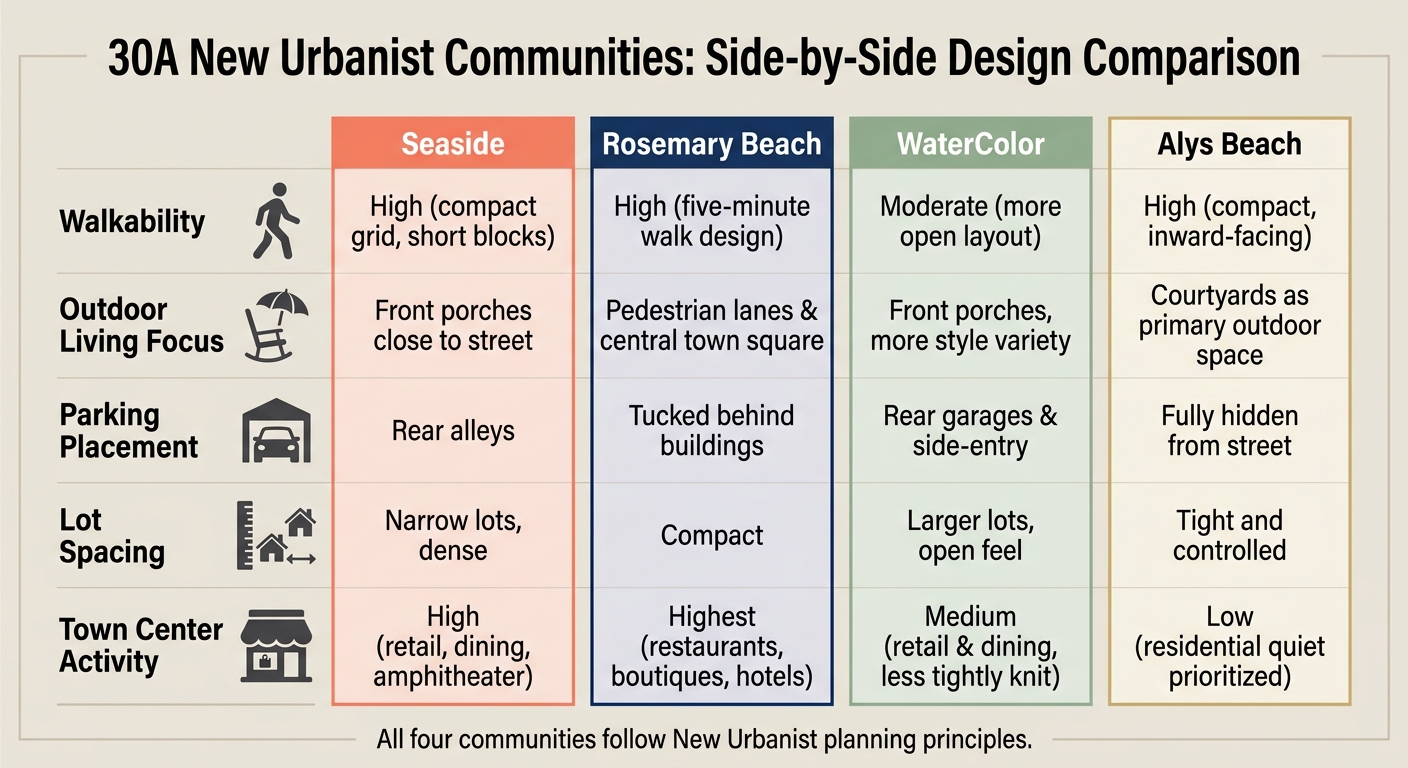
30A New Urbanist Communities: Side-by-Side Design Comparison
Put these communities next to each other, and one thing stands out fast: the same New Urbanist rules can lead to very different street experiences.
| Community | Walkability | Porch/Courtyard Use | Garage/Parking Placement | Lot Spacing | Mixed-Use Core |
|---|---|---|---|---|---|
| Seaside | High; compact grid, short blocks | Front porches close to street; picket fences | Rear alleys | Narrow lots, dense | Town center with retail, dining, and amphitheater |
| Rosemary Beach | High; five-minute town design | Pedestrian lanes and central town square | Tucked behind buildings | Compact | Strongest mixed-use core; restaurants, boutiques, and hotels |
| WaterColor | Moderate; more open layout | Front porches common; more style variety | Rear garages and side-entry options | Larger lots, more open feel | Town center with retail and dining; less tightly knit than Seaside |
| Alys Beach | High; compact and inward-facing | Courtyards as primary outdoor living space | Out of sight from street; service areas hidden | Tight, controlled | Limited street-level retail; design prioritizes residential quiet |
Walkability and Street Life
The biggest split comes down to tight pedestrian planning versus a looser, resort-style layout.
Seaside and Rosemary Beach lean hard into short blocks, rear parking, and easy walking routes, which keeps street views cleaner and puts daily destinations close by. You can feel that in the way the streets work. They invite walking instead of making it feel like a chore.
WaterColor uses much of the same setup, but the mood is looser. Wider spacing between lots gives it a more relaxed feel, even if that softens some of the close-knit street energy. Alys Beach stays compact too, but it turns inward. Instead of front porches doing most of the social work, courtyards take the lead as the main outdoor living space.
Garages, Lot Spacing, and Street View
Parking placement does a lot of the heavy lifting here.
Seaside and Rosemary Beach push garages to rear alleys, which takes cars out of the main street view almost entirely. That one move changes a lot. Streets feel more like places for people and less like storage for vehicles.
WaterColor also keeps most parking out of sight, using rear garages and some side-entry setups. Alys Beach goes even further by hiding service areas and parking behind its white stucco exteriors. The result is the most tightly controlled street view of the four.
Mixed-Use Planning and Town Center Activity
Seaside and Rosemary Beach have the liveliest mixed-use cores. Retail, dining, and gathering spaces sit within a short walk of most homes, which helps keep activity centered and visible.
WaterColor has a town center too, and it still anchors the community, but the overall layout feels more spread out. Alys Beach takes a different path. It has limited street-level retail and a plan that favors residential calm over commercial activity, giving it the quietest public feel in the group.
What These Design Differences Mean for Daily Life and Real Estate
Those street-level details show up fast in day-to-day life and in home-buying choices. Planning rules don’t just shape how a place looks. They shape how people move through it, where they spend time, and which homes tend to cost more.
In Rosemary Beach, walkability and tucked-away parking make errands, dining, and beach trips easier on foot. You feel that in simple ways: a short walk to coffee, less time dealing with cars, and streets that feel made for people first. For buyers, that same setup puts extra weight on homes near the town center and main pedestrian routes.
How Form Affects Daily Use and Buyer Priorities
Across 30A, the same New Urbanist rules can lead to different levels of walkability, street privacy, and mixed-use energy. That’s where things get interesting. Two places may follow a similar planning playbook, but daily life can still feel quite different from one community to the next.
For residents, that can mean an easier daily routine built around walking. For buyers, it means location, access, and street design matter more when judging value. A home isn’t just about square footage or finishes. It’s also about how close you are to the places you’ll use most, how the street feels, and how easily you can get around without getting in the car.
Conclusion: One Planning Idea, Four Different Outcomes on 30A
These design rules lead to four different versions of life on 30A. Seaside, Rosemary Beach, WaterColor, and Alys Beach all start from the same New Urbanist playbook, but each one applies it in its own way. That shift changes how the place feels when you’re there.
Rosemary Beach is the most centered on its town core. It’s built around a five-minute walk plan, with parking tucked behind buildings. Alys Beach goes another direction. Its streets feel quieter and more inward-facing, and parking stays hidden instead of feeding the open street activity you see in Seaside or Rosemary Beach.
In day-to-day life, that changes a lot. It shapes how far people walk, how private the streets feel, and how much activity gathers around the town center. Same planning idea, four different daily experiences.
For more place-specific context, sowal.co covers South Walton and 30A in practical detail.
FAQs
Which 30A community feels most walkable day to day?
It depends on the kind of walkability you’re after.
Rosemary Beach is often seen as the most walkable if you want a social, village-style setup. Footpaths and boardwalks lead into a central town square, so it feels easy to get around on foot.
Seaside is another top pick for day-to-day walkability, while Alys Beach has a denser, more private, resort-style pedestrian layout near its town center.
How do porches and courtyards change the neighborhood feel?
In 30A communities, front porches help shape a more social, walkable streetscape. They bring everyday living closer to the sidewalk, which makes casual hellos and neighborly chats feel natural.
By contrast, inward-facing courtyards create a quieter, more private, resort-like atmosphere. Rather than opening toward the street, they carve out secluded outdoor space and often offer better thermal comfort, while still fitting the town’s overall look.
Which community is best for quiet living or town-center activity?
If you want a lively town-center feel, Rosemary Beach and Seaside are the main standouts. Both have walkable village layouts, central squares, restaurants, boutiques, and cafés, so it’s easy to step outside and feel like something’s going on.
If privacy matters more, WaterSound Beach leans the other way. It offers a gated, low-density setting with a much quieter feel. Blue Mountain Beach and Dune Allen also move at a slower pace, with less structure and larger lots.