Rosemary Beach Sculpture Exhibit Guide 2026
Free, walkable outdoor sculpture show opens Oct 17, 2026 and runs through Oct 2027 — routes, start points, parking and visitor tips.
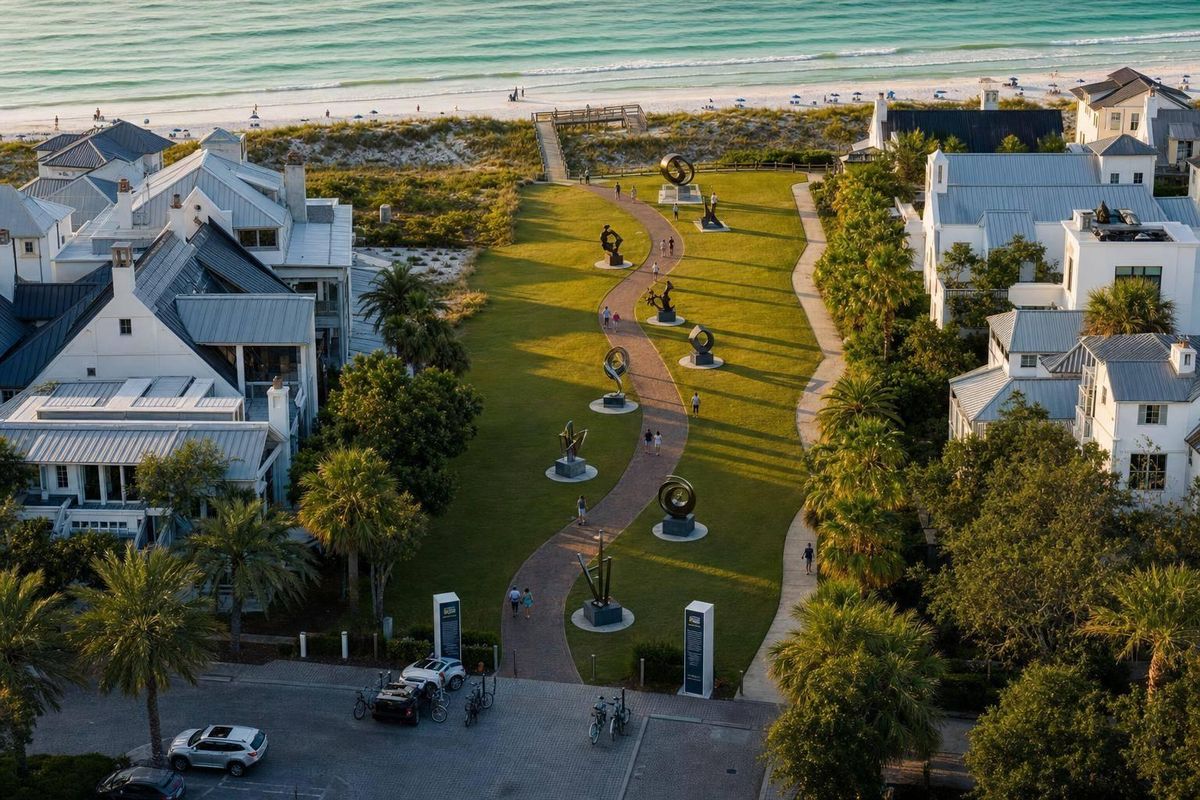
If I wanted the short answer: this is a free, walkable outdoor sculpture show that opens on Saturday, October 17, 2026, and stays up through October 2027. I don’t need tickets, I don’t need a set entry time, and I can see it best by starting near Barrett Square, Town Hall Green, or Main Street.
Here’s the plain version:
- What it is: The Fifth Biennial Rosemary Beach Sculpture Exhibition
- When it runs: October 17, 2026 to October 2027
- Cost: $0
- How to see it: Walk the town center, greens, pocket parks, and boardwalk-linked areas
- Best starting points: South Barrett Square, North Barrett Square, Town Hall Green, or Main Street
- How long it takes: About 45–60 minutes for a short loop or 90–120 minutes for a longer walk
- How far I’ll walk: Roughly 1.5–2.0 miles for the short route or 2.5–3.5 miles for the full route
- What helps most: A printed catalog, the site map, and the Otocast app
- Backup parking: Inlet Beach Regional Access, with about 117 spaces
- Best times to go: Before 10:00 a.m. or after 4:00 p.m.; April–May and September–October are the easiest months for a walk
The main thing to know is simple: this is not one single sculpture garden. The works are spread across town, so I’d treat it like a walking route, not a stop-and-stand visit. Some pieces sit right in busy central areas. Others are out in quieter greens and residential paths.
What will I see? A mix of abstract, figurative, and mixed-media outdoor pieces, often in metal, bronze, stone, and other weather-ready materials. In plain terms, some works are easy to read at a glance, while others make more sense when I walk around them and look from a few angles.
If I’m planning my visit, I’d keep it simple:
- Start in the town center
- Pick up the free catalog
- Use the short loop if I just want a casual art walk
- Use the full loop if I want the greens and boardwalk sections too
- Wear shoes that can handle pavement, sand, and wood paths
- Add coffee, lunch, or dinner near the route so I’m not moving the car twice or use a South Walton itinerary generator to plan the rest of your day.
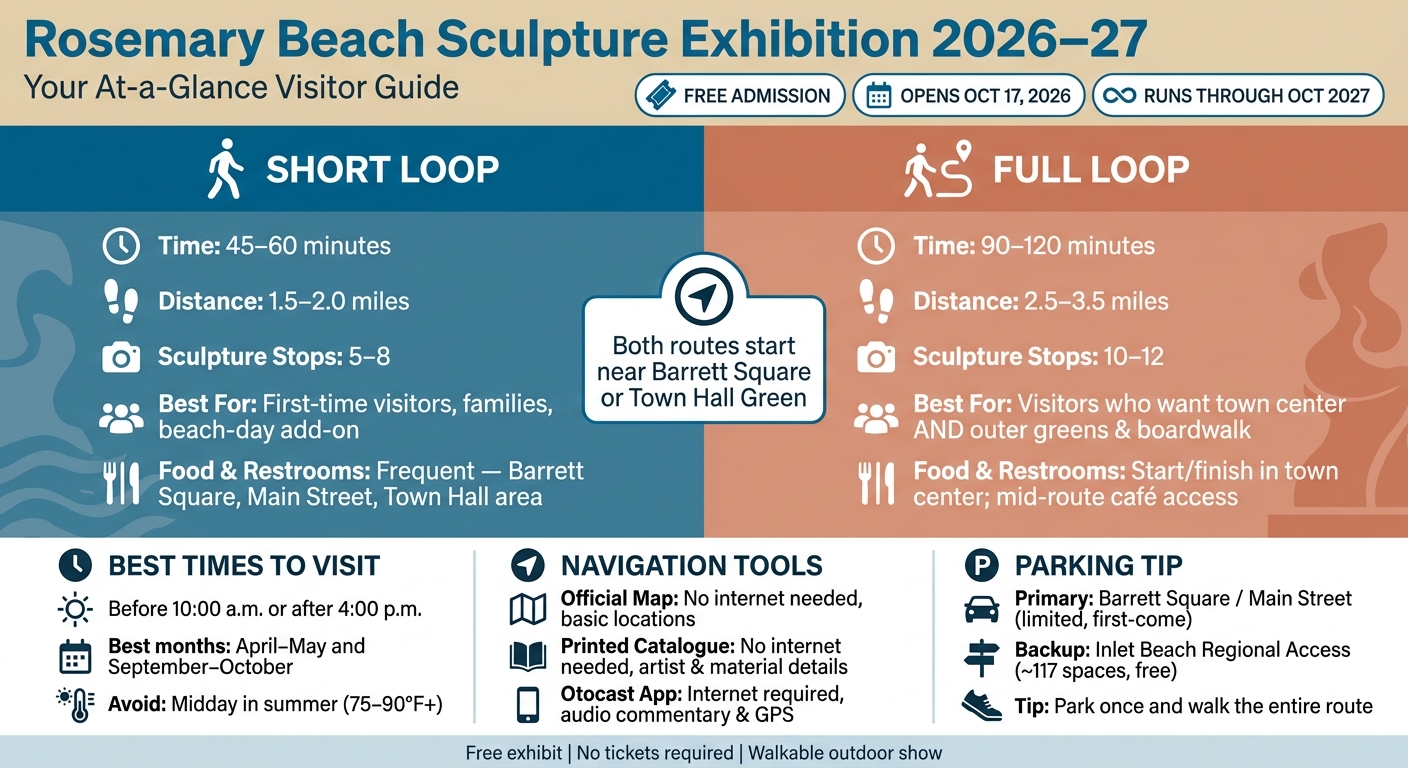
Rosemary Beach Sculpture Walk: Short Loop vs Full Loop at a Glance
Quick Comparison
| Option | Time | Distance | Stops | Best for |
|---|---|---|---|---|
| Short loop | 45–60 min. | 1.5–2.0 miles | 5–8 | First-time visitors, families, beach-day add-on |
| Full loop | 90–120 min. | 2.5–3.5 miles | 10–12 | People who want the town center and outer greens |
So if I were giving one piece of advice, it would be this: park once, start near Barrett Square, and walk it in the morning or late afternoon. That gives me the simplest way to see the show, use the map well, and fit food or a beach stop into the same outing.
sbb-itb-d06eda6
Where the Sculptures Are Located and How the Exhibit Is Laid Out
The 2026–27 exhibition stretches across town-center hubs, small parks and greens, and areas linked by the boardwalk. It’s meant to be seen on foot, with sculptures placed along a natural walk through town. Because the layout is spread out, a map matters - especially when you head into quieter spots like East and West Long Green Parks, St. Augustine Green, Butterfly Park, and Playground Park. Some works are right on busy corners. Others are tucked away in calmer greens.
Where to Start: Barrett Square, Town Hall Green, and Main Street
A good place to begin is North or South Barrett Square, Town Hall Green, or Main Street. These central spots give you a simple starting point, with shops, cafés, restrooms, and several sculpture locations all within a short walk. That makes it easier to get oriented before you wander into the quieter residential parts of the exhibit.
The Town Administration Building near the town center is one of the places where you can pick up the Exhibition Catalogue. From there, you can shape your visit into either a short loop or a longer walk through the greens.
How to Navigate the Exhibit on Your Own
Three tools do most of the work: the official map, the printed catalogue, and the Otocast app. The catalogue is available at local merchants around Barrett Square and Main Street, including The Hidden Lantern Bookstore. It lists numbered locations, artist names, titles, materials, and short descriptions.
The free Otocast app adds artist commentary and location guidance as you walk. It’s handy, but it works best when you have a data connection. If reception gets spotty or your battery starts to fade, the printed catalogue is a solid backup.
| Tool | Ease of Use | Level of Detail | Internet Required |
|---|---|---|---|
| Official exhibit map | Very easy | Basic - sculpture locations, landmarks, and street names | No |
| Printed catalogue | Easy | Moderate - artist info, titles, materials, and brief descriptions | No |
| Otocast app | Moderate | High - photos, audio commentary, and geo-location | Yes (data or Wi-Fi) |
Once you have the map and catalogue in hand, following the exhibit on foot feels pretty straightforward.
A Walking Route for Seeing the Exhibit
Now that the main sculpture areas are on the map, here are two easy ways to walk the exhibit. Bring the map and catalogue with you as you go. The grounds are easy to cover on foot, though the surface changes as you move between pavement, sand, and boardwalks.
Short Loop: 45 to 60 Minutes Around the Town Center
Start at South Barrett Square. It’s a handy starting point because you’re near coffee, restrooms, and several sculpture sites. From there, head across to Town Hall Green and the central lawn along Main Street, where a group of works sits close to the town center. Then continue along Main Street toward the West and East Greens, where the route opens up and the pace tends to slow a bit.
After that, pass through North Barrett Square and a nearby pocket park, like Playground Park or Kingston Park, before looping back on Town Hall Road or a nearby boardwalk path. Most casual walkers and families can do this route in 45–60 minutes, with about 5–8 sculpture stops along the way.
This loop is a good fit for mid-morning or late afternoon, when the weather is often easier to handle and a café break is never far away.
Full Loop: 90+ Minutes Through Greens and Boardwalk Areas
If you want to go beyond the center and see the quieter outer greens, take the longer route into the residential area. Start in the main display zone, then move out from there. After Town Hall Green, continue into East Long Green Park and West Long Green near the association office, where several 2026–27 exhibition works are installed.
From there, the boardwalk network threads between cottages, gardens, parks, and pools. That part of the walk gives you a clear sense of how the exhibit sits inside the neighborhood instead of feeling set off on its own. Plan for 10–12 stops and 2.5–3.5 miles total.
A few simple prep tips help here:
- Wear closed-toe shoes or sturdy sandals for the sandy stretches.
- Bring water.
- Use the town center as a natural halfway point if anyone in your group wants a break before heading into the residential greens.
| Route | Approx. distance | Estimated time | Likely sculpture stops | Food / restroom access |
|---|---|---|---|---|
| Short Loop | 1.5–2.0 miles | 45–60 minutes | 5–8 stops | Frequent - Barrett Square, Main Street, Town Hall area |
| Full Loop | 2.5–3.5 miles | 90–120 minutes | 10–12 stops | Start/finish in town center; mid-route return to cafés and restrooms |
Artists, Sculpture Styles, and What to Expect
As you walk the route, the biggest differences from one stop to the next usually come down to material, scale, and placement. The 2026–27 juried sculpture exhibition brings abstract, figurative, and conceptual work to Rosemary Beach's town center and greens. So as you move through the area, expect that mix to show up again and again.
The jury screens for artistic quality, durability, safety, and coastal outdoor performance. That affects what you see on the route. These pieces need to hold up in sun and salt air, and they also need to read well from a distance.
Materials and Styles You Are Likely to See
You'll likely see durable materials often used in outdoor sculpture, especially metal, bronze, stone, and mixed-media work. Abstract metal pieces tend to lean on form, line, reflection, and negative space. That means they can look different from morning to afternoon as the light shifts.
Figurative bronze works are usually easier to read at first glance. You can often tell what you're looking at right away, which is part of why they're often placed where visitors can get close. Mixed-media installations may combine metal, wood, stone, or fabricated elements. They also tend to interact more with a path, garden edge, or architectural feature instead of simply sitting alone in an open area.
How to Look at the Work Without an Art Background
You don't need an art history class to enjoy this exhibit. The best habit is simple: slow down and change your angle. Walk around the piece. Step back. Then get closer. Pay attention to scale, texture, shadow, and distance. Watch what happens in sun versus shade.
That small shift in how you look can change everything. A sculpture that seems plain from one side may feel more dramatic from another. An abstract piece might make more sense once you notice the gaps, the balance, or the way it frames the space around it.
Here are a few quick cues to help you spot what you're seeing from stop to stop:
| Sculpture type | Typical material | Scale | Where you're likely to find it in Rosemary Beach |
|---|---|---|---|
| Abstract metal | Steel, stainless steel | Medium to large | Open greens, town square, lawn areas with long sightlines |
| Figurative bronze | Bronze | Small to medium | Pocket parks, pedestrian paths, courtyards |
| Mixed-media installation | Metal, wood, stone, fabricated elements | Varies | Garden edges, landscaped areas, paths, or architectural features |
Open greens, courtyards, and paths also change the way each piece reads. A sculpture in an open green will feel different from one placed near a courtyard or along a pedestrian path, even if the style is similar. In other words, placement isn't just background detail. It's part of the work itself.
After the visual basics, parking and timing are the next practical pieces.
Parking, Food Stops, and the Best Times to Visit
Parking and Access
30A beach access points and parking near Barrett Square and Main Street are limited, and most spaces are first-come, first-served. On busy days, weekends, and holidays, those spots can fill up fast. Before you walk away from the car, check posted time limits, residential-only rules, and any other parking signs.
If parking in the town center is full, head to Inlet Beach Regional Access. It's just east of Rosemary Beach on 30A and is the best backup option. The site has free parking at the East, Central, and West access points, with about 117 spaces total, plus restrooms on-site. From there, you can walk or bike west into Rosemary Beach. Once you arrive, the route begins naturally at Barrett Square and stays easy to do on foot.
Coffee, Lunch, and Dinner Spots Near the Route
It helps to build one meal stop into the walk. The good news? The town center makes that simple.
For a morning visit, Charlie's Café on Barrett Square is an easy first stop for fresh-made donuts, espresso drinks, breakfast sandwiches, wraps, and sweet treats. Summer Kitchen Café on Main Street is another popular breakfast and brunch pick, and it fits neatly into the route.
If lunch is the plan, Cowgirl Kitchen on Main Street serves American fare in a casual setting. After the full loop, dinner options are easy too. Restaurant Paradis on Barrett Square is the town's fine dining spot, while Havana Beach Bar & Grill on Main Street serves coastal fare with Gulf views and rooftop seating.
A simple way to plan it:
- Do breakfast before the loop
- Or save dinner for after it
Best Times to Visit and Key Takeaways
Timing makes a big difference here. Midday heat can make the walk less comfortable, especially in summer. For the best visit, aim for April through May or September through October, when temperatures are milder and crowds are often lighter. In warmer months, mornings before about 10:00 a.m. and late afternoons after about 4:00 p.m. are usually the most comfortable times to go.
| Season | Typical Temperature Range (°F) | Crowd Level | Viewing Comfort |
|---|---|---|---|
| Spring (Apr–May) | 65–80°F | Moderate | Very good |
| Summer (Jun–Aug) | 75–90°F+ | High | Mixed |
| Fall (Sep–Oct) | 65–80°F | Moderate to low | Excellent |
| Winter (Nov–Feb) | 50–65°F | Low | Good if layered |
If you can, park once and do the route on foot. And if the town-center spaces are gone, Inlet Beach Regional Access is the backup to use.
FAQs
Is the exhibit stroller- and wheelchair-friendly?
Some spots can be tougher to get through. The Rosemary Beach sculpture exhibit winds through cobblestone streets and open green spaces, and the uneven ground in the town center can be harder to handle with strollers or wheelchairs.
Rosemary Beach was built to be walkable, but these routes aren’t as smooth as the dedicated accessible trails you’ll find in other parts of South Walton.
Can I see the best sculptures without doing the full walk?
Yes. The eight sculptures are marked 1 through 8 along a flat, paved path, so you can stop in whatever order you like and spend more time with the pieces that catch your eye.
The Otocast app can help you spot sculptures nearby and read artist insights, which makes it simple to plan a shorter visit and move at your own pace.
What should I bring for the sculpture walk?
Bring comfortable walking shoes, sunblock, a hat, sunglasses, and a reusable water bottle. If you're heading out in the morning or staying into the evening, a light jacket is a smart extra layer.
You may also want to bring your smartphone with the Otocast app for the self-guided audio tour. If you plan to take photos, pack a camera and a portable charger too.