South Walton Small Business Guide
Practical checklist for launching a small business in South Walton: town fit, zoning, seasonal cash flow, staffing, and local marketing.
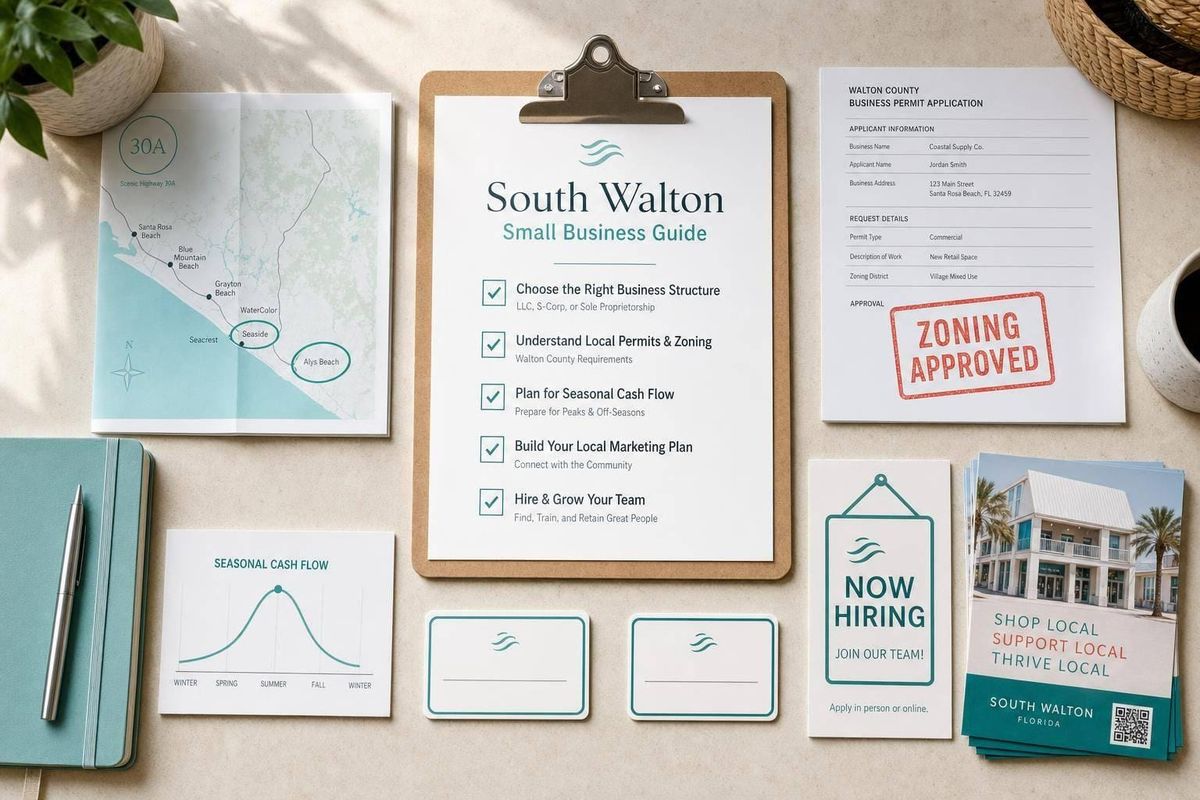
If I were starting a business in South Walton today, I’d focus on five things first: town fit, legal setup, seasonality, staffing, and local visibility. With 4.586 million visitors and $3.93 billion in direct spending in 2025, the area offers demand - but demand is uneven, and summer-heavy traffic can hide off-season risk.
Here’s the short version:
- Pick the right town. Seaside and Rosemary Beach lean visitor-heavy and walkable. Santa Rosa Beach has more year-round local demand. Grayton Beach tends to fit local-serving and repeat-visitor concepts. Inlet Beach is growing fast, but costs can climb fast too.
- Check zoning before signing anything. A space can look right and still not allow your business type.
- Handle state and county steps separately. Forming a Florida LLC costs $125. The annual report is $138.75 if filed on time. You may also need a DBA, EIN, county approvals, and industry licenses.
- Plan by month, not by year. Summer 2025 had 1,928,600 visitors and 69.1% occupancy. Winter dropped to 494,400 visitors and 31.9% occupancy.
- Keep cash set aside. I’d plan for 3 to 6 months of fixed costs before slow season.
- Hire early for peak months. Start recruiting 8 to 12 weeks before demand spikes.
- Show up where people search. Google, Visit South Walton, and sowal.co are key discovery channels.
A few details can swing the whole plan: parking, flood risk, insurance cost, hurricane prep, commute time, and whether locals can support you outside tourist months. That’s why a “good idea” alone is not enough here.
Quick comparison
| Area | Best fit | Traffic pattern | Off-season support | Cost pressure |
|---|---|---|---|---|
| Seaside | Walk-in retail, coffee, dessert | High foot traffic | Lower | High |
| Grayton Beach | Galleries, bars, local-favorite spots | Moderate | Medium | Medium |
| Santa Rosa Beach | Services, wellness, repeat local spend | More spread out | Higher | Medium to lower |
| Rosemary Beach | Upscale walk-in concepts | High foot traffic | Lower | High |
| Inlet Beach | Growth-focused concepts | Rising | Medium | Rising |
sbb-itb-d06eda6
What I’d keep top of mind
- Town fit beats name value
- Zoning check comes before lease signing
- Cash flow matters more than yearly revenue
- Insurance and storm risk can change the math
- Local listings help people find you faster
If you want to launch in South Walton, this guide points to the simple path: match the concept to the town, clear the legal steps, budget for season swings, build your local vendor and hiring base, and get listed where visitors and locals already look.
1. Pick the Right South Walton Town for Your Business
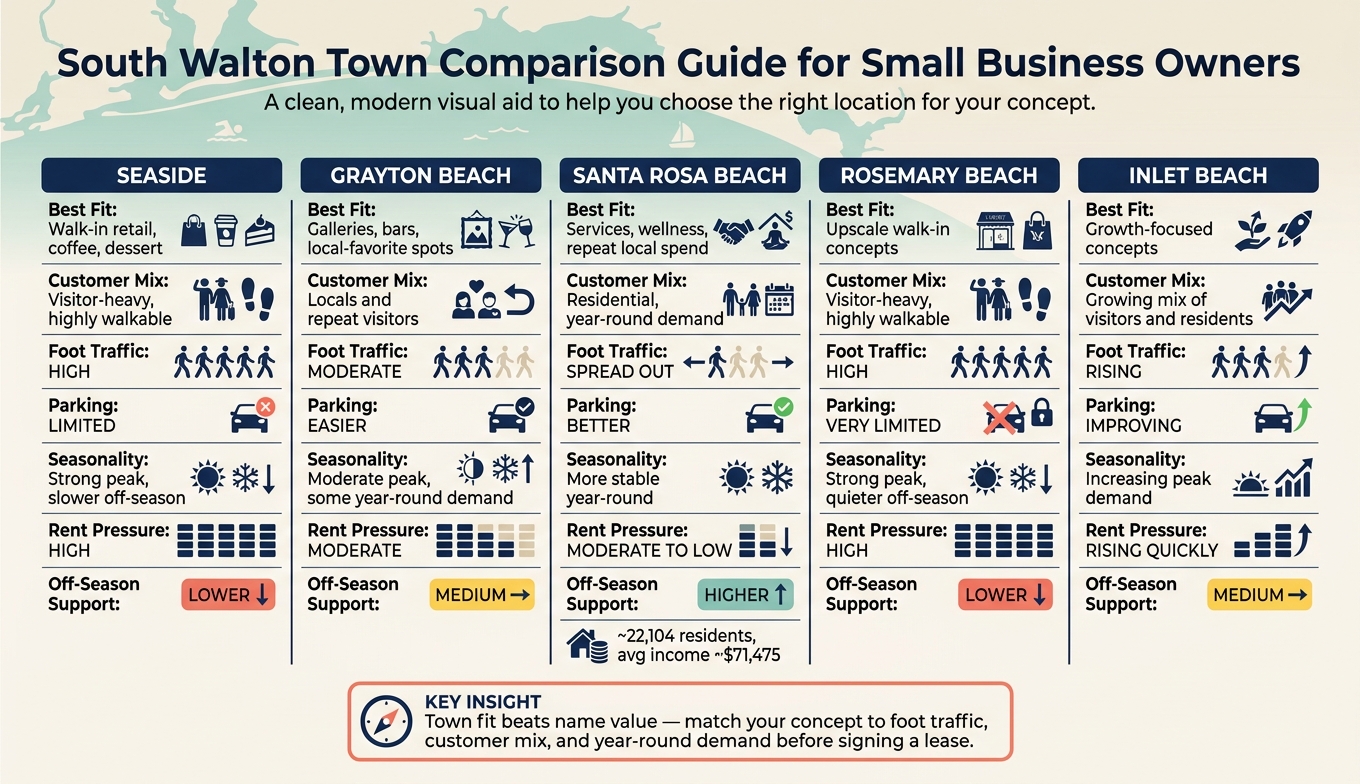
South Walton Town Comparison Guide for Small Business Owners
South Walton's beach towns are NOT all the same. Pick the wrong one, and you can get hit with higher rent, tougher hiring, parking headaches, and more rules before you even open the doors.
The smart move is simple: match your business model to the area's customer mix, traffic pattern, and cost structure before you sign a lease.
Compare Seaside, Grayton Beach, Santa Rosa Beach, Rosemary Beach, and Inlet Beach
Each town attracts a different crowd. And that changes a lot more than people think. It affects pricing, store hours, staffing, parking, and how much rent pressure you can handle.
| Town | Customer Mix | Foot Traffic | Parking | Seasonality | Rent Pressure |
|---|---|---|---|---|---|
| Seaside | Visitor-heavy, highly walkable | High | Limited | Strong peak, slower off-season | High |
| Grayton Beach | Locals and repeat visitors | Moderate | Easier | Moderate peak, some year-round demand | Moderate |
| Santa Rosa Beach | More residential, year-round demand | Spread out | Better | More stable year-round | Moderate to low |
| Rosemary Beach | Visitor-heavy, highly walkable | High | Very limited | Strong peak, quieter off-season | High |
| Inlet Beach | Growing mix of visitors and residents | Rising | Improving | Increasing peak demand | Rising quickly |
That table gives you the fast version. Here's what it means on the ground.
Walkable, visitor-heavy towns tend to work best for businesses that rely on people strolling by and making quick buying decisions. Think coffee shops, dessert spots, impulse retail, or high-end convenience. Seaside and Rosemary Beach fit that pattern well.
Grayton Beach leans more toward locals and repeat visitors. That makes it a good fit for galleries, offbeat restaurants, and bars that win people over with personality instead of polish.
Santa Rosa Beach is a different animal. It fits service, wellness, and everyday-needs businesses that depend on repeat local spending. The area has about 22,104 residents, with average individual income around $71,475. That's the kind of base that can support businesses outside peak visitor months.
Inlet Beach is moving fast. More growth usually means more demand, but it also means rent pressure can climb in a hurry.
Check Demand, Gaps, and Nearby Business Clusters
Before you commit to a concept or location, spend time in the area during peak hours and map out what's already there by category. Don't just look at direct rivals. Look for what's missing.
A street packed with coffee shops may not need another coffee shop. But it might have room for dessert, grab-and-go breakfast, kids' retail, or a service business that benefits from nearby traffic. Count what's present, then focus on what's absent.
Local listings can save you time here. sowal.co tracks South Walton dining, shopping, and neighborhood patterns across 30A communities. It's a useful way to see where categories are crowded and where nearby businesses may help each other instead of competing for the same attention.
A lot of winning concepts on 30A don't stay boxed into one town. They spread across the market. Black Bear Bread Co. and Ophelia Swimwear, for example, both operate in multiple 30A communities, including Grayton Beach, Seaside, Seacrest, and Inlet Beach. That's a strong clue about how proven businesses grow in this area.
Factor In Lifestyle, Commute, and Year-Round Operations
Location doesn't just shape sales. It shapes your day-to-day life and your staffing plan too.
If you're running the business yourself, your commute matters more than it may seem. Summer traffic can turn a short drive into a slog. So test the route at the exact time you'd be opening or managing shift changes, not on a quiet weekday when the roads feel easy.
You also need to plan for the sharp swing from winter to spring. Traffic, staffing needs, and inventory levels can change fast. Businesses with flexible labor, adjustable inventory, and lower fixed overhead usually handle that better than businesses stuck with high rent and full-time payroll all year.
Storm planning matters too. One site can be much easier to manage than another, even in the same town. Storm-surge risk, evacuation delays, and utility outages can vary block by block. Before you commit, find out:
- What insurance is likely to cost
- Whether inventory and equipment can be protected
- How fast the business could reopen after a storm
Once you've narrowed down the town and the site, the next step is to check Florida registration, EIN rules, and Walton County zoning before moving ahead.
2. Register Your Business and Meet Local Compliance Requirements
Once you've chosen your South Walton town and narrowed down a site, the next step is formation and local approval. These do not move through one system. State filing and county permitting happen on separate tracks.
Register with Florida and Get an EIN
Start with the Florida Division of Corporations (Sunbiz) at sunbiz.org. Many owners choose an LLC because it's a common fit for small businesses.
In Florida, LLC formation costs $125. You'll also need to file an annual report that costs $138.75 and is due by May 1. Miss that deadline, and the fee jumps to $538.75.
Every LLC and corporation must name a Florida registered agent. That agent needs a Florida street address and must be available during business hours. If you won't be onsite during the day, a commercial registered agent service often makes sense.
If you plan to operate under a brand name instead of your legal entity name, you'll need to file a fictitious name, also called a DBA, with the state. Florida also requires you to publish that name once in a local newspaper in the county where your main business location is.
After your entity is formed, apply for an EIN (Employer Identification Number) through the IRS at irs.gov. It's free and is often issued right away online. You'll need it for core tasks like opening a business bank account, running payroll, and filing taxes.
Confirm Walton County Permits, Zoning, and Industry Rules
In South Walton, zoning can make or break a deal. Florida does not have one statewide business license, so local zoning, tax receipts, and inspections are handled apart from state formation.
Before you sign a lease anywhere along 30A, confirm that your intended use is allowed under Walton County's Land Development Code. The county uses zoning categories such as General Commercial (GC), Neighborhood Commercial, and resort-oriented districts. Each one has its own rules about which business types can operate there.
That matters more than many first-time owners expect. A spot may look perfect for a café, but the zoning may still limit food service. It's a lot easier to check first than to fix a bad lease later.
Some industries face extra layers of approval. Restaurants and lodging businesses often need licenses from the Florida Department of Business and Professional Regulation (DBPR), Division of Hotels and Restaurants. They may also need health department inspections, plus food-safety and fire-safety compliance on an ongoing basis.
Tour operators that use beaches or waterways may need local commercial-use permits.
Vacation rentals have one of the more stacked rule sets. If you rent out a unit more than three times per year for stays under 30 days, Florida treats it as a vacation rental and requires a DBPR license. Walton County also requires an annual Short-Term Rental Certificate and registration to collect the Tourist Development Tax (TDT). In South Walton's south-end tourist district, that tax is 5% on short-term lodging.
State vs. Local Requirements Checklist
| Level | Step | Notes |
|---|---|---|
| State | Choose entity type (LLC, corporation, sole proprietorship, partnership) | LLC is a popular choice for small businesses |
| State | File with Sunbiz (Articles of Organization or Incorporation) | $125 for LLC formation; annual report is $138.75 if filed on time |
| State | Appoint a Florida registered agent | Required for LLCs and corporations |
| State | Register a fictitious name/DBA if needed | Required if operating under a trade name |
| State | Apply for EIN from the IRS | Free; apply online at irs.gov |
| County/Town | Verify zoning for your location | Confirm the use is allowed before signing a lease |
| County/Town | Apply for Walton County business tax receipt or local business registration, if required | May be required depending on your business type |
| County/Town | Schedule required inspections (fire, building, etc.) | Applies to public-facing spaces |
| Industry | DBPR license (food service, lodging, vacation rentals) | Required for regulated sectors such as restaurants, lodging, and vacation rentals |
| Industry | Short-Term Rental Certificate (vacation rentals) | Annual Walton County requirement |
| Industry | Register for Tourist Development Tax (TDT) | 5% in South Walton's south-end tourist district |
| Industry | State professional license (real estate, accounting, etc.) | Governed by the relevant state board |
A simple way to handle this is to start with the state items, then move to county and industry steps. The order matters. Some local approvals, including zoning sign-off, may need to happen before you can secure certain DBPR licenses.
Once you've mapped out the state, county, and industry approvals, build your budget and cash flow around South Walton's seasonal cycles.
3. Build a Business Plan for a Seasonal Coastal Market
Once zoning and licensing are done, it's time to build your plan around South Walton's seasonal demand.
This is not the kind of market where an annual estimate tells you much. In South Walton, businesses often live or die by monthly cash flow. So plan by month, not by year. Walton County tourism data shows just how sharp the swings can be: Summer 2025 brought 1,928,600 visitors with 69.1% occupancy, while Winter 2025 fell to 494,400 visitors with 31.9% occupancy.
Estimate Startup Costs and Monthly Overhead in South Walton
A simple way to build your budget is to split it into two buckets: one-time startup costs and monthly overhead.
One-time costs usually include deposits, build-out, furniture, inventory, permits, pre-opening payroll, and launch marketing. Monthly overhead covers rent, payroll, utilities, insurance, software, and replenishment. In a coastal market, you should also add line items for storm contingencies and salt-air maintenance. If you skip those, the budget can look fine on paper and still fall apart in practice.
One cost that new owners often miss is insurance. One Florida estimate puts general liability for a small business with 2–5 employees at about $53–$91 per month, and a business owner's policy (BOP) at about $97–$168 per month. But those numbers are just a starting point. Coastal exposure can push premiums much higher than what you'd pay in an inland Florida town.
Get quotes early. Insurance can change your break-even point fast.
Plan Cash Flow Across Peak, Shoulder, and Off-Season Months
Model each month on its own across peak, shoulder, and off-season periods.
For every month, assign expected sales, staffing levels, inventory purchases, rent, payroll taxes, insurance, and marketing spend. Then look for the months where cash turns negative. That's the part many owners learn the hard way: a visitor-based business may make most of its money in a short peak window, but fixed costs keep showing up all year.
Hold 3–6 months of fixed expenses in reserve before slow season. Treat that as a launch requirement, not a “maybe later” item.
It also helps to run two forecasts at the same time:
- A 13-week rolling cash forecast updated weekly
- A 12-month forecast updated monthly
Used together, these forecasts can flag staffing and inventory gaps before they turn into a scramble. And timing matters. Buy inventory and schedule hiring before peak season starts, not when demand is already at your door.
Compare Business Models by Cost, Complexity, and Seasonality Risk
| Business Model | Setup Cost | Regulatory Complexity | Staffing Needs | Seasonality | Growth Potential |
|---|---|---|---|---|---|
| Retail shop | Medium to high | Medium | Medium | High | Medium |
| Café / restaurant | High | High | High | High | Medium |
| Service business | Low to medium | Medium | Low to medium | Lower if local-client based | High |
| Tour operator | Medium | High | Seasonal / variable | Very high | Medium |
| Property services business | Medium | Medium to high | Medium | Moderate to high | High |
Some models handle seasonality better than others.
Service businesses and property services often have an easier time because they can adjust staffing and expenses with less friction. Cafés and retail shops can do well in peak months, but they usually carry higher fixed costs and need tighter planning around labor and inventory to make it through the off-season. Tour operators can post strong summer margins, but they're also more exposed to weather swings and sudden drops in visitor volume.
With the budget in place, the next move is getting vendors, staffing, and local support lined up before peak season.
4. Find Suppliers, Hire Staff, and Build a Local Network
Next, build three parts of the business: your vendor list, your team, and your local relationships. Your peak, shoulder, and off-season calendar should guide when you place orders and when you hire.
Find Local Vendors, Contractors, and Service Providers
In a coastal market like South Walton, local know-how goes a long way. You want vendors and contractors who already know how to deal with humidity, salt corrosion, seasonal rushes, and hurricane prep.
A good place to start is the sowal.co business directory, which includes local food, retail, home, and professional providers. You can also check the Walton Area Chamber business directory for vetted providers. Then take it a step further and meet people at Chamber networking events. That gives you a chance to ask other owners a simple but useful question: Who actually shows up and responds when things get hectic?
Once you have a short list of vendors, shift your focus to staffing before peak season begins.
Hire for Seasonal Demand and Florida Compliance
Start recruiting 8–12 weeks before peak season. First, decide which roles need to be filled year-round and which ones are seasonal. Then write job descriptions that spell out hours, schedule expectations, and how long the seasonal role will last. Small details can help, too. Mention perks like meals, parking help, or beach proximity so applicants can tell early on whether the job fits what they want.
On the compliance side, Florida businesses need to take care of payroll tax registration, eligibility checks, new-hire reporting, and workers' compensation. The Florida SBDC at UWF offers no-cost, confidential consulting and holds office hours one day a week at the Walton Area Chamber office in Walton County. If you'd rather hand off HR and payroll, Emerald Coast Workforce Solutions offers staffing, HR, payroll, and time tracking for businesses in South Walton and Walton County.
After that, local workforce groups and business support organizations can help you fill hiring gaps without scrambling at the last minute.
Local Support Organizations and Hiring Channels
Use the table below as a quick source list.
| Category | Organization | What It Offers |
|---|---|---|
| Supplier directories | sowal.co Business Directory | Local vendor listings across food, retail, home services, and professional categories |
| Supplier directories | Walton Area Chamber Business Directory | Use the Chamber directory to vet vendors |
| Networking groups | Walton Area Chamber of Commerce | Networking events, educational programs, workshops, and member promotions |
| Staffing sources | CareerSource Okaloosa/Walton | Job postings, wage reimbursements, customized apprenticeships, and employee training grants |
| Staffing sources | Emerald Coast Workforce Solutions | Full-service staffing, HR, payroll, and time tracking for South Walton and Walton County |
| Advisory support | Florida SBDC at UWF | No-cost, confidential help with start-up, hiring, and compliance; weekly Walton County office hours |
Once your vendors and staff are set, the next step is getting in front of customers through South Walton channels. From there, those local ties start turning into customer reach.
5. Promote Your Business Through South Walton and 30A Channels
Once your vendors and staff are in place, the next job is getting found. South Walton's summer visitation tops 1.9 million visitors, and those people need a way to find your business before they ever step inside. The smart move is simple: show up where they already look, then build local visibility around those places.
Show Up Where Visitors and Locals Already Look
People planning a trip tend to use a pretty short list of sources. About 60% use Google, 24% go to VisitSouthWalton.com, and 23% check Visit South Walton's social media. That gives you a clear starting point.
Start with a free listing on VisitSouthWalton.com. If your business serves visitors in Walton County, you can qualify. Just make sure your details stay accurate and up to date. After that, check the Visit South Walton Cooperative Partner Program, which offers print and digital placements in official tourism marketing starting at about $600 per placement.
For local reach, sowal.co is worth using too. You can use it for listings, event submissions, featured content, newsletter sponsorships, and ads.
Use Digital Marketing That Fits a Coastal Audience
Your Google Business Profile (GBP) is one of the top local SEO moves you can make. Claim it, verify it, and complete every field: business name, category, hours, phone number, website, and attributes like outdoor seating, kid-friendly, or pet-friendly. In your description, include South Walton, 30A, and your town name, because that's how many people search.
Photos do a lot of heavy lifting here. Businesses that update photos often get about 35% more clicks from Google search. Try to have at least 20 high-quality images that show your exterior, interior, products, and nearby landmarks. Update them by season so your profile doesn't look stale.
Reviews matter too. Ask happy customers to mention the town and what they liked about their visit. Over time, that can help local search visibility.
On social media, Instagram and Facebook work especially well for South Walton discovery. Short videos, Reels, and photo carousels are a good fit for showing your space, daily specials, and behind-the-scenes moments. Tag your location in every post and use location-based hashtags.
Your content should shift with the season:
- During peak season, post reservation prompts and last-minute availability.
- During the off-season, lean into community stories and locals-only offers so year-round residents still see you.
Compare Local Marketing Channels by Reach and Cost
| Channel | Primary Audience | Cost Level | Best Use Case | Ideal Timing |
|---|---|---|---|---|
| Google Business Profile | Visitors + locals searching nearby | Free (time investment) | Drive calls, directions, walk-ins | Year-round; update seasonally |
| VisitSouthWalton.com listing | Visitors planning trips | Free (if qualified) | Destination-level discovery | Year-round |
| Visit South Walton Co-op Program | Visitors via official tourism media | About $600+ per placement | Amplify reach via destination campaigns | Peak + shoulder seasons |
| sowal.co listings, events, and content | Visitors + potential residents | Free and paid options | Lifestyle discovery, dining, events, relocation | Year-round |
| Instagram/Facebook (organic) | Visitors + locals | Free (time investment) | Visual discovery, reservations, community engagement | Peak-heavy; consistent year-round |
| Google Ads (paid search) | Visitors with active intent | $10–$30+ per day per campaign | Drive bookings, calls, reservations | Peak + shoulder seasons |
| Geo-targeted social ads | Visitors currently in area + locals | Moderate | Promote daily specials, events, walk-ins | Peak season + holiday weekends |
| Email marketing | Past visitors + local subscribers | Low | Repeat visits, off-season retention, loyalty | Shoulder + off-season |
Start with the free options first: Google Business Profile and a VisitSouthWalton.com listing. Once you can track calls, bookings, or walk-ins, add paid channels. Put more time and money into the ones that bring results, then keep building from there.
Conclusion: A Simple Roadmap for Launching in South Walton
Starting a business in South Walton comes down to five clear steps: pick the right town, sort out licenses and permits, plan for seasonal swings, line up suppliers and staff, and show up where people already search.
As the town choice section makes clear, fit matters more than name recognition. A well-known area isn't always the right one. Your concept needs to match the town's foot traffic, customer mix, and year-round demand. It's smart to walk the area at different times of day and on different days of the week, then look for demand gaps before signing a lease.
Once you've found a site that fits, move fast on filings and permit checks. Register your entity with the State of Florida, get your EIN, and check Walton County zoning and permit rules before you sign a lease or start any build-out. That step can save you from expensive mistakes later.
Because South Walton runs on tourism, seasonality has to be part of the plan from day one. Build a 12-month cash plan that shows when revenue should be strong and when it may thin out. Then set aside cash during peak months to help cover slower periods. It's also worth stress-testing your budget against rent, utilities, insurance, and base payroll. A business can look good on paper in July and feel very different in January.
With vendors and staff lined up, the last piece is visibility. Reliable suppliers, seasonal staffing systems, and a presence on the channels visitors and locals already use - such as Google Business Profile, Visit South Walton listings, and a local guide like sowal.co - can help your business stay visible after launch. South Walton tends to reward businesses that match the market, stay compliant, plan for seasonality, and keep showing up.
FAQs
How do I choose the best South Walton town for my business?
Start with the Walton County Interactive Map. Use it to check the zoning district and sector classification for each site you're considering.
Then look a little deeper. Make sure the property isn't inside an overlay district, such as the Route 30A Scenic Corridor. That one detail can change what you're allowed to build and how the site needs to be planned.
It also helps to use the county's Planner on Call service before you pick a location. They can help clear up local rules, setback requirements, and site limits tied to environmental protections.
What should I check before signing a lease in South Walton?
Before you sign a lease in South Walton, make sure your planned use lines up with three rules:
- County zoning
- Short-term rental rules
- Private community restrictions
Start with the Walton County GIS map. Use it to check the zoning for the property and see whether it sits in any overlay district, like the Route 30A Scenic Corridor.
Then read the HOA or condo documents. Those rules can limit what you can do with the property, even if the county allows it.
You’ll also want to confirm occupancy limits and parking requirements. That sounds small, but it can become a headache fast if your plan doesn’t match the rules on paper.
How much cash should I keep for the off-season?
Set aside enough cash to cover fixed yearly costs and help you avoid compliance penalties during the off-season.
At a minimum, plan for the annual Short-Term Vacation Rental Certificate fee:
- $300 for each individual property
- $227 for a property in a registered community
It also makes sense to keep a cash buffer in place so you don’t get hit with the $500-per-day fine for non-compliance or a lapsed tax registration.