South Walton Transit Plan Overview
A 'Park Once' transit overhaul aims to cut CR 30A gridlock with parking hubs, trams, multi-use paths and paid parking to improve beach access.
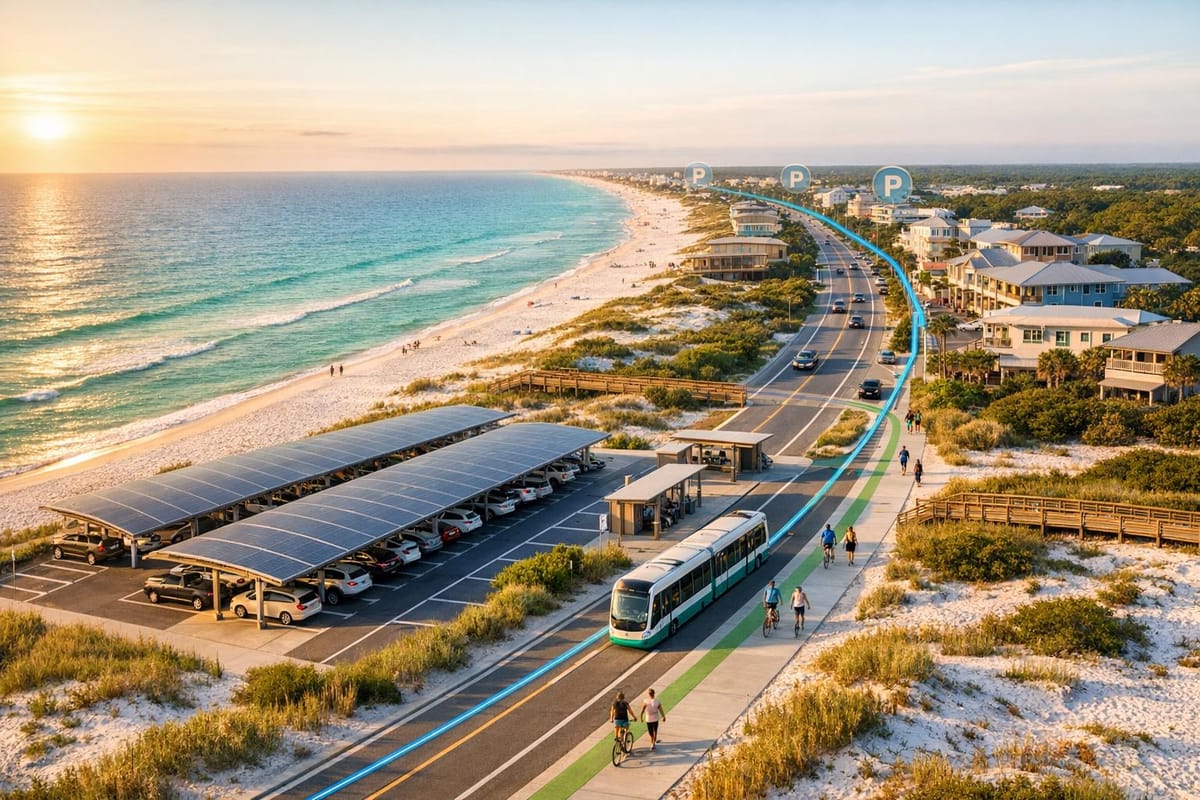
South Walton's new transit plan tackles growing traffic and parking issues along CR 30A and Scenic Gulf Drive. With a "Park Once" strategy, the focus is on reducing car dependency by introducing transit hubs, shuttles, and improved pathways for walking and biking. Key projects include:
- Beach Tram Service: Shuttle connecting inland parking to beach access points.
- 393 Transit Hub: Opened Dec 2025, offering parking, bike racks, and a transit building.
- Grayton Beach Transit Circulator: Launched 2025, linking major destinations with free trams.
- CR 30A Multi-Use Path: Reconstruction for safer pedestrian and cyclist use.
Funded by a 5% bed tax, these initiatives aim to ease congestion and improve mobility for residents and visitors alike. You can even generate a custom itinerary to plan your transit-friendly trip. Paid parking and expanded transit options are set to roll out in 2026, ensuring a smoother travel experience.
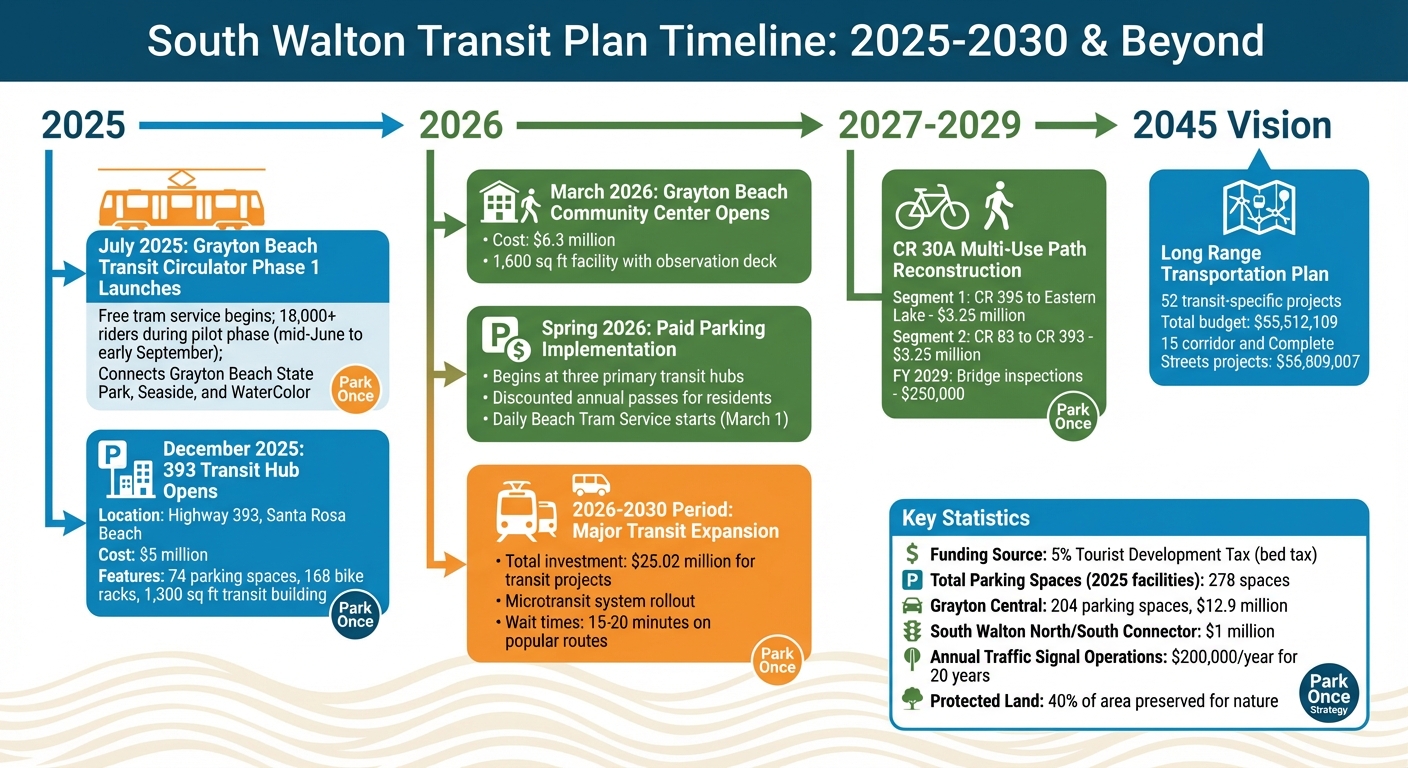
South Walton Transit Plan Timeline and Key Projects 2025-2030
Current Transit Projects in South Walton
South Walton is making strides in reshaping its transit network with a focus on convenience and sustainability. These projects aim to provide practical alternatives to driving, tackling parking and traffic congestion while enhancing access to the area's stunning beaches.
Walton County Beach Tram Service
The Beach Tram Service is a shuttle system that uses covered beach trucks to transport passengers between inland parking lots and beach access points. One of its main routes connects the Grayton Beach Municipal Parking Facility to the Grayton Community Center and Restroom Facility, creating a seamless link between parking and the shoreline. By reducing the number of cars on busy roads, this service not only eases congestion but also improves the overall beach-going experience. The plan includes expanding the network with well-placed transit hubs to improve accessibility further.
393 Municipal Parking Facility and Transit Building
Situated on Highway 393, just north of the Ed Walline Regional Beach Access in Santa Rosa Beach, this $5 million facility opened in December 2025. It plays a vital role in the county's transit system, offering 74 parking spaces, racks for 168 bikes, and spots for low-speed vehicles and golf carts. The 1,300-square-foot transit building features an air-conditioned waiting area, public restrooms, and even a small art gallery showcasing Walton County's Artists of the Year.
Designed with flexibility in mind, the facility can accommodate a second-level parking deck if future demand requires it. County Administrator Brian Kellenberger highlighted its importance:
This is what we call a sub-hub. It supplements beach parking, but it's also a key piece in a bigger public transportation network that we're continuing to build.
Starting in spring 2026, the facility will implement paid parking, with discounted annual passes available for local residents. These hubs, along with regional beach access points and parking amenities, are part of a broader effort to integrate transit with recreational spaces.
Seagrove Regional Beach Access (RBA)
The Seagrove Regional Beach Access, located at 3910 E. County Highway 30A, provides a handicap-accessible dune walkover and ADA-compliant parking spots, ensuring that everyone can enjoy the beach. Its direct connection to the regional multi-use path makes it easy for pedestrians and cyclists to reach the beach without relying on cars. This aligns with the larger goal of reducing vehicle dependency along the coastline, making the area more pedestrian-friendly and accessible.
Infrastructure Improvements Supporting the Transit Plan
South Walton's transit plan isn't just about shuttles and parking lots. It's a broader effort to rethink how people move around, emphasizing walking, biking, and using low-speed vehicles instead of relying entirely on cars. These upgrades align with the "Park Once" idea, encouraging visitors and residents to explore the area without constantly getting back into their cars.
CR 30A Multi-Use Path Reconstruction
The multi-use path along CR 30A is undergoing significant reconstruction to improve safety and durability for pedestrians and cyclists. Two key segments are being rebuilt: CR 395 to Eastern Lake (Somerset Bridge area) and CR 83 to CR 393, with each section receiving $3,250,000 in funding. This work is scheduled between fiscal years 2027 and 2029, with an additional $250,000 allocated in FY 2029 for bridge inspections along the trail. These improvements are designed to handle high user traffic while maintaining structural integrity. The upgraded path connects seamlessly to transit hubs like the 393 Municipal Parking Facility, reinforcing the "Park Once" concept by making it easier for people to explore the area on foot or by bike. These changes also pave the way for future dedicated transit lanes.
Low-Speed Vehicle (LSV) Lane on CR 30A
Dedicated lanes and pull-off areas are being added for low-speed vehicles (LSVs) and transit to reduce congestion caused by vehicles stopping in travel lanes. By giving LSVs their own space, these changes aim to ease traffic flow while promoting eco-friendly travel options. This initiative is part of the 2045 Long Range Transportation Plan, which outlines 52 transit-specific projects with a combined budget of $55,512,109 across the Okaloosa-Walton region. Along with the LSV lanes, broader roadway upgrades are also in place to support the shift toward multimodal transportation.
Roadway Improvements Along CR 30A
Roadway improvements are also being prioritized to enhance safety and efficiency. A notable project is the South Walton North/South Connector, a $1,000,000 locally funded initiative that links CR 30A to US 98, improving access and alleviating coastal traffic bottlenecks. Additionally, Walton County has committed $200,000 annually for 20 years to operate a traffic signal system, ensuring smoother traffic flow at critical intersections. These efforts reflect the "Complete Streets" philosophy, which aims to transform CR 30A into a balanced corridor that serves drivers, cyclists, and pedestrians alike. The 2045 LRTP also highlights 15 corridor and Complete Streets projects, with a total cost of $56,609,007, all focused on creating a safer and more accessible transportation network.
Future Transit Developments (2026-2030)
South Walton is set to expand its transit network significantly from 2026 to 2030, with $25.02 million earmarked for transit projects during this period. These initiatives will build upon the "Park Once" strategy, focusing on reducing car dependency by enhancing transit hubs and introducing more flexible transportation options. A prime example of this effort is the phased rollout of the Grayton Beach Transit Circulator.
Grayton Beach Transit Circulator Phase 1
The Grayton Beach Transit Circulator began operations in July 2025, coinciding with the opening of Grayton Central, a $12.9 million municipal parking facility. This facility offers 204 parking spaces and includes a 1,700-square-foot transit building. During its pilot phase, which ran from mid-June to early September, the free tram service transported over 18,000 riders, demonstrating strong community interest. District Five County Commissioner Tony Anderson called the facility "the future of South Walton" at its inauguration.
The circulator connects key destinations such as Grayton Beach State Park, Seaside, and WaterColor, aligning with the "Park Once" philosophy by encouraging visitors to park at the edge of the community. To further enhance this connection, a $6.3 million community center and restroom facility is under construction near the beach access point.
Microtransit Plan Implementation
Walton County's microtransit system employs a hub-and-spoke design, with Grayton Central as the main hub and facilities like the 393 Transit Hub, which opened in December 2025, operating as sub-hubs. Starting in Spring 2026, the county plans to introduce paid parking at three primary transit hubs, offering discounted annual passes for local residents.
This system is designed to accommodate multiple modes of transportation, including standard parking, ADA-accessible spaces, bike racks, and low-speed vehicle parking. Pilot programs have tested vehicles with capacities ranging from 14 to 20 passengers, with estimated wait times of 15 to 20 minutes along popular routes like 30A and Scenic Gulf Drive.
Priority Projects from the Walton County Plan
In addition to these transit developments, the 2045 Long Range Transportation Plan outlines several priority projects aimed at improving regional connectivity. For fiscal years 2026–2030, the plan allocates $82 million for non-Strategic Intermodal System capacity projects and $56.77 million for Strategic Intermodal System initiatives.
One standout project is the South Walton North/South Connector, a $1 million effort designed to link CR 30A with US 98, alleviating traffic congestion along the coast. Walton County has also committed $200,000 annually to maintain and operate traffic signal systems. Sustainability is a key consideration in this plan, with 15% of project ranking criteria dedicated to environmental impact.
How the Transit Plan Affects Sustainability and Community Growth
Supporting Eco-Friendly Transportation
The transit plan is designed to reduce car traffic along 30A, helping to preserve South Walton's natural charm. By introducing a centralized parking system, it minimizes the number of vehicles circling for parking spots, which in turn lowers carbon emissions. This is especially important in an area where 40% of the land is set aside for nature, including state parks, forests, and the unique coastal dune lakes.
A key part of this initiative is the $5 million 393 Transit Hub, which opened in December 2025. This hub includes 74 parking spaces, with dedicated spots for bicycles and low-speed vehicles (LSVs), and links directly to the top bike trails and multi-use path system. Starting March 1, 2026, a daily beach tram service will provide a car-free way to reach popular beach access points, making it easier for locals and visitors to get around without relying on personal vehicles.
By centralizing parking and connecting key destinations through transit, we can improve quality of life for everyone - from lifelong locals to first-time visitors. - Brian Kellenberger, Walton County Administrator
These measures not only protect the environment but also create better experiences for the community.
Improving Quality of Life for Residents and Visitors
The transit plan offers more than just environmental perks - it also enhances daily life for both residents and visitors. Services like GoWal and seasonal beach trolleys provide free transportation, eliminating travel costs for riders. With wait times for these trolley-style vehicles expected to range between 15 and 20 minutes during peak hours, the system is designed to be both efficient and convenient for regular use.
Transit hubs are envisioned as more than parking facilities - they're community spaces. For instance, the 393 Transit Hub includes a 1,300-square-foot building with public restrooms, dog-walking areas, and small art galleries that highlight local artists' work. Similarly, the upcoming Grayton Beach Community Center, set to open in March 2026, will feature a 1,600-square-foot facility with an observation deck and boardwalk access to the beach. These additions aim to strengthen the sense of community while supporting sustainable growth.
Conclusion
Key Takeaways
South Walton's transit plan marks a notable step toward reshaping the region's transportation and managing its growth effectively. Two key projects - the 393 Transit Hub, set for completion in December 2025, and the Grayton Beach Municipal Parking Facility, expected by May 2025 - will provide 278 parking spaces. These facilities will serve as the backbone for upcoming services like the Beach Tram, laying the groundwork for a phased approach to reducing traffic and improving mobility options.
The plan's "park once" philosophy directly tackles one of South Walton's biggest issues: traffic congestion along CR 30A. By concentrating parking and introducing free shuttle services, the initiative aims to cut down on the number of vehicles circling for parking spots, all while preserving the area's scenic charm. Early pilot programs have shown strong community approval, signaling a positive reception to these changes.
Funding for these projects comes from a 5% Tourist Development Tax, and starting in Spring 2026, paid parking - offering discounted annual passes - will help maintain accessibility and support the system financially.
Looking further ahead, the transit strategy positions South Walton for long-term growth through 2030 and beyond. Plans include projects like the Grayton Beach Transit Circulator and the introduction of microtransit services to widen coverage. Meanwhile, infrastructure improvements such as low-speed vehicle (LSV) lanes and multi-use paths will promote a variety of transportation choices. The Okaloosa-Walton TPO's 2050 Long Range Transportation Plan, set for adoption in 2026, outlines 52 transit projects with a combined investment exceeding $55 million. Together, these initiatives reflect South Walton's dedication to eco-conscious development and streamlined transit solutions.
Finally, we're getting some of this to come to fruition. And the most important thing to me is we're able to demonstrate that we can do it.
– Brian Kellenberger, Walton County Administrator
FAQs
Where can I park once and ride to the beach?
If you're heading to Grayton Beach, the Grayton Beach Central Parking lot is a great starting point. From here, you can hop on a free trolley that takes you straight to the beach. The lot is equipped with restrooms and an air-conditioned waiting area, making your wait comfortable. Plus, it’s conveniently located near dining and shopping options.
Another option is the Seaside Park & Ride on Hwy 331. This service runs free trolleys daily from 6 a.m. to midnight, with trolleys arriving every 30 minutes. It’s an easy and reliable way to access the beach without the hassle of parking nearby.
When does paid parking start, and what will it cost?
Paid parking in Seaside and surrounding areas was introduced in 2022, with hourly rates in effect. As of now, details about the exact costs or starting dates for 2026 have not been officially announced.
How will microtransit work, and how long will waits be?
Microtransit in South Walton is set to introduce a more flexible and convenient way to get around. Using smaller vehicles, this service will operate on-demand, allowing riders to request transportation through a mobile app or a quick phone call. These vehicles will run within specific service areas, offering a more personalized travel experience.
Although exact wait times haven't been confirmed yet, the aim is to keep delays to a minimum. Generally, microtransit services strive for wait times between 5 to 15 minutes, depending on factors like demand and the area being covered.