Top 5 Sculptures at Underwater Museum of Art
Explore five standout sculptures at the Underwater Museum of Art and their roles as artificial reefs supporting Gulf marine life; dive details included.
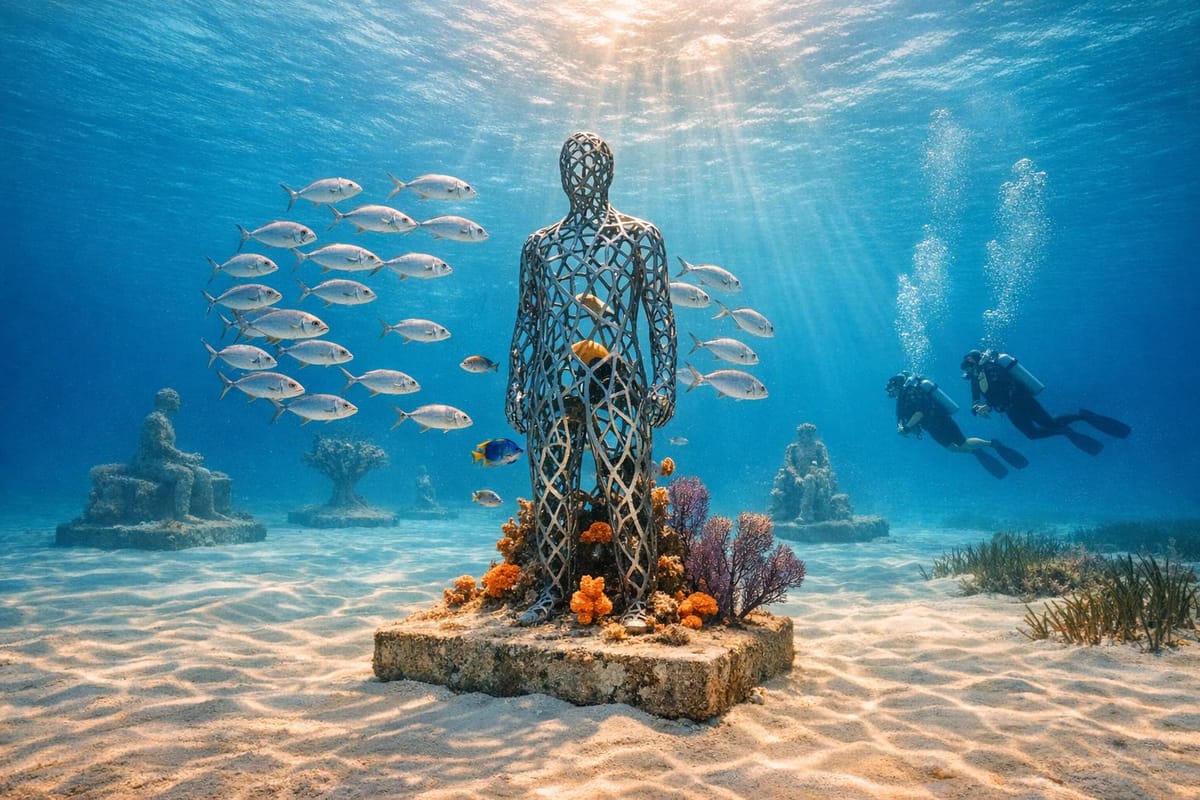
The Underwater Museum of Art (UMA), located 58 feet deep in the Gulf of Mexico near Grayton Beach State Park, is the first permanent underwater sculpture garden in the U.S. Since its inception, UMA has installed 47 sculptures across a one-acre seabed. These installations serve dual purposes: they are both striking works of art and artificial reefs supporting marine life. Divers from around the world visit this unique site, blending art with ecological restoration.
Here are the top 5 sculptures at UMA:
- The Lost Kingdom of Artemis by Denna Ameen: A Greco-Roman-inspired structure with three entrances, fostering habitats for marine life like sea turtles.
- Among the Anemone by Frank Henderson: A sea anemone-inspired piece with tentacle-like structures, offering shelter to over 80 marine species.
- Opus by Allison Wickey: A layered octopus sculpture symbolizing resilience, now part of the thriving reef system.
- Saguaro by Ghazal Ghazi: A 10-foot stainless steel desert cactus, bridging ecosystems while supporting coral and fish populations.
- Flamingle by Rachel Herring: A playful flamingo design that doubles as a marine habitat.
Certified divers can visit UMA through local dive operators like Dive30A. Each sculpture not only enhances the underwater landscape but also contributes to marine conservation efforts.
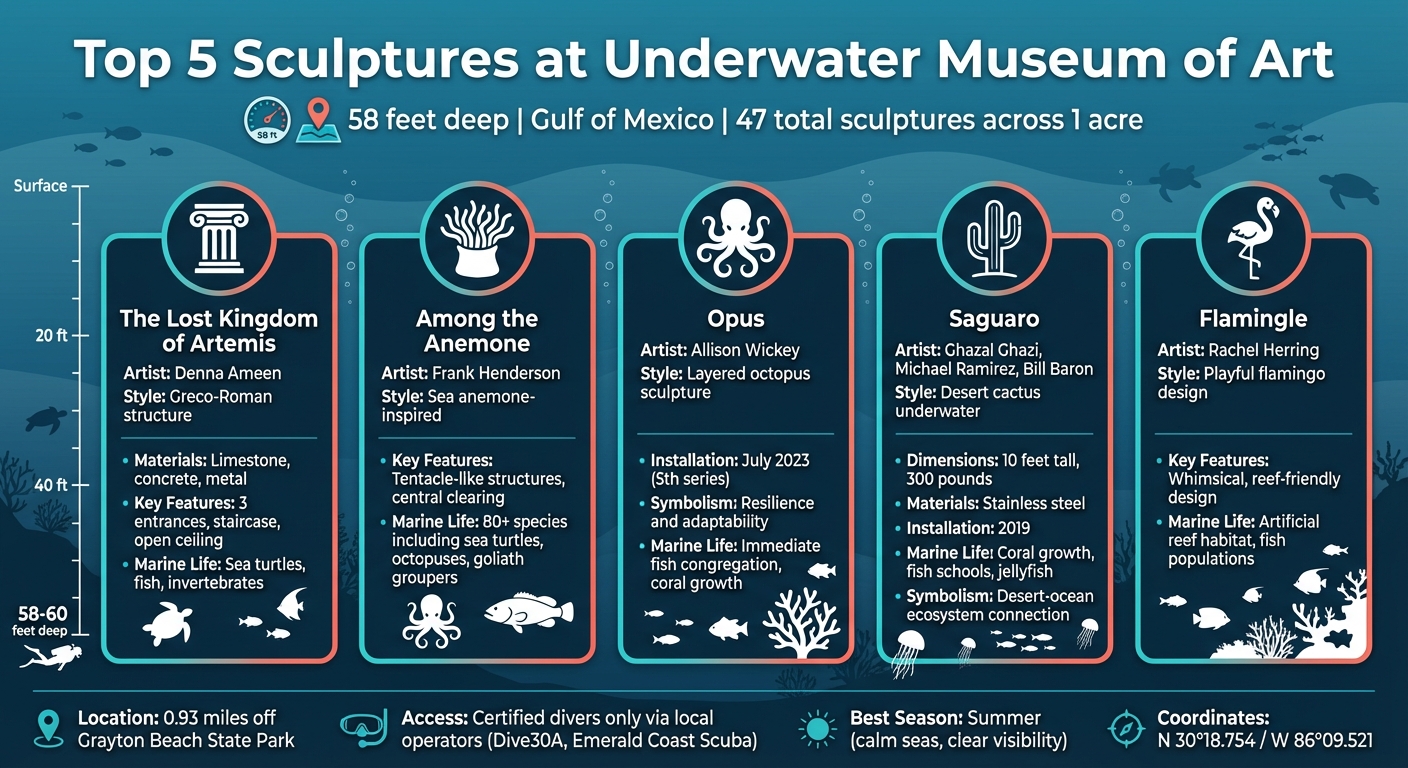
Top 5 Sculptures at Underwater Museum of Art: Features and Marine Life Impact
1. The Lost Kingdom of Artemis by Denna Ameen
Design and Artistic Features
Denna Ameen, an artist based in New Orleans, designed this stunning underwater sculpture. Modeled after a submerged Greco-Roman structure, it draws inspiration from the surrealism of Giorgio de Chirico and the imaginative architecture of Antoni Gaudí . Crafted from limestone, concrete, and metal, the piece features three entrances and a staircase leading to an open ceiling. This design evokes an air of mystery, inviting divers to explore its Atlantean ambiance. The combination of artistic influences and materials creates a visually striking centerpiece for underwater exploration.
Diver Interaction Opportunities
The sculpture isn't just a visual marvel - it’s designed to be explored. Divers can enter through its three distinct passageways, each offering unique perspectives. Inside, the staircase leads to an open ceiling that frames the water column above, providing a breathtaking view. This open design also allows sea turtles and other marine life to pass through, enhancing the diving experience. For those looking to uncover hidden details, bringing a dive light is highly recommended, as it can reveal intricate crevices and textures within the structure .
Marine Life Habitat Benefits
Beyond its artistic appeal, the sculpture serves an ecological purpose as an artificial reef . It provides shelter and feeding grounds for local marine species . Over time, corals, sponges, and other organisms will colonize its surfaces, transforming it into a vibrant, living reef. The multiple entrances create microhabitats, offering ideal spaces for fish and invertebrates to thrive. This dual role as art and habitat makes the sculpture a meaningful addition to the underwater ecosystem. It joins other snorkel reefs in South Walton that provide vital habitats for local marine life.
2. Among the Anemone by Frank Henderson
Design and Artistic Features
Frank Henderson, the artist behind the Space Nest sculpture from the 2023 UMA installation, crafted Among the Anemone to play with scale and perspective in an underwater setting. The sculpture is designed to resemble a sea anemone, with tentacle-like structures stretching outward, creating an immersive and almost otherworldly experience. At its core lies a central clearing, offering divers a unique space to pause and take in the surroundings. The design invites visitors to feel as though they’ve shrunk to the size of a clownfish navigating the dangers of a predatory anemone.
"Part of the fun of this sculpture is for the viewer to feel like they are at the scale of the tiny fish that sea anemones prey on." - Emerald Coast Magazine
This artistic approach shifts how divers perceive their underwater environment, immersing them in a world where they feel like miniature creatures. It’s a creative twist on traditional underwater sculptures, blending art with a sense of wonder and discovery while also providing a foundation for marine ecosystems to thrive.
Marine Life Habitat Benefits
The sculpture's tentacles are more than just visually striking - they’re designed to serve as safe havens for marine life. Acting as an artificial reef, the structure gradually transforms into a thriving ecosystem. Its surfaces provide a stable base for corals, sponges, and other organisms to attach and grow, fostering a diverse marine habitat. Over time, this contributes to healthier fish populations in the Gulf of Mexico.
In fact, the site has already attracted over 80 different marine species, including sea turtles, octopuses, and even goliath groupers. These interactions highlight the sculpture’s role in supporting marine biodiversity while offering a sustainable boost to local fisheries.
Diver Interaction Opportunities
Beyond its ecological contributions, Among the Anemone is designed to be fully interactive for divers. Its tentacles invite exploration, allowing visitors to swim around and through the structure. The central clearing offers a unique vantage point to experience the sculpture from within. However, diving to this site requires SCUBA certification, as it sits at a depth of 58–60 feet.
Accessing the sculpture is straightforward, with boats able to anchor near the Super Reef Anchor point at coordinates N 30°18.754 / W 86°09.521. Summer is usually the best time to visit, offering calm seas and clearer visibility. While exploring, it’s crucial to avoid touching the sculpture - skin oils can interfere with the delicate process of reef development.
3. Opus by Allison Wickey
Design and Artistic Features
Allison Wickey's Opus brings the octopus to life as a sculptural masterpiece. Installed in July 2023 during the museum's fifth series, this creation reflects Wickey's deliberate choice of subject. As a founding partner and original visionary of the Underwater Museum of Art, she carefully selected the octopus for its symbolic depth and connection to the sea.
"The octopus is a symbol of mystery, embodying all that the sea symbolizes in one creature. Not only are they intriguing, but they are also elegant and mesmerizing to watch." - Allison Wickey, Artist
Wickey’s signature approach - layered and textured - ensures Opus reveals something new from every perspective. This sculpture follows her earlier work, the 2018 Anamorphous Octopus, which utilized 16 metal bars to create optical illusions. Together, these designs bring both artistic complexity and a deeper narrative to the underwater art.
Symbolic Meaning
While visually captivating, Opus also conveys a powerful metaphor for resilience and adaptability. Wickey sees the octopus as a reflection of how we face modern challenges, often with humor and flexibility.
"I think the octopus is a good symbol for the times, as we learn to work our way out of new and strange issues in current society while retaining a sense of humor." - Allison Wickey, Artist
This symbolism resonates with the octopus’s ability to adapt and thrive in its environment. By depicting this creature, Wickey invites divers to connect with its beauty, intelligence, and the resilience it represents.
Marine Life Habitat Benefits
Beyond its artistic allure, Opus plays a vital role in supporting marine ecosystems, aligning perfectly with the Underwater Museum of Art's mission. Like all UMA sculptures, it acts as an artificial reef, providing essential habitat for marine life in the Gulf. Walt Hartley, President of the South Walton Artificial Reef Association, noted the immediate impact of the 2023 sculptures, including Opus.
"Fish began to congregate around all the sculptures almost immediately. 'If you build it, they will come!'" - Walt Hartley, SWARA President
Placed on a previously barren seabed, the installation has transformed the sandy flats into a thriving environment that fosters coral growth and shelters marine species. With this addition, the museum now boasts 40 permanent sculptures, further enriching its artificial reef system. Opus exemplifies how UMA bridges art and conservation, turning empty seabeds into flourishing habitats.
Diver Interaction Opportunities
For those eager to explore Opus firsthand, local operators like Dive30A and Emerald Coast Scuba offer diving trips to the site. Divers not only experience the artistry of the sculpture but also witness its evolution as marine life begins to claim it as home. Summer is the ideal time for this adventure, with calmer seas and clearer visibility making the underwater journey even more memorable. Before heading out, review these tips for diving the museum to ensure a safe and successful trip.
4. Saguaro by Ghazal Ghazi
Design and Artistic Features
Saguaro stands as a striking underwater sculpture - a 10-foot desert cactus brought to life on the Gulf floor. This stainless steel creation was a collaborative effort by Ghazal Ghazi, Michael Ramirez, and Bill Baron. Measuring 10 feet tall and weighing about 300 pounds, the piece was crafted in Tucson and installed in 2019.
Built from stainless steel, the sculpture is designed to resist the corrosive effects of saltwater, while also providing an ideal surface for coral to attach and grow. To keep it securely in place, it’s anchored to a concrete pad. Speaking about the sculpture, Bill Baron shared:
"It is cool because it will be untampered with. It is like a weird little sunken treasure."
This unique installation is not just a visual marvel but also a gateway to understanding its deeper ecological and symbolic roles.
Symbolic Meaning
The connection between the desert and ocean is at the heart of Saguaro's message. Artist Ghazal Ghazi explained the intentional symbolism behind the piece:
"Saguaros sustain and promote life in the desert, just as our sculpture does for marine life underwater by providing coral reef habitats to distressed marine life. In this way, the saguaro serves as a metaphor for the diversity, resilience, and interconnectedness of ecosystems - spanning from the Sonoran Desert to the Gulf of Mexico." - Ghazal Ghazi, Artist
Through this duality, Saguaro reflects UMA’s mission to blend artistic expression with the creation of thriving marine habitats.
Marine Life Habitat Benefits
Since its installation, Saguaro has become a hub for marine life. Coral has started to grow on its surface, and it has attracted schools of fish and jellyfish, contributing to the Gulf’s artificial reef system. Its vertical structure is particularly valuable, providing shelter and resources for various marine species and supporting local fisheries. Additionally, the sculpture serves as a research platform for scientists and students studying artificial reefs and their ecological impact on the Gulf.
Diver Interaction Opportunities
For certified divers, Saguaro offers an unforgettable underwater experience. The sculpture is accessible only by boat, requiring a short offshore trip and diving certification. Divers can locate the site using the coordinates for the central sculpture (SWARA Skull) at N 30°18.754 W 086°09.562. The surreal sight of a desert cactus thriving as an underwater reef makes the journey worthwhile. For more diving tips and travel recommendations along South Walton’s 30A coastline, visit sowal.co.
Diving Florida's FIRST UNDERWATER MUSEUM!!! | Grayton Beach Scuba
5. Flamingle by Rachel Herring
Flamingle brings a touch of playful charm to UMA's collection, blending art and marine life in a unique way.
Design and Artistic Features
Crafted by artist Rachel Herring, Flamingle stands out with its whimsical design. The sculpture was chosen through a rigorous jury process that reviews international submissions annually. Beyond its artistic appeal, Flamingle meets UMA's high standards by doubling as a living reef. Its cheerful design aligns perfectly with UMA's goal of combining creative expression with marine conservation.
Marine Life Habitat Benefits
Flamingle isn't just art - it’s a home for marine life. Strategically placed in the Gulf of Mexico, the sculpture attracts various marine species and provides essential shelter for local fisheries. Over time, it evolves into an artificial reef, transforming from a temporary stop for marine creatures to a permanent habitat. This growth supports fish populations and promotes a flourishing underwater environment. In turn, this lively habitat draws divers eager to experience its beauty.
Diver Interaction Opportunities
Divers visiting UMA can explore Flamingle as part of their underwater adventure. Located about 0.93 miles off Grayton Beach State Park, the museum's layout ensures easy navigation between sculptures, especially when visibility is good. This underwater gallery offers a rare experience, blending artistic exploration with the wonders of marine life in the Gulf's depths.
Conclusion
The Underwater Museum of Art (UMA) brings together artistry and marine conservation in a truly unique way. Art enthusiasts can admire a curated collection of sculptures from international artists, each transformed over time as marine life takes root on their surfaces. Certified divers get to explore the first permanent underwater sculpture garden in the U.S., descending to depths of 58–60 feet to experience interactive installations that redefine the concept of a gallery. Conservationists, on the other hand, witness these sculptures doubling as artificial reefs, fostering essential habitats for Gulf fisheries.
"The Underwater Museum of Art is integral to marine conservation... It is a positive movement in the right direction leading by example to create net positives for our oceans." – Zachery Long, Artist
Located off the shores of Grayton Beach State Park, UMA spans an acre and features over 40 sculptures. The site’s innovative approach earned it the 2023 CODA award for "Collaboration of the Year", a testament to the partnership between the Cultural Arts Alliance of Walton County and the South Walton Artificial Reef Association.
For those eager to experience UMA, certified divers can book trips with local charter operators to see the sculptures up close. Non-divers can also contribute by sponsoring sculptures or joining as a "Friend of UMA." If you're planning a visit to South Walton, sowal.co offers detailed guides to the area’s towns, events, dining spots, and beaches, ensuring there's something for everyone to enjoy., sowal.co offers detailed guides to the area’s towns, events, dining spots, and beaches, ensuring there's something for everyone to enjoy.
FAQs
What’s the best time of year to dive UMA?
The ideal time to visit the Underwater Museum of Art (UMA) is during the summer. This season often brings the addition of new sculptures, making it an exciting period to explore the underwater exhibits. Plus, the warm weather and calm waters create perfect conditions for diving and getting an up-close look at the art.
How do I book a dive trip to see the sculptures?
To plan your dive trip to the Underwater Museum of Art, explore the guided tours and diving packages available through local operators. You’ll find options like private charters, snorkeling adventures, and scuba diving excursions, many of which depart from Grayton Beach State Park or nearby locations. It’s a good idea to book ahead, especially during busy seasons, and double-check with the provider about any required certifications or safety guidelines.
Can non-divers experience or support UMA?
Visitors who don't dive can still engage with the Underwater Museum of Art by heading to Grayton Beach State Park. While the sculptures themselves are submerged, you can take in the surroundings from the shore or opt for a guided boat tour to get closer to the site. For those interested in a more immersive experience, local dive operators offer trips to the museum, providing an opportunity to explore and learn more about this fascinating destination.