WaterColor Home Market: Single-Family Trends
Location-driven high-end coastal market: median single-family price ~$3.3M, $1,010–$1,223/sqft, and 4.4–5.9 months supply.
WaterColor single-family homes are still expensive, but buyers have more choice than they did when supply was tighter. I’d sum up the market like this: detached homes are selling around $3.32 million at the median, most closed sales fall near $1,010 to $1,100+ per square foot, and supply is sitting at about 4.4 to 5.9 months.
If you’re looking at this market, a few things matter most right now:
- Location changes everything. Beach access, Gulf frontage, and closeness to the Beach Club or Western Lake can shift value fast.
- Detached homes need their own read. The single-family median is above the community-wide median of about $2.93 million.
- Buyers are picky. Days on market swung from 18 days in December 2025 to 97 days in January 2026.
- Move-in-ready homes do better. Older homes or listings priced too high can sit for 200+ days.
- Phase matters. Phase 1, Camp WaterColor, lakefront areas, Park District, The Crossings, and Phase V each attract a different buyer.
Here’s the short version: if I were pricing or buying in WaterColor, I would watch median sold price, price per square foot, days on market, and phase-level demand first. The market is not moving as one block. It breaks into smaller pockets based on rental rules, amenity access, home size, and beach proximity.
| Metric | What it shows now |
|---|---|
| Median single-family sale price | $3.32 million |
| Community-wide median sale price | $2.93 million |
| Closed-sale price per sq. ft. | $1,010 to $1,100+ |
| Active-listing price per sq. ft. | Up to $1,223 |
| Active listings | About 36 to 40 |
| Supply | About 4.4 to 5.9 months |
| DOM range noted | 18 to 97 days |
If you want a clean read on WaterColor, this is the main idea: micro-location beats broad averages.
WaterColor 30A Community Tour: Districts, Prices, Amenities
sbb-itb-d06eda6
Price Ranges and Price Per Square Foot
In WaterColor, single-family home pricing comes down to a few big factors: location, beach access, and how close a home sits to the neighborhood’s main amenities. Homes nearer the shoreline, especially those with deeded beach access, usually sell at the top end of the market. You can see that most clearly in the area’s price bands and in the gap between lower and higher price-per-square-foot figures.
Current Median Price and Price Bands
The easiest way to read this market is by looking at it in tiers. Interior homes tend to trade at the lower end. Gulf-view homes sit in the middle. Gulf-front homes land at the top and usually bring the highest price per square foot.
That pattern isn’t random. Buyers pay more for direct water access, stronger views, and a shorter path to the sand. In a place like WaterColor, those details matter a lot.
How Location Affects Price Per Square Foot
Once you look inside those tiers, location drives the price-per-square-foot spread even more. Gulf-front homes post the highest numbers, Gulf-view homes come next, and interior homes follow behind.
Homes close to the WaterColor Beach Club and the Boathouse on Western Lake also tend to fetch more because buyers want easy access to those spots. The same goes for the neighborhood’s shared features, like pools, courts, and trails. They help support a lifestyle-driven premium across the community.
That premium doesn’t just affect asking prices. It also shows up in how different home sizes and phases move through the market.
Days on Market, Inventory, and Sales Pace
Days on market and inventory show who has more leverage in WaterColor. For single-family homes, the market stays fairly steady at the luxury end, and the clearest patterns show up when you compare homes by size and by phase.
What Days on Market Tell Us Right Now
Days on market in WaterColor shift based on price band, condition, and phase. Homes that are move-in ready and priced in line with the market tend to sell faster. Homes that are priced right in the most sought-after phases also show the strongest sales pace.
Buyer taste in 2026 is pushing this even further. Buyers are leaning toward resilient, updated homes, which means older listings or homes with fewer updates can sit longer before finding the right offer.
Inventory Levels and What They Mean for Buyers and Sellers
Low inventory gives sellers more power on price, but that edge mostly holds for homes in the best locations and homes that have been kept up well. When WaterColor supply gets tighter, buyers going after top-tier spots usually have less room to negotiate.
A few details matter more than others here. Deeded beach access and well-kept amenities help support resale appeal. And sale-to-list ratios can give you a pretty clear read on how firm sellers are staying on price as inventory shifts from one phase to another.
Those same patterns show up again in home size trends and phase-level demand.
Home Size Trends and Phase-by-Phase Demand
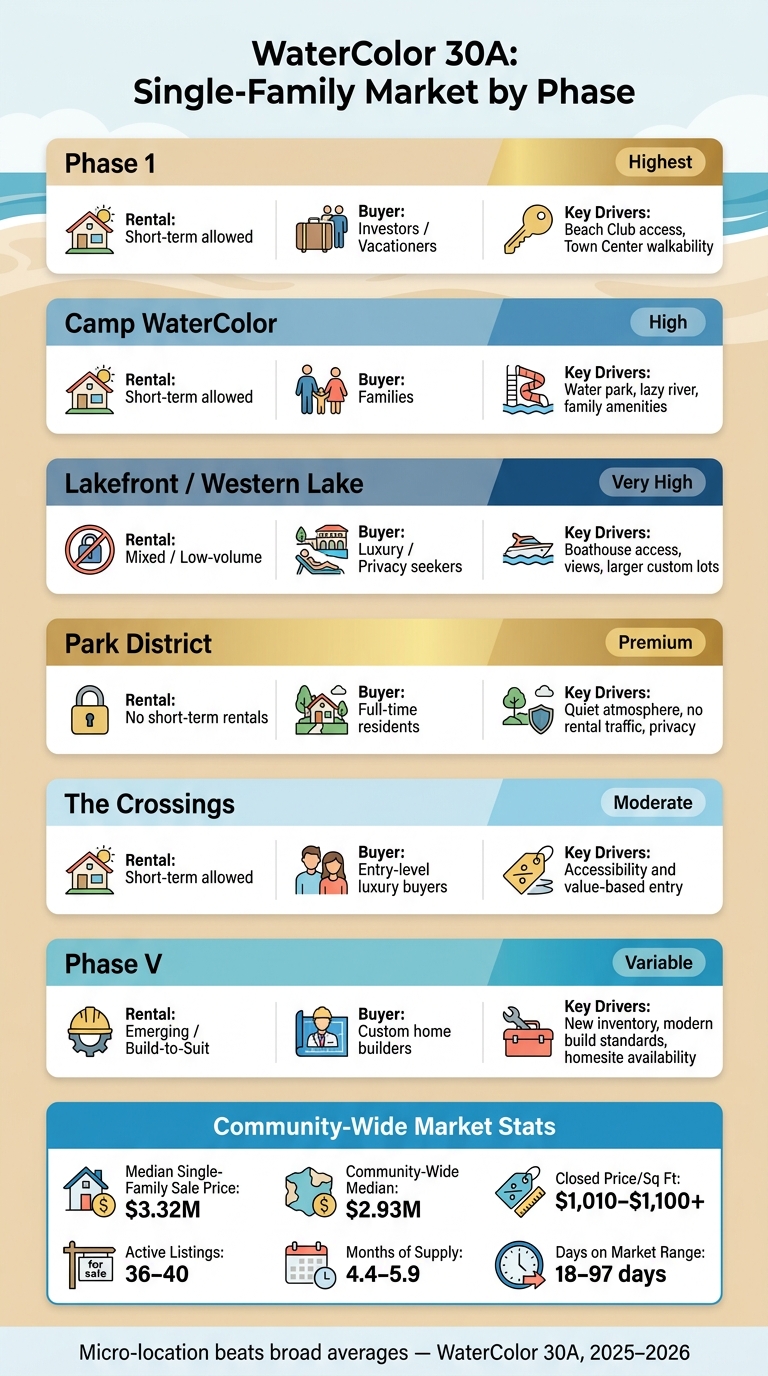
WaterColor 30A: Single-Family Market Snapshot by Phase
Price matters, but in WaterColor, home size and phase often explain why one property moves fast while another sits.
A big reason is simple: the homes are not all built the same. Older parts of the community tend to have more cottage-style homes. Newer sections, along with lakefront areas, usually have larger custom homes with more square footage and floor plans built for bigger groups or multi-generational stays. In the older phases, cottage layouts are more common. Newer homes often lean modern coastal, Mediterranean, or West Indies in style.
Across the community, a few features show up again and again because they fit the way people use these homes:
- Bunk rooms
- Large porches
- Carriage houses
- Guest suites
Those features make a difference for both rentals and family use. They help owners host larger groups, and they work well for extended stays with kids, grandparents, or visiting friends. Buyers also lean more toward fortified coastal construction because it can help with durability and insurance costs.
Those layout differences become much easier to see when you break the market down by phase.
How WaterColor Phases Shape Pricing and Buyer Demand
The phase mix below shows how location, amenity access, and rental rules shape both demand and pricing.
| Phase | Rental Profile | Typical Buyer | Price Tier | Demand Drivers |
|---|---|---|---|---|
| Phase 1 | Short-term allowed | Investors / Vacationers | Highest | Beach Club access, Town Center walkability |
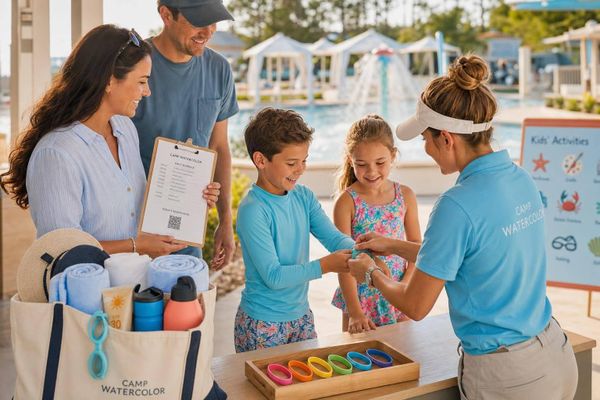
| Camp WaterColor | Short-term allowed | Families | High | Water park, lazy river, family amenities |
| Lakefront / Western Lake | Mixed / Low-volume | Luxury / Privacy seekers | Very High | Boathouse access, views, larger custom lots |
| Park District | No short-term rentals | Full-time residents | Premium | Quiet atmosphere, no rental traffic, privacy |
| The Crossings | Short-term allowed | Entry-level luxury buyers | Moderate | Accessibility and value-based entry |
| Phase V | Emerging / Build-to-Suit | Custom home builders | Variable | New inventory, modern build standards, homesite availability |
For larger homes in phases with heavy amenity use, the WaterColor wristband system plays a direct role in how guests access the community. That can affect the rental experience in a very practical way. Buyers should confirm guest-access rules and rental procedures by comparing property management options before closing.
Key Takeaways for WaterColor Single-Family Buyers and Owners
The latest numbers show a market that’s expensive, but still moving. WaterColor remains one of the priciest single-family pockets on 30A, with a median sold price near $3.3 million and most closed sales landing around $1,010 to $1,100+ per square foot. Active listings can push up to about $1,223 per square foot, which shows how much pricing can shift by phase and frontage type. Homes in the best spots still pull the strongest premiums.
Inventory sits in the middle ground. There are about 36 to 40 active listings and roughly 4.4 to 5.9 months of supply, depending on the reporting period. That gives buyers some room to shop, but not enough to drag prices down across the board.
What stands out most right now is speed. Days on market ranged from 18 days in December 2025 to 97 days in January 2026. That’s a big swing, and it says a lot about buyer selectivity. A well-priced home in a prime spot can still move. Miss the mark, and a listing can sit for 200+ days.
Inside WaterColor, not all homes compete on the same playing field. Beach access, proximity to Camp WaterColor, location near Western Lake, and rental restrictions all create separate price bands within the same community. That’s why broad neighborhood averages only go so far. For any given property, the micro-location often matters more than the ZIP code-style summary.
Larger homes with flexible layouts still draw the broadest pool of buyers. And if you're weighing updates or remodel work, it makes sense to judge each change by how well it fits rental demand within HOA rules.
Local context from sowal.co helps explain the demand behind WaterColor's market.
Market Signals Worth Watching Next
The three metrics to watch most closely are median sold price, price per square foot, and days on market. Recent data puts the median sold price at $3,120,000 in December 2025, up 11.3% year over year, while the average sold price reached $3,443,000, up 22.8% year over year. If those numbers start leveling off for more than a brief stretch, that could be an early sign that the market is cooling.
DOM is the next big clue. If homes start taking longer to sell on a steady basis, buyers gain more negotiating room. On the other hand, if months of supply drop below 4, that would point to a tighter market with more control staying on the seller side.
It’s also worth tracking phase-level absorption near the beach, Camp WaterColor, and Western Lake. If those high-amenity sections begin to slow relative to interior phases, it may mean the location premium is shrinking. That would have a direct effect on both pricing plans and long-hold decisions.
FAQs
Which WaterColor phase fits my goals?
It comes down to what matters most to you.
If you want rental income and easier access to the Beach Club and Town Center, Phases 1–4 are usually the better match.
If you're looking for a primary residence or a quieter second home, Phase V tends to make more sense. It has rental restrictions, sits closer to the Park District, and makes day-to-day errands easier. The trade-off is simple: it's farther from the beach.
How much negotiation room do buyers have now?
In WaterColor, buyers usually have limited room to negotiate. Sellers tend to stay firm, and homes often sell for about 92% of the original list price.
If you're hoping for a bit more wiggle room, look at homes that have been sitting on the market longer. Those sellers are often more open to adjusting their expectations.
What home features help resale most?
In WaterColor, move-in-ready homes with modern updates and high-quality finishes tend to have the strongest resale appeal. Buyers often lean toward homes that don't need work right away, which can also help cut future maintenance and insurance costs.
Homes with Fortified designations or recent mitigation upgrades also draw strong interest. The same goes for homes with practical layouts that fit both family living and rental income goals, especially when they're in walkable spots near community amenities.