FAQs About 30A Nature Schools
Overview of outdoor, nature-based schools along Florida's 30A: programs, age ranges, tuition, locations, enrollment and scholarship options.
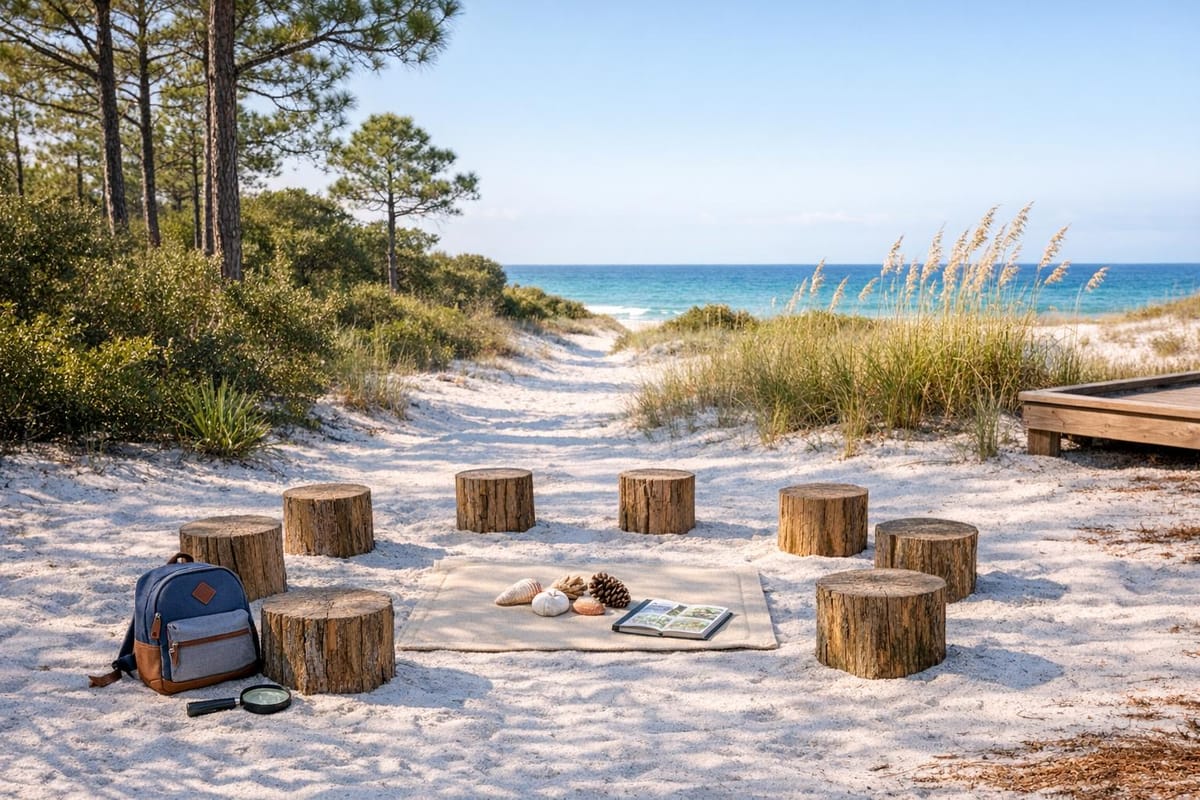
If you're exploring education options along Florida's 30A coastline, nature-based schools offer a refreshing alternative to indoor classrooms. These programs immerse students in outdoor learning, using local habitats like state parks and coastal ecosystems as classrooms. They emphasize hands-on activities like animal tracking, plant identification, and wilderness skills, tailored to children of different age groups. Here's a quick overview of what you need to know:
- Programs Offered: Full-time private schools, homeschool enrichment, and Montessori-style programs.
- Age Groups: Typically for children aged 3–12, with activities suited to developmental stages.
- Tuition: Varies by program; ranges from $700–$900/month or $1,960/semester, with additional fees.
- Locations: Santa Rosa Beach, Point Washington, and nearby state parks.
- Scholarships: Many schools accept Step Up For Students funds, offering financial support.
These schools provide a blend of outdoor education and personal development, making them a compelling choice for families in the area.
30A Nature Schools Comparison Guide: Programs, Tuition, and Key Features
Forest schools: Lessons in outdoor education
Nature School Options in 30A
The 30A area offers three distinct nature school programs, each reflecting its own educational philosophy and approach to hands-on, nature-based learning.
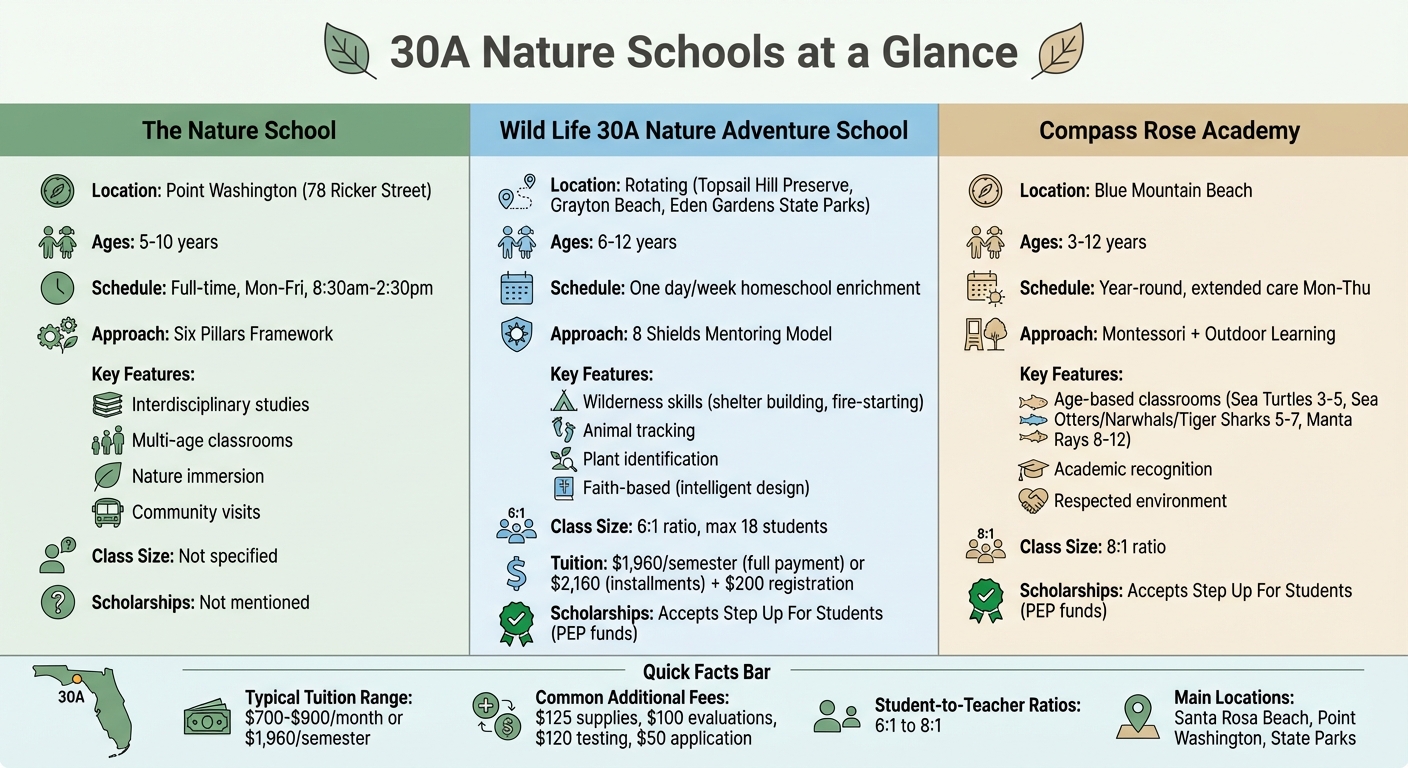
The Nature School operates as a full-time private school in Point Washington for children aged 5–10. Classes run Monday through Friday from 8:30 am to 2:30 pm. The school uses a "six pillars" framework that emphasizes interdisciplinary studies, continuous progress, multi-age classrooms, nature immersion, and social, emotional, and physical wellness. Outdoor excursions and community visits are integral to the program's approach.
Wild Life 30A Nature Adventure School provides a one-day-a-week homeschool enrichment program for children aged 6–12. It uses the "8 Shields Mentoring model", with classes held in rotating locations such as Topsail Hill Preserve, Grayton Beach, and Eden Gardens. With a 6:1 student-to-teacher ratio and a maximum of 18 students per class, the program focuses on wilderness skills like shelter building, fire-starting, animal tracking, and identifying edible plants. While faith-based and rooted in the concept of "intelligent design", the program welcomes students from all backgrounds. Tuition for the spring semester is $1,960 if paid in full, plus a $200 non-refundable registration fee.
Compass Rose Academy in Blue Mountain Beach combines Montessori principles with outdoor learning for children aged 3–12. The school operates year-round, maintaining an 8:1 student-to-teacher ratio. Students are grouped into age-based classrooms: Sea Turtles (ages 3–5), Sea Otters/Narwhals/Tiger Sharks (ages 5–7), and Manta Rays (ages 8–12). Co-founder Christine Buscarello shared the school's founding vision:
This group of parents wanted a school that would allow their children to learn in an environment where they would be challenged and encouraged, respected and acknowledged, motivated and loved.
Since relocating to Blue Mountain Beach in 2012, Compass Rose Academy has been recognized for its academic programs. The school also offers extended care Monday through Thursday.
Both Wild Life 30A Nature Adventure School and Compass Rose Academy accept Step Up For Students scholarships (PEP funds) .
Curriculum and Age Groups
What's Included in the Curriculum
Nature schools in the 30A area take a hands-on approach to education, focusing on outdoor learning instead of traditional classroom methods. Students dive into wilderness skills such as building shelters, starting fires, tracking animals, and identifying edible plants. Wild Life 30A sums this up perfectly:
"Whether it's building a shelter, starting a campfire, learning to track native animals, or identifying edible plants, each week will be a new opportunity to sharpen your skills."
But it’s not just about survival techniques. Students explore local coastal ecosystems, bird behavior, weather patterns, and navigation skills. They also participate in creative nature-based arts and team-building games. Some schools incorporate unique teaching methods - like Compass Rose Academy, which merges Montessori principles with outdoor exploration. Small class sizes are a priority, ensuring each child gets individual attention. And the programs are carefully designed to meet the developmental needs of different age groups.
Age Ranges and Development Stages
The hands-on curriculum evolves to meet the needs of children at various stages of development, offering activities that grow with them. From sensory play for toddlers to more advanced outdoor challenges for older kids, each program is tailored to specific age groups.
For younger children (ages 3–5), the focus is on sensory experiences and developing social-emotional skills through play and interaction in nature. As kids grow, the activities become more complex. School-age children (6–12) take on advanced outdoor skills and problem-solving tasks. Physical activities like climbing and balancing are adjusted for each age group, helping to build confidence and improve decision-making skills.
Tuition and Enrollment
How Much Does It Cost?
If you're exploring nature-based education along 30A, understanding tuition and enrollment details is key. Costs vary depending on the program and schedule. For instance, The Balanced Scholar 30A has a $350 registration fee, with monthly tuition ranging from $700 for part-time to $900 for full-time. Wildlife 30A charges a $200 registration fee, and spring semester tuition costs $1,960 if paid upfront or $2,160 when split into five installments. At Prickly Pear Nature School, a $250 deposit (credited toward the first month's tuition) is required, and tuition is determined using a sliding scale:
The sliding scale thrives on trust! We trust you to be honest in your assessment of your economic reality.
Additional fees to consider include approximately $125 for annual supplies, $100 for evaluations, $120 for standardized testing (such as Renaissance STAR), and a $50 application fee at Cocoplum Nature School.
Many schools accept Florida's Step Up for Students scholarships, including programs like PEP, Unique Abilities, and Family Empowerment. To use these scholarships, parents often need to set up an account in the Education Management Assistant (EMA) portal. Keep in mind that some schools may require tuition to be paid upfront, with reimbursement coming later through the scholarship. As Cocoplum Nature School puts it:
Tuition is an investment in the present as it preserves childhood in a natural and nurturing environment. It's also an investment for the future - a future in which your child is living joyfully as their truest self.
Once you're familiar with tuition and fees, the next step is to review each school's enrollment process to secure your child's spot.
How to Enroll Your Child
The enrollment journey often begins with a school tour. For example, South Walton Montessori Academy emphasizes this as the first step:
The first step in the Enrollment process is to set up a tour of the school.
After the tour, you'll need to complete a formal application and provide student intake forms.
At Wildlife 30A, parents select a specific day of the week (Tuesday through Friday), enroll online, and meet with teachers before the program begins. Cocoplum Nature School, on the other hand, follows a strict timeline. For instance, the primary application window for the 2026-27 school year closed in early February, and a trial day with an interview is part of the process. With small class sizes (typically 18 students and a 6:1 student-to-teacher ratio), waitlists can form quickly. While some schools allow year-round enrollment if space is available, contacting them early is essential to securing a spot.
Where Are 30A Nature Schools Located?
Main School Locations
Nature-based schools along 30A are primarily found in Santa Rosa Beach and Point Washington, making them convenient for families in the South Walton area. Some schools have permanent campuses, while others use local state parks as their outdoor classrooms.
For example, Wildlife 30A Nature Adventure School takes a flexible approach, utilizing multiple state parks. According to the program:
We adventure in Topsail Hill Preserve, Grayton Beach and Eden Gardens State Parks depending on which day you choose!
Classes on Tuesdays and Wednesdays rotate between all three parks, while Thursdays and Fridays are held exclusively at Topsail Hill Preserve.
On the other hand, some schools operate from fixed locations. The Nature School is based at 78 Ricker Street in Point Washington (Santa Rosa Beach area), nestled among wooded canal lots near the state forest. The school highlights its setting by stating:
Students will be surrounded in nature in our facility on the wooded canal lots of Point Washington.
South Walton Academy is located at 305 Mack Bayou Road in Santa Rosa Beach, just off US Highway 98. Meanwhile, 30A Learning Academy is centrally situated at 7 Town Center Loop C15 in Santa Rosa Beach, right along the 30A corridor.
Thanks to their central placement in Santa Rosa Beach and Point Washington, these schools are easily accessible for families in nearby communities like Seaside and Inlet Beach. Many of them also collaborate with local attractions such as the E.O. Wilson Biophilia Center and Alaqua Animal Refuge, offering students enriching field trip opportunities. These diverse locations highlight the area's strong commitment to outdoor education.
Choosing the Right Nature School
How to Compare Schools
Start by identifying the type of program that aligns with your family's needs. Some nature schools operate as full-time private institutions meeting all academic standards, while others provide part-time enrichment for homeschool families. In the 30A area, where outdoor learning thrives, it's also important to consider site-specific logistics.
Look for schools with student-to-teacher ratios between 6:1 and 8:1, as these provide more personalized attention during outdoor activities. Ensure that staff members are CPR-certified and that the school has clear Emergency Action Plans for outdoor locations. If the school uses state parks as learning sites, confirm they hold commercial contracts with Florida State Parks.
Factor in the practicality of drop-off and pick-up, especially during peak traffic times on US-98. To gauge the academic quality, request examples of student work, such as portfolios or project samples. Also, check whether the school offers scholarships and if your family qualifies.
Once you’ve reviewed these essentials, you’ll be ready to plan your school visit.
Next Steps for Parents
After narrowing down your options, check each school’s website for calendars and schedules. Attend open houses to observe the learning environment and meet the instructors. As you move forward with the enrollment process, clarify the onboarding steps to help your child adjust to outdoor learning.
It’s also helpful to connect with other South Walton families who have children enrolled in nature-based programs. Their experiences can provide insights into daily routines, communication practices, and how well the school meets its commitments. Once you’ve made your shortlist, schedule campus tours or park visits to see the learning spaces in action.