30A Rental Occupancy Trends by Season
Seasonal 30A rental trends: summer occupancy tops 90%, spring/fall 60–80%, winter often under 50%; pricing, long-term stays, and amenities shape returns.
Planning a trip to Florida’s 30A or investing in a rental property? Here’s what you need to know:
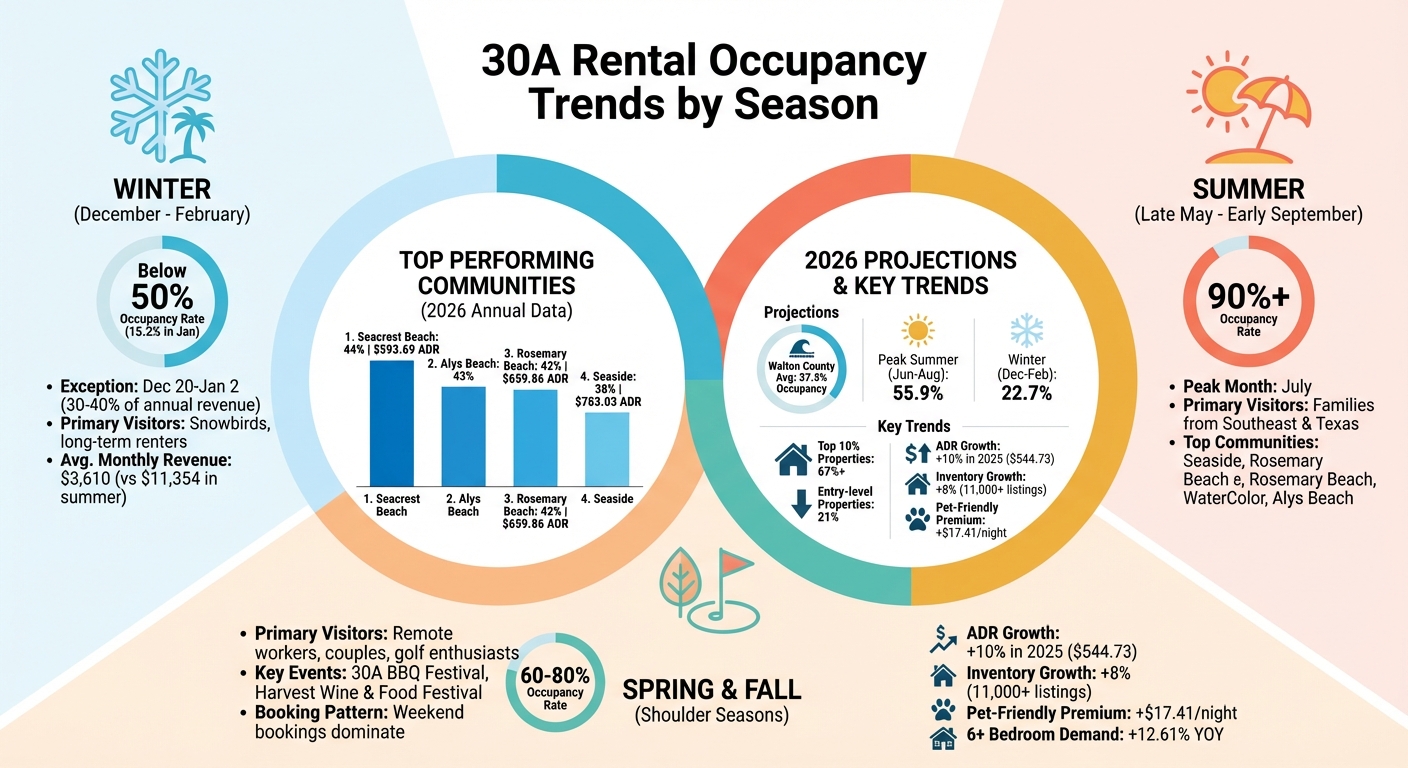
- Summer (Late May–Early September): Occupancy rates exceed 90%, driven by family vacations. Popular spots like Seaside and Rosemary Beach thrive, with peak pricing in July.
- Spring & Fall (Shoulder Seasons): Occupancy ranges from 60%-80%. These months attract remote workers, couples, and those avoiding summer crowds. Events like the 30A BBQ Festival boost demand.
- Winter (December–February): Rates drop below 50%, except for holidays like Christmas and New Year’s. Snowbirds and long-term renters sustain some properties during the off-season.
- Top Communities: Seacrest Beach leads with a 44% annual occupancy rate, while Seaside has the highest average daily rate ($783.03).
- Trends for 2026: Walton County’s average occupancy is projected at 37.8%, with increasing competition among property owners due to rising inventory and stricter regulations.
Key Takeaway: Understanding seasonal trends is essential for maximizing rental income or planning an affordable vacation. Summer offers high demand, while spring and fall provide balance. Winter requires strategic pricing to attract long-term stays.
30A Rental Occupancy Rates by Season: Complete Guide to Peak and Off-Season Trends
Investing in 30A Rentals 2025 | Summer Performance & Where the Market’s Headed
Peak Season: Late May to Early September
The summer months on 30A mark the busiest time for vacation rentals, with demand peaking from late May through early September. Families from the Southeast and Texas flock to this coastal paradise, pushing occupancy rates to over 90% in sought-after spots like Seaside, Rosemary Beach, WaterColor, and Alys Beach. Let’s dive into what drives this surge and how different communities perform during this lucrative season.
What Fuels Peak Season Demand
The main factor behind summer’s high demand? School vacations. Families from cities like Birmingham, Atlanta, Houston, and New Orleans plan their trips around school schedules, making June and July especially busy. The appeal of 30A lies in its white sandy beaches, warm Gulf waters, and endless outdoor activities that keep visitors entertained.
Larger properties - those with 3–6 bedrooms - are especially popular during this time, catering to multigenerational groups. Features like private pools, spacious outdoor areas, and easy beach access are must-haves for many renters. Local real estate expert Corbin Roush sums it up well:
"The highest rental income typically occurs during the peak summer season, which runs from late May through early August. Families and vacationers are drawn to 30A for its beaches, outdoor activities, and events during this period".
Top Communities for Peak Season Rentals
Not all 30A communities perform the same during summer. Rosemary Beach leads the pack with an average daily rate of around $700 during peak season, while Santa Rosa Beach follows closely with an average of $635. What makes these communities stand out? Their walkability and vibrant town centers. Guests love the convenience of parking their cars and exploring on foot or by golf cart.
Seaside is a favorite for its New Urbanism design, offering a pedestrian-friendly experience that families adore. WaterColor, on the other hand, combines resort-style amenities with family-oriented spaces. Then there’s Alys Beach, famous for its striking white architecture and upscale vibe, which attracts luxury travelers. Properties near the Gulf or close to dining and shopping hubs command top-dollar rates and maintain high occupancy. July emerges as the most profitable month, with some luxury beachfront homes pulling in over $1 million annually.
Shoulder Seasons: Spring and Early Fall
The shoulder seasons on 30A - March through May and September through November - are a prime opportunity for rental property owners. During these months, occupancy rates generally range from 60% to 80%. These periods draw a mix of travelers, including remote workers, golf enthusiasts, couples looking for a peaceful escape, and visitors aiming to sidestep the peak-season crowds and prices. Let's dive into the trends and events that shape these lucrative seasons.
Occupancy Rates in Spring and Fall
Spring Break in March and April brings a surge in demand as families flock to the area for warm weather and beach access before summer kicks in. On the other hand, September and October cater to guests seeking a quieter, less crowded experience. Real estate agent Corbin Roush highlights the appeal of early fall:
"Early fall, including September and October, can produce high rental income due to lower crowds and attractive pricing for visitors seeking a quieter experience".
Weekend bookings dominate during these months, significantly outpacing weekday reservations. Smaller rentals, such as one- and two-bedroom properties, are particularly popular with solo travelers and remote workers. Pet-friendly accommodations also stand out, commanding an average daily rate premium of $17.41.
Events and Activities During Shoulder Seasons
Local events play a big role in driving bookings during these months. For instance, the 30A BBQ Festival recently raised an impressive $132,000 for charity, showcasing the magnetic pull of community events. The Harvest Wine & Food Festival is another standout fall attraction. Golf trips remain a consistent draw throughout the shoulder seasons.
To maximize revenue, savvy property owners keep a close eye on the Visit South Walton events guide. This helps them identify high-demand weekends and adjust pricing and minimum stay requirements accordingly. Offering competitive, event-driven rates is a key strategy for maintaining strong bookings after the summer rush fades.
Winter Season: December to February
Winter on 30A experiences a sharp decline in occupancy rates, often dipping below 50%. January is particularly slow, with occupancy sometimes reaching as low as 15.2%, and the 2026 low-season average is expected to hover around 22.7%. This is a stark contrast to the summer months, where occupancy rates soar past 90%. Despite these challenges, the holiday stretch from December 20 to January 2 is a bright spot, contributing 30–40% of the annual revenue. During this time, Christmas and New Year's bookings fetch the highest nightly rates of the year. Beyond the holiday period, smaller spikes in demand occur during events like Valentine's Day, the 30A Songwriters Festival, and the 30A Wine Festival. However, the steep drop in bookings throughout the rest of the season presents unique hurdles for property owners.
Winter Occupancy Challenges
Once the holiday rush subsides, bookings remain sparse. Average monthly revenue plummets to $3,610 during the winter, a far cry from the $11,354 seen in the peak summer months. Similarly, average daily rates drop to about $551. While daytime highs in February reach a mild 65°F, Gulf water temperatures stay between 61°F and 64°F - chilly enough to deter most swimmers unless they’re equipped with wetsuits. Booking behavior also shifts, with guests planning their stays just 36 days in advance during this season. Real estate agent Justin Nash from Spears Group describes the winter slowdown:
"The winter season tends to be slower, with occupancy rates often falling below fifty percent, except for holidays and special events".
Attracting Snowbirds and Long-Term Guests
To combat the challenges of the low season, many property owners are focusing on snowbirds and long-term renters. Around 66.4% of Walton County listings now require stays of 30 days or more to cater to this demographic. Corbin Roush of Spears Group emphasizes the importance of adapting to this market:
"Off-season income can be supplemented by long-term rentals or special promotions to maintain a steady cash flow".
Snowbirds are drawn to properties offering practical amenities like fully equipped kitchens, dependable Wi-Fi, accessible layouts, and pet-friendly features such as fenced yards or proximity to nature trails. Marketing efforts that highlight a "lifestyle upgrade" - centered on wellness, relaxation, and local experiences such as yoga classes or farmers' markets - can also appeal to this group. Offering multi-month discounts, such as 50% off the standard daily rate for stays longer than 30 days, has proven to be an effective strategy for securing extended bookings.
Occupancy Trends by 30A Community
Looking closer at seasonal occupancy patterns, it’s clear that location and amenities play a big role in shaping guest preferences across the 30A communities.
Comparing Neighborhood Performance
Occupancy rates vary significantly across 30A, highlighting the unique charm and appeal of each community. According to 2026 market data, Seacrest Beach takes the lead with a 44% occupancy rate, followed by Alys Beach at 43% and Rosemary Beach at 42%. Inlet Beach and Santa Rosa Beach are tied at 41%, while Watersound trails slightly at 40%. Interestingly, Seaside - despite charging the highest average daily rate (ADR) at $783.03 - has the lowest occupancy at 38%.
This contrast between occupancy and ADR reveals a clear trend: many guests prioritize value over prestige. For example, Seacrest Beach, with an ADR of $593.69, attracts more bookings than Seaside. Rosemary Beach finds a balance, maintaining a solid 42% occupancy while offering an ADR of $659.86.
In the summer's peak, neighborhoods like Seaside, Rosemary Beach, WaterColor, and Alys Beach frequently surpass 90% occupancy. These areas benefit from their well-known reputations and walkable designs, which are particularly appealing to families looking for a self-contained vacation experience. Understanding these trends helps set the stage for a deeper dive into how amenities and location influence occupancy.
How Amenities and Location Affect Occupancy
Beyond community averages, specific property features can significantly impact occupancy rates. Proximity to the beach is the most influential factor. Homes marketed as "steps to the beach" or "beachfront" consistently outperform the market. For example, Seawalk Sanctuary, a beachfront 6-bedroom property in Santa Rosa Beach, achieved 59.6% occupancy from February 2025 to February 2026, with a high ADR of $2,937.97. Another standout, Majestic View - a 5-bedroom home described as "steps to the beach" - reached 66.9% occupancy and brought in $375,127 in revenue during the same period.
Justin Nash of Spears Group highlights this trend:
"Properties that are close to the beach, walkable to shops and restaurants, or offer desirable features such as pools or outdoor living spaces tend to perform particularly well".
Walkability also plays a significant role. Homes near dining and shopping hubs like Seaside Central Square or the Merchants of Seaside enjoy a "walkability premium", often achieving occupancy rates above 60%. These features make certain properties stand out, offering a combination of convenience and lifestyle appeal that guests find irresistible.
Historical Trends and 2026 Projections
Occupancy Trends from 2022 to 2025
Over the last few years, the 30A rental market transitioned from the pandemic-driven highs to a more stable environment. In 2022-2023, Florida vacation rentals saw occupancy rates between 68-72%, fueled by pent-up travel demand and the flexibility of remote work. By 2025, however, the market began to level off, with Destin and 30A reporting a 57% occupancy rate - a 3% drop from 2024.
Even with this dip in occupancy, property owners benefited from higher pricing. Average Daily Rates (ADR) rose by 10% in 2025, reaching $544.73, while Revenue per Available Rental (RevPAR) climbed 7% to $308.61. Luxury properties gained traction, with upscale listings growing 5.23% year-over-year in 2025, while budget-friendly rentals faced declining demand.
Steve Strano of PPG Realtors highlighted this shift:
"The market has shifted from budget condos to high-end beach houses with pools, golf carts, and concierge services. This premium positioning helps maintain high ADRs".
External challenges also played a role. Rising insurance premiums, new regulations, and disputes over beach access contributed to an 11.8% drop in visitors to South Walton in 2024. At the same time, inventory expanded by 8% in 2025, surpassing 11,000 active listings, which intensified competition among property owners. These dynamics are reshaping the landscape for operators in the region.
What to Expect in 2026
Looking ahead, 2026 is shaping up to be what experts call a "professional operator year" - one where success hinges on smart pricing, standout amenities, and effective marketing rather than relying on high demand alone. Florida's overall occupancy is expected to range between 62-66%, with Walton County averaging a more modest 37.8%.
Seasonal trends remain consistent. Peak summer months (June through August) are projected to see 55.9% occupancy in Walton County, while winter months (December through February) may drop to 22.7%. Shoulder seasons - May, October, and November - are expected to perform 15-25% better than 2022-2023, thanks to remote workers and budget-conscious travelers.
Several key factors will influence 2026 performance. The 2026 FIFA World Cup is likely to affect U.S. travel patterns, potentially boosting bookings during the tournament. Additionally, Walton County's new regulations - including a $300 annual certification fee and stricter safety inspections - will increase operational costs but could also reduce oversupply by discouraging less committed operators.
The gap between top-performing and struggling properties continues to grow. Best-in-class rentals (top 10%) maintain occupancy above 67%, while entry-level properties average just 21%. Larger homes with 6+ bedrooms are experiencing the fastest demand growth at 12.61% year-over-year, and pet-friendly listings command an additional $17.41 per night on average.
Conclusion
30A's seasonal rental patterns hold valuable insights for both property owners and travelers. During the bustling months from late May through early September, top communities often see occupancy rates soar past 90%. In contrast, the quieter winter months can see rates drop to below 50%.
For property owners looking to thrive in 2026, it's essential to prepare for fluctuating conditions. Monthly scenario modeling - covering conservative, base, and optimistic forecasts - can help anticipate shifts in insurance costs and occupancy rates. Additionally, targeting snowbirds with flexible pricing during December through February can help fill bookings during slower periods.
Travelers can also benefit from understanding these trends. Spring and fall provide an ideal balance, with occupancy rates typically sitting between 60% and 80%. As highlighted by 30A.com:
"May is the calm before the summer storm. School hasn't let out yet so the area is not crowded, and the weather is truly fantastic."
FAQs
When should I book 30A for the best rates?
During the winter months, particularly in January and February, rental rates in 30A hit their lowest. This season offers a quieter, more serene beach experience, making it perfect for travelers looking for an affordable and peaceful escape.
How can owners boost winter occupancy on 30A?
If you're looking to fill your vacation rental during the quieter winter months on 30A, a few smart strategies can make a big difference.
One effective approach is dynamic pricing - adjusting your rates based on demand. Lowering prices slightly during the off-season can attract more guests while still ensuring profitability.
Another idea? Offer special deals or extended stay discounts. Snowbirds, in particular, are drawn to Florida’s mild winters and often prefer longer stays. A discount for week-long or month-long bookings can be exactly what they’re looking for.
It’s also important to focus on maintaining your property’s appeal. Guests are more likely to book if your rental is in great condition and offers features like cozy furnishings or heated amenities for cooler weather.
Finally, emphasize the off-season perks in your marketing. Highlight benefits like fewer crowds, peaceful beaches, and lower travel costs to appeal to travelers seeking a more relaxed getaway. These details can be the push they need to book your property.
Which 30A amenities increase bookings the most?
Luxury amenities like private pools can significantly increase bookings in the 30A area. These features not only draw in more guests but also justify higher nightly rates and improve occupancy levels. Together, these factors contribute to a stronger return on investment (ROI) for property owners.