
Can Family Stays Count as Personal Use Days?
Most family visits, discounted stays and owner swaps count as IRS personal-use days; only relatives who pay fair market rent and use it as their primary home are usually excluded.
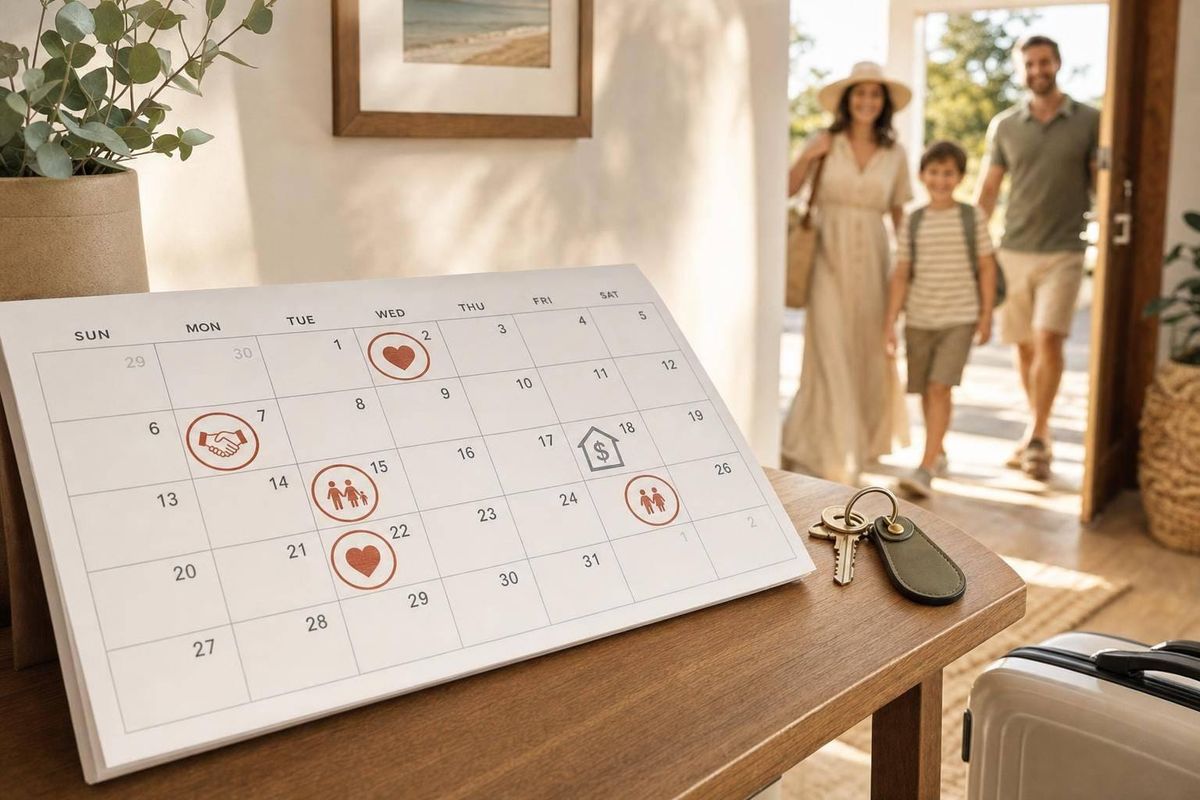
Yes - in most cases, family stays do count as personal use days. If you rent out a vacation home, the IRS usually counts days used by you, your family, or anyone paying below market rent as personal use days.
Here’s the short version:
- Family staying for free? Personal use.
- Friend gets a discount? Personal use.
- Home swap with another owner? Personal use.
- Relative pays full market rent and uses the home as a main home? Usually not personal use.
The number that matters is the IRS limit: more than 14 days or more than 10% of the days rented at fair rental price, whichever is higher. If you go over that limit, the home is usually treated as a residence for tax purposes, which can limit rental deductions.
A few fast examples:
- If you rent the home for 100 days, your personal-use limit is 14 days.
- If you rent it for 200 days, your limit is 20 days.
- If your parents stay 7 days for free and friends stay 5 days at a discount, that is 12 personal days already.
| Stay type | How the IRS usually treats it |
|---|---|
| Owner stay | Personal use |
| Family stay for free | Personal use |
| Friend stay below market rent | Personal use |
| Unrelated guest paying full market rent | Rental use |
| Relative paying full market rent and living there as a main home | Usually rental use |
| Reciprocal owner swap | Personal use |
The main point: I would track who stayed, what they paid, and whether the price matched market rent for those exact dates. That calendar often decides the tax result.
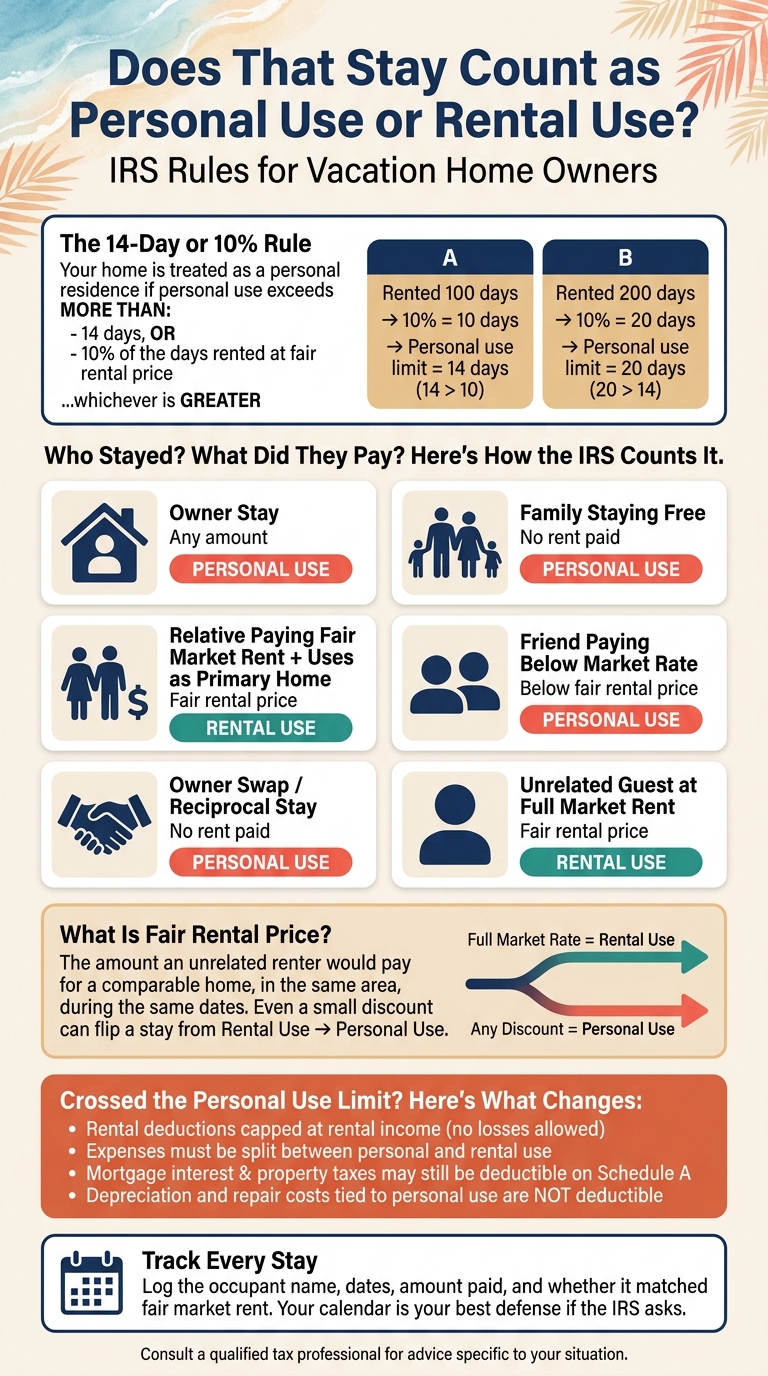
IRS Personal Use vs. Rental Use: Who Stays & What They Pay
The 14-Day Rule: What the IRS Says about Personal Use Days
sbb-itb-d06eda6
The Basic IRS Test: Personal Use, Rental Use, and the 14-Day or 10% Rule
For a 30A vacation home, the IRS starts with a basic question: is the property a dwelling unit? To meet that test, it needs sleeping space, a bathroom, and cooking facilities.
Once the property qualifies, the IRS looks at each day of use and places it into one of three buckets: personal use, rental use, or vacant. Personal use goes over the limit when it is more than the greater of 14 days or 10% of the days the home is rented at a fair rental price. If you go over that line, the property is treated as a residence for tax purposes.
Here’s what that looks like in practice:
- If your 30A home is rented at a fair rental price for 200 days, 10% equals 20 days. That means your personal-use limit is 20 days, because 20 is more than 14.
- If it is rented for 100 days, 10% equals 10 days. Since 10 is less than 14, the fixed 14-day limit applies.
How to Count Personal Days, Rental Days, and Vacant Days
Your own stays count as personal-use days. The same goes for days when family or friends use the home for free or pay less than market rate. Days rented at a fair rental price count as rental days. Empty days count as neither, even if the home is listed and available for rent.
One detail trips people up: a day rented at a fair rental price still counts as rental use even if you also use the home that day. That’s why a day-by-day log matters. Track who stayed, what they paid, and how they know you. If the IRS asks, that record can do a lot of the heavy lifting.
The next piece is how family and friend stays fit into that personal-use total.
What Changes When the Home Crosses the Residence Threshold
Once personal use goes past the limit, the tax treatment changes. You have to split expenses between personal and rental use, and your rental deductions can’t be more than your rental income.
Mortgage interest and property taxes tied to personal use may still be deductible on Schedule A, subject to the usual limits. But expenses tied to personal use - like utilities, repairs, and depreciation - are not deductible. If rental expenses go past rental income, the extra amount usually carries forward or becomes nondeductible instead of creating a current-year loss.
That’s the baseline rule. The next section covers the family-member exception and below-market stays.
When Family and Friend Stays Count as Personal Use Days
A family member's stay usually counts as personal use, and that includes relatives of any co-owner. So if one owner's mother spends a week at a shared 30A beach house and doesn't pay a fair rental price, that week counts as personal use for all co-owners.
There's only one narrow carveout: the relative must pay fair rental price and use the home as a primary residence.
The Exception for a Family Member Who Pays Fair Rental Price and Uses the Home as a Primary Residence
This exception is strict. Both parts have to be met.
- The family member uses the home as a primary residence
- The family member pays fair rental price
If either part is missing, the stay counts as personal use.
Fair rental price means the amount an unrelated renter would reasonably pay for that home, in that market, for those same dates. It doesn't mean a token payment or a steep discount.
Friends, Guests, and Discounted Stays
Friends are judged by the same rent test. If a friend pays full market rent, the stay is rental use. If the stay is free or priced below market, it counts as personal use.
Table: Personal Use vs. Rental Use by User Type
Use the table below to sort common stays by tax treatment.
| User | Payment | Primary Residence? | IRS Treatment |
|---|---|---|---|
| Owner | Any amount | N/A | Personal use day |
| Parent staying free | None | No | Personal use day |
| Adult child living there as a primary residence and paying fair rental price | Fair rental price | Yes | Not personal use |
| Friend paying below market | Below fair rental price | No | Personal use day |
| Friend paying full market rent | Fair rental price | No | Rental use day |
| Swap guest under a reciprocal stay | No rent paid | N/A | Personal use day |
Fair rental price is the line that matters, and the next section applies that rule to common beach-house situations.
Fair Rental Price, Owner Swaps, and Common Beach-Home Scenarios
How to Judge Fair Rental Price for a South Walton or 30A Home
Once a stay falls into either personal or rental use, the next step is simple: figure out whether the rate was fair market rent. For a 30A home, that means the amount an unrelated guest would pay for a similar place in the same area during the same season.
You’ll want to compare your home with similar properties in the same neighborhood and for the same week. Things like bedroom count, beach access, pool, view, and interior finishes can change the rate quite a bit.
Good records matter here. Save screenshots of similar listings, local agency rate sheets, or any other proof showing what comparable homes were charging for those exact dates. sowal.co can help you get a sense of neighborhood patterns and seasonal demand.
One small catch: even a minor discount to family can turn the stay into personal use.
That same rule applies to reciprocal stays too, even when no money changes hands.
Owner Swaps and Reciprocal Use Arrangements
An owner swap is just what it sounds like: two owners trade stays instead of paying rent. For tax purposes, the IRS treats those swap days as personal use because no fair rental price is paid.
So if you trade a week in Seagrove for a week in North Carolina, both owners count those days as personal use.
Table: Common South Walton and 30A Scenarios and Their IRS Treatment
| Scenario | IRS Treatment | Effect on 14-Day or 10% Test |
|---|---|---|
| Parents visit for 7 days, pay no rent | Personal use | Adds 7 personal days; may push home toward residence classification |
| Friends pay below fair rental price for 5 days | Personal use | Adds 5 personal days; days do not count as rental use |
| Adult child uses the home as a main residence and pays fair market rent under a bona fide lease at fair rental price | Rental use | Days can count as rental; may increase deductible use |
| Week rented at full market rate to unrelated guests | Rental use | Adds 7 rental days; helps meet rental thresholds |
| Vacant 10 days between two bookings | Neither personal nor rental | Not counted; no effect on 14-day or 10% thresholds |
| 7-day 30A beach week traded for 7-day stay at another owner's vacation home | Personal use for both owners | Adds 7 personal days; reduces rental-day total |
These are the buckets you use when counting personal-use days. First classify each stay based on how it was paid for, then apply the IRS test.
Conclusion: The Key Rule Is Whether a Stay Is Personal, Fair-Market Rental, or an Exception
For South Walton and 30A owners, the last check is pretty simple: who stayed, what they paid, and whether the rate matched the market. In most cases, family stays, below-market stays, and owner swaps count as personal use. A family member is left out only if they use the home as a main home and pay a fair rental price.
That fair rental price rule is the line that matters most. If the amount charged is below market, the IRS will generally treat the stay as personal use.
Those personal days from family visits, discounted stays, and swaps all count toward the greater-of-14-days-or-10%-of-rented-days limit. Go over that limit, and rental deductions on a 30A home are generally capped at rental income.
Because the IRS counts days, not assumptions, your records matter. Use a calendar or spreadsheet to track the occupant, the rate charged, and whether the stay was at fair rental price. If a day falls into a gray area, treat it as personal use and check the tax treatment with a qualified tax professional.
FAQs
How do I prove fair rental price?
You need to show that the rate you charged lines up with the market for similar properties in the same area.
The IRS won’t accept rough guesses. So keep contemporaneous records that show how you arrived at the price at the time you set it.
Helpful records can include:
- Notes on seasonal demand
- Average nightly rates for similar local rentals
- Emails or messages with property managers or real estate agents
Do partial-day stays count as personal use?
The IRS guidance here doesn't clearly say whether partial-day stays count as personal use. What it does make clear is that owners need to track personal-use days and rental days for tax classification.
For accurate reporting, keep a daily log that shows guest details and how the property was used.
What records should I keep for IRS purposes?
Keep records that show how the property was used and how you reported the income and expenses tied to it. A simple day-by-day log works well. Track personal days vs. rental days, plus who stayed at the property and when.
You should also hang on to documents like:
- Closing statements
- Improvement invoices
- Mileage logs
- Booking calendars or guest details
- Registrations
- Tax forms
- Receipts
If the property had mixed use, keep proof that shows how you split rental use from personal use. That support matters if you ever need to show how you figured the numbers on your return.