QBI Examples for South Walton Rentals
How hours, records, management setup, and personal use determine Section 199A (QBI) eligibility for South Walton vacation rentals.

Not every South Walton rental gets the QBI deduction. If I want a shot at the Section 199A write-off, I need to look at hours, records, management setup, and personal use first.
Here’s the short version:
- A rental may qualify if it has separate books, at least 250 hours of rental services, and time records
- A self-managed 30A home often has a stronger case because I can track my own work
- A manager-run rental can still qualify, but the manager’s logs and invoices matter a lot
- Personal use can change the answer fast, especially if it goes over the greater of 14 days or 10% of rental days
- Missing the IRS safe harbor does not end the issue; the rental may still qualify under general trade-or-business rules
If I strip the article down to one point, it’s this: QBI is based on facts, not location. Two homes on the same street can have different tax results.
Quick comparison
| Case | Setup | QBI outlook | Main issue |
|---|---|---|---|
| 1 | Condo with local property manager | Possible | Need manager logs and separate books |
| 2 | Owner-managed beach home | Stronger | Need current time tracking |
| 3 | Fully manager-run home, little owner activity | Weaker | Hours and trade-or-business proof may be thin |
| 4 | Rental with owner holiday stays | Limited | Personal use may block safe harbor |
I’d read this article as a fact-check list: How many hours were worked? Who did the work? Are the records clean? Did personal use go too far? Those four questions drive most of the answer.
Real Estate QBI Deduction - Rev Proc 2019-38 Safe Harbor
sbb-itb-d06eda6
QBI basics for 30A rentals
The Section 199A QBI deduction can cut federal tax on rental profit that qualifies. But there’s a catch: the rental has to count as a trade or business first. For a South Walton owner, that can mean a deduction based on net rental profit after expenses like management fees, repairs, insurance, property taxes, and depreciation.
A rental gets there in one of two ways. The first is the IRS rental real estate safe harbor under Revenue Procedure 2019-38, which treats the rental as a trade or business for QBI purposes only. The second is the general Section 162 standard, where the activity is carried on with continuity, regularity, and a clear profit motive.
If a rental misses the safe harbor, that does not automatically kill the deduction. It just means you lose the presumption and move into a facts-and-circumstances review instead. That difference matters. On 30A, two owners can have similar homes and end up with very different QBI results based on how the rental is run and documented.
Three IRS factors rental owners should watch
The safe harbor comes down to three practical items: separate books, 250 hours of rental services, and current service logs.
Separate books and records means rental income and expenses stay separate from personal spending. In plain English, don’t mix beach-house money with grocery-store money. A dedicated bank account and a simple ledger that tracks rents, fees, repairs, insurance, taxes, and depreciation can meet this rule.
250 hours of rental services per year is the work threshold. Hours from the owner, property manager, cleaners, and contractors can all count. For properties held at least four years, the 250-hour test must be met in any three of the last five years.
Contemporaneous records are logs that show the date, the service performed, who did it, and how much time was spent. That sounds more formal than it is. For a typical 30A rental, cleaning invoices and monthly manager statements can go a long way toward filling this gap.
If you claim the safe harbor, attach the required statement to the tax return each year.
Comparison table: Four South Walton rental setups at a glance
The table below gives a side-by-side look at the four scenarios. It shows how the property type, the owner’s role, and the management setup can push the QBI result in different directions.
| Setup | Property Type | Owner Involvement | Likely QBI Posture | Key Documentation | Main Risk Factor |
|---|---|---|---|---|---|
| Case 1 | Condo managed by a South Walton rental company | Low–moderate oversight | Possible if activity and records support it | Manager statements + owner oversight log | Sparse records; hours may fall short |
| Case 2 | Owner-managed beach home on 30A | High | Strong if substantial rental services are documented | Owner time log, vendor invoices, booking records | Failure to keep contemporaneous logs |
| Case 3 | Manager-run beach home with little owner activity | Minimal | Weak without added documentation | Manager statements only | Insufficient combined hours and weak records |
| Case 4 | Beach condo rented in peak season and used by the owner on holidays | Moderate during rental periods | Limited; personal use can complicate QBI | Rental vs. personal use calendar, expense allocation | Personal use can block safe harbor eligibility |
Case studies: Condos and beach homes with different management structures
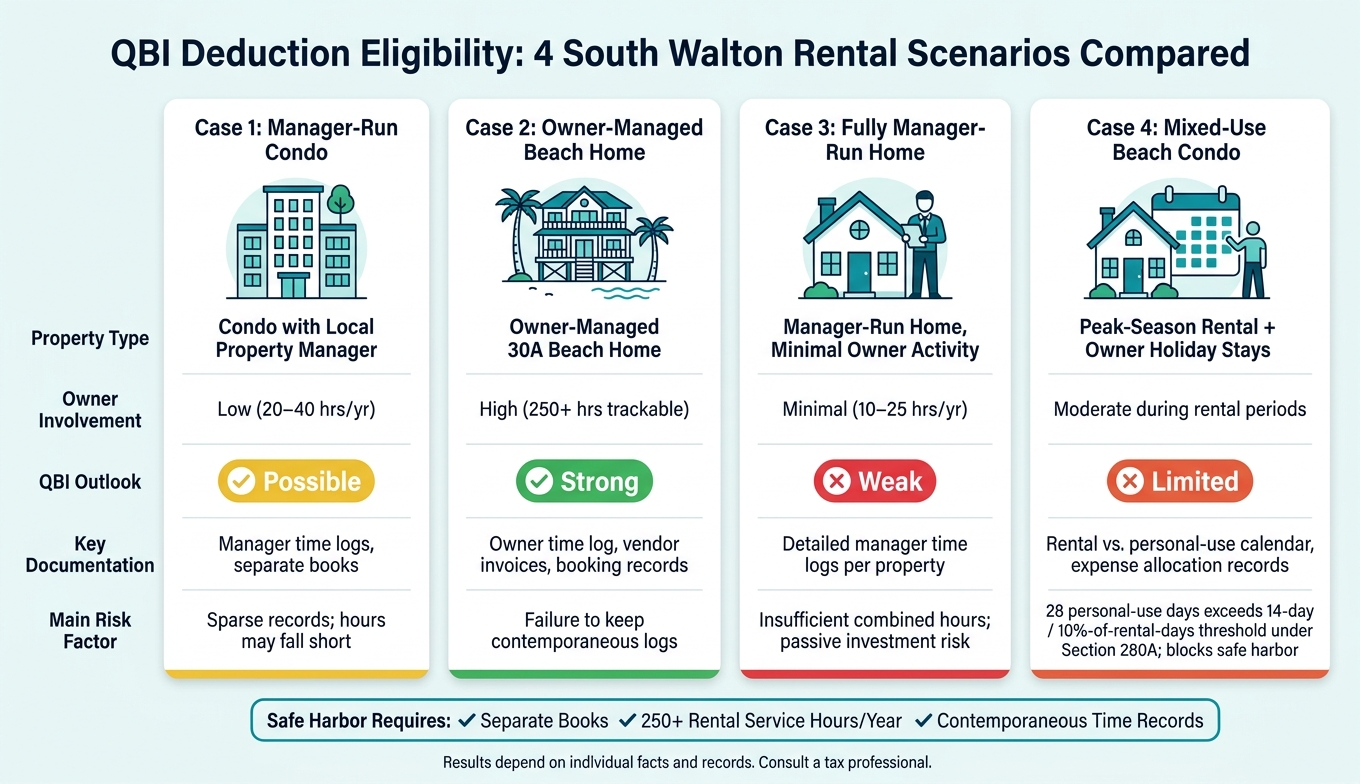
QBI Deduction Eligibility: 4 South Walton Rental Scenarios Compared
These examples show how the same QBI rules can lead to different results based on who does the work and how well that work is tracked.
Case 1: Condo managed by a South Walton rental company
Take a 2-bedroom condo in a South Walton resort community. A local rental company handles almost all daily work: listing management, dynamic pricing, guest communication, cleaning coordination, and routine maintenance. The owner's role is light, usually about 20–40 hours a year, mostly spent reviewing monthly statements and approving larger repairs.
Illustrative annual figures:
| Item | Amount |
|---|---|
| Gross rental income (170 nights @ avg. $500/night) | $85,000 |
| Management fees (20%) | $17,000 |
| Cleaning and laundry | $8,000 |
| Repairs and maintenance | $4,000 |
| Property taxes and insurance | $7,500 |
| Utilities, internet, HOA dues | $12,500 |
| Net rental income (potential QBI) | $36,000 |
On paper, documented staff and vendor hours can get past 250 hours. But that's not the whole ballgame. The big issue is whether the management company keeps usable time logs and whether the rental books are kept separate. If those records are in place, the enterprise may still satisfy the rental real estate safe harbor even when the owner is barely involved. If not, the analysis moves to a Section 162 facts-and-circumstances review.
This is likely QBI if the manager's logs and separate books are complete. Minimal owner involvement does not sink the setup if the records are clean.
Case 2: Owner-managed beach home on 30A
Now look at a beach home on 30A where the owner handles the full operation personally: listing updates, booking approvals, guest messaging, vendor scheduling, supply runs, and turnover inspections. This kind of setup gives the owner the clearest path to the 250-hour threshold.
The owner may log about 217 hours before adding another 40–60 hours of rental administration. Not every task counts, though. Investment reviews, refinancing, and acquisition research do not count toward the total.
This is the strongest safe-harbor case because the owner can track the work directly. There is less guesswork, fewer missing records, and less dependence on a third-party manager. Once the owner steps back, though, the picture changes fast. At that point, the manager's records start to matter more than the owner's hours.
Case 3: Manager-run beach home with little owner activity
This example involves a higher-end 30A home under full-service third-party management. The manager handles marketing, guest screening, cleaning, landscaping, and preventive maintenance. The owner mostly reviews monthly statements and weighs in on major capital projects or annual pricing decisions, for about 10–25 hours a year of direct involvement.
Low owner involvement does not automatically kill the safe harbor. What matters is whether the manager's employees and contractors can show qualifying hours for that specific property. That takes detailed time logs and activity records tied to the rental enterprise.
Here's the problem: this setup can drift too far into passive territory. If the facts look more like investment oversight than an active rental business, the safe harbor may fail. And if that happens, the backup Section 162 case may not be strong either.
Of the three, this is the weakest setup unless the manager can prove the qualifying hours. If the owner also uses the home personally, there's another layer to deal with: personal-use limits.
Case study: Mixed-use vacation rental with owner stays
Unlike Case 3, this condo’s holiday use changes the QBI analysis.
Case 4: Beach condo rented in peak season and used by the owner on holidays
This example turns on one thing: personal use.
Picture a 2-bedroom condo in Seagrove Beach. The owner rents it to unrelated guests from June 1 through August 15, for 65 rental days, at an average of $400 per night. That brings in $26,000 in peak-season gross income. A few shoulder-season weekends in May and September add $3,500, so annual gross income reaches $29,500.
The owner also uses the condo during the year: spring break for 8 days in March, Thanksgiving week for 5 days, and a year-end trip for 6 days, plus a couple of long weekends. That adds up to 28 personal-use days. And that’s where things shift. Even with solid rental income, owner stays can change the tax result.
Because personal use exceeds the greater of 14 days or 10% of rental days, the condo is treated as a residence under Section 280A. That residence status blocks the Section 199A rental real estate safe harbor. Once a mixed-use property is treated as a residence, rental deductions are limited to gross rental income, and excess expenses carry forward instead of creating a current-year loss.
So QBI doesn’t disappear from the conversation, but the path gets narrower. At that point, QBI depends on trade-or-business status and how the owner allocates rental use.
The fallback is Section 162 trade-or-business treatment. That means the activity must be regular, continuous, and aimed at profit. In plain English, the owner needs to show this isn’t just a casual side arrangement. Records matter here, including:
- Separate books
- Guest logs
- Manager records
- Vendor invoices
Those items help support the Section 162 position.
Tax treatment takeaway for mixed-use rentals
The practical lesson is pretty direct: personal-use days can be the one fact that changes the QBI answer, even when rental income looks strong.
This condo may still lose safe-harbor eligibility if holiday stays push personal use above the Section 280A threshold. Then the owner has to move to a Section 162 analysis.
To protect QBI eligibility, owners should keep personal stays modest and move them away from peak holiday weeks on 30A. In this setting, the calendar can matter more than the revenue.
This case shows why the owner-use calendar often controls the QBI result.
Conclusion: What changes the QBI answer for South Walton rentals
A 30A address doesn't decide QBI. Operations and records do. In these four examples, the answer comes down to the same core variables.
Use the summary below as the quick read across all four cases.
| Factor | QBI impact |
|---|---|
| Property type | Both condos and beach homes can qualify; the form matters less than the operations. |
| Owner-managed setup | Tends to produce clearer evidence because the owner's hours and tasks are directly traceable. |
| Manager-run setup | Can still qualify, but enterprise documentation - contracts, reports, invoices - carries more weight. |
| Mixed personal use | Creates the most uncertainty; precise day-count tracking and a profit-focused approach are needed. |
| Separate review for each rental | Each rental needs its own assessment, even if two properties share the same owner and street. |
Across all four cases, QBI hinged on four things: service hours, records, management structure, and personal use.
One habit makes a big difference: treat each property as its own business file. Keep separate books, separate logs, and separate calendars. An owner with two South Walton rentals may find that one qualifies for QBI while the other does not, simply because the facts are different.
The right QBI answer depends on the property's actual hours, records, and use pattern. A tax professional who knows real estate QBI can review each property's facts and records.
FAQs
Can one rental qualify for QBI if my other South Walton rental does not?
Yes. One rental can qualify for the QBI deduction while another does not.
QBI treatment is decided property by property, not across your full portfolio. Each South Walton rental is reviewed based on how that specific unit is used, including whether it’s a short-term rental and whether you materially participate in that particular property.
Which rental activities count toward the 250-hour QBI test?
For the 250-hour safe harbor for QBI, count time spent on rental services like:
- Advertising the property
- Working on leases
- Screening tenants
- Collecting rent
- Handling day-to-day operations
- Maintenance and repairs
- Property management
- Buying materials
- Supervising workers
You should also keep contemporaneous records, including time logs.
Time spent traveling usually does not count. The same goes for investment-type tasks, such as reviewing financial statements or planning for long-term capital needs.
How much personal use is too much for QBI eligibility?
The IRS treats the property as a personal residence if your personal use goes over the greater of:
- 14 days
- 10% of the days the property is rented at fair market value
If you cross that line, you have to split expenses and depreciation between rental use and personal use. That can limit your rental loss deductions.
And there's a catch here: days used by friends or family usually count as personal use too.