Homestead Exemptions for Seniors in Walton County
Seniors 65+ in Walton County can slash property taxes with standard, low-income and 25-year homestead exemptions; apply in person by March 1.
For seniors in Walton County, property tax exemptions can lead to significant savings. If you're 65 or older and own your primary residence, you may qualify for exemptions that reduce your taxable property value, potentially saving up to $2,400 annually. Here's what you need to know:
- Standard Homestead Exemption: Reduces taxable value by up to $50,000.
- Additional Senior Exemptions: Includes a $25,000 reduction for residents aged 65+ and a low-income senior exemption offering another $50,000 reduction if your household income is below $38,686 for 2026.
- Long-Term Residency Benefit: Seniors aged 65+ who’ve lived in their home for 25+ years may qualify for a full exemption if the property’s value is under $250,000.
Applications must be submitted in person at the Walton County Property Appraiser's office by March 1 each year. Required documents include proof of age, residency, income (if applying for low-income exemptions), and ownership. Forms like DR-501 and DR-501SC are essential. Once approved, most exemptions renew automatically, except for the low-income senior exemption, which requires annual income verification.
To maximize your savings, gather the necessary paperwork and apply on time.
Florida’s Brand New Expanded Homestead Exemptions For Seniors Starts Now - Senior Relief Tax 2026!
Who Qualifies for Senior Homestead Exemptions
If you’re a senior in Walton County, specific residency, ownership, age, and income conditions must be met to qualify for homestead exemptions. Let’s break down the requirements so you can determine if you’re eligible.
Residency and Ownership Requirements
To qualify, the property must be your permanent residence - your full-time, exclusive home. Walton County verifies this through official records and documentation, so make sure your paperwork reflects your residency.
Additionally, you need to have legal or equitable ownership of the property as of January 1 of the application year. This means the deed or other ownership documents must be recorded in Walton County’s official records. For those who purchase a home late in the year, ensure the deed is recorded before January 1 to qualify for that tax year.
Age and Income Requirements
You must be at least 65 years old by January 1 of the year you’re applying . If your birthday falls on January 2 or later, you’ll need to wait until the following year to apply. Proof of age can be provided using a Florida Driver’s License or Florida Identification Card that lists your current address . If you don’t have either, alternative documents like a birth certificate or voter registration card are acceptable.
For the low-income senior exemption, there’s an extra step: your household adjusted gross income must be below the limit set annually by the Florida Department of Revenue. This threshold changes each year to account for cost-of-living adjustments. When calculating household income, include the adjusted gross income of everyone living in the home, except boarders or renters. To confirm the current income limit, you can contact the Walton County Property Appraiser's Office at 892-8123 .
Once you’ve verified your eligibility, you can explore the different types of exemptions available.
Types of Homestead Exemptions for Seniors
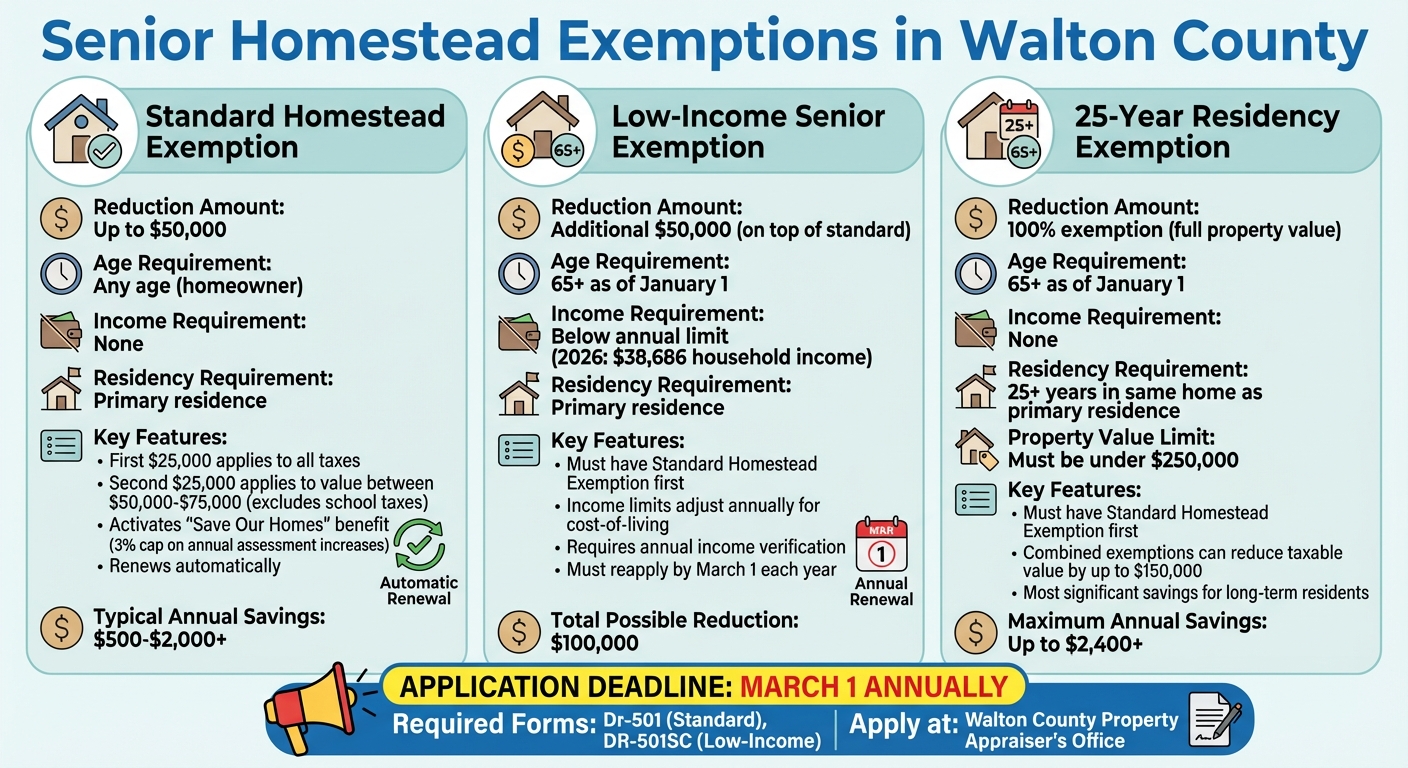
Walton County Senior Homestead Exemptions Comparison Chart
Walton County seniors have access to three homestead exemptions that can help reduce property taxes.
Standard Homestead Exemption
The Standard Homestead Exemption allows homeowners to lower the taxable value of their primary residence by up to $50,000. To qualify for additional senior-specific benefits, this exemption must be claimed first. It works through a two-tier system: the first $25,000 applies to all tax components, while the second $25,000 applies only to the portion of value between $50,000 and $75,000 - excluding school taxes. Additionally, this exemption activates the "Save Our Homes" benefit, which caps annual increases in assessed property value.
"The Homestead Exemption is the foundation of Florida's property tax relief system. Not only does it provide immediate tax savings, but it also serves as the gateway to additional benefits like Save Our Homes assessment caps and portability."
– Robert Martinez, Florida Property Appraiser
Once approved, the exemption renews automatically each year, provided your residency status remains unchanged. Florida seniors typically save between $500 and $2,000 or more annually through this exemption.
Low-Income Senior Exemption
Seniors aged 65 and older with lower incomes may qualify for an additional $50,000 reduction on top of the standard exemption. Eligibility is determined by income limits, which are adjusted annually to reflect cost-of-living changes set by the Florida Department of Revenue. To take advantage of this exemption, applications must be submitted by March 1 of the relevant tax year.
25-Year Residency Exemption
For long-term residents, there’s an even greater benefit. Seniors who are 65 or older as of January 1 and have lived in their home as a permanent residence for at least 25 years may qualify for a full (100%) exemption of the assessed value of their property - provided the property's just value is under $250,000. To be eligible for this benefit, homeowners must first claim the Standard Homestead Exemption. When combined, these exemptions can reduce taxable property value by up to $150,000.
With these exemptions outlined, gather the necessary documents to begin your application process.
Documents and Forms You'll Need
To meet the March 1 deadline for your application, you'll need to gather specific documents that confirm ownership, residency, and eligibility. These items are essential for verifying your status before visiting the Property Appraiser's office. Here's a breakdown of what you'll need to prepare.
Required Documents
Start by presenting a recorded deed or tax bill that proves legal ownership of the property as of January 1. You'll also need to provide Social Security cards, W-2 forms, or tax returns for all property owners.
Make sure to bring a valid Florida Driver's License or Florida ID showing your current property address. Additionally, all Florida vehicle registrations should list your homestead address. To further confirm residency, include either a Voter Registration Card or a Declaration of Domicile. If you're not a U.S. citizen, include a copy of your unexpired Permanent Resident Card.
For exemptions specifically for seniors, bring proof of age that shows you were 65 or older as of January 1. If you're applying for the Low-Income Senior Exemption, you'll need to submit federal tax forms such as 1040, 1040A, or 1040EZ, along with SSA-1099, W-2s, and other relevant 1099 forms for all household residents. Remember, household income includes the adjusted gross income of everyone living in the home, not just the property owner.
Application Forms
The main form you'll need is DR-501 (Original Application for Ad Valorem Tax Exemption), which covers the Standard Homestead Exemption . If you're applying for the Low-Income Senior Exemption, you'll also need to complete DR-501SC (Adjusted Gross Household Income Sworn Statement and Return). This form acts as an affidavit to declare your household income .
All these forms are available on the Walton County Property Appraiser's website at waltonpa.com, at their office, or through their online portal . If you're transferring "Save Our Homes" benefits from a prior Florida homestead, ask about Form DR-501T (Transfer of Homestead Assessment Difference) to port your assessment cap .
How to Apply for Homestead Exemptions
Step 1: Verify Eligibility and Gather Documents
Start by confirming that you meet the eligibility requirements outlined earlier. Make sure your Florida Driver's License and vehicle registration reflect your current property address. Refer to the Documents section for a complete list of what you’ll need. Once you’ve verified your eligibility and collected all necessary documents, you’re ready to move on to the application process.
Step 2: Complete and Submit the Application
Using the documents you’ve prepared (see the Documents and Forms section), fill out the appropriate application form. For the Standard Homestead Exemption, use Form DR-501. If you’re applying for the Low-Income Senior Exemption, complete Form DR-501SC. Applications can be submitted online, by mail, or in person at the Walton County Property Appraiser's office. However, first-time applicants are required to apply in person. Keep in mind, the deadline is strict: March 1 of the tax year. As noted by the Walton County Tax Collector:
"If you fail to make an application for an exemption by March 1 of the tax year you shall not be eligible for an exemption that tax year".
Step 3: Monitor Your Application and Handle Renewals
Check your August Trim Notice to confirm your exemptions have been applied. This notice ensures your application was processed correctly. The Standard Homestead Exemption renews automatically unless there’s a change in ownership. However, the Low-Income Senior Exemption requires yearly renewal. As stated by the Walton County Property Appraiser:
"The applicant must submit a sworn statement of household income to the property appraiser no later than March 1 each year".
To renew the Low-Income Senior Exemption, submit Form DR-501SC along with updated income documentation annually by March 1.
Conclusion
Homestead exemptions can significantly lower property taxes for seniors in Walton County. By combining the standard homestead exemption with senior-specific benefits, you could reduce your home's taxable value by $50,000 to $100,000 or more. This could mean annual savings of up to $2,400, while the Save Our Homes protection caps annual assessment increases at 3%.
To take advantage of these benefits, make sure to submit all applications by March 1 to qualify for that tax year. Keep in mind that while the standard exemption renews automatically, the senior exemption requires you to provide income documentation every year.
If you're 65 or older and own your primary residence in Walton County, these exemptions could offer meaningful financial relief. For example, the income limit for the senior exemption in 2026 is $38,686. Additionally, those earning less than $10,000 (or $12,000 if aged 70 or older) may qualify for a full property tax deferral.
Make sure to gather the necessary documents, confirm your eligibility, and visit the Walton County Property Appraiser's office by March 1. As mortgage expert Phil Ganz explains:
"Florida offers some of the most senior-friendly property tax exemptions in the country, but the savings depend on applying correctly and on time."
Don’t wait - apply before March 1 to secure these savings.
FAQs
What happens if I miss the March 1 deadline?
If you don’t get your homestead exemption application submitted in Walton County by March 1, you’ll miss out on the tax benefits for that year. Make sure to file on time to enjoy potential property tax savings.
Can I apply if my deed wasn’t recorded by January 1?
If your deed isn’t recorded by January 1, you generally won’t be eligible for the homestead exemption for that year. Recording the deed by this date is crucial, as it serves as proof of ownership and is used for assessment purposes. To ensure you qualify, make sure your deed is recorded before January 1.
Does rental income count toward the low-income limit?
In Walton County, rental income does not count when calculating the low-income limit for homestead exemptions. This policy ensures that seniors seeking exemptions are evaluated based on other eligible income sources.