
How to Evaluate Skilled Nursing Care Quality
Don't choose a skilled nursing facility by stars alone; check Medicare and state reports, tour more than once, and verify staffing and therapy.

The short answer: I would not choose a skilled nursing facility based on the star rating alone. I would check Medicare Care Compare, read state inspection and complaint reports, visit the building more than once, and ask direct questions about staffing, therapy, call-light response, infection control, and turnover.
Here’s the core of it in plain English:
- Start with public data. A low inspection score, repeat citations, or weak short-stay rehab outcomes can point to trouble.
- Tour in person. Look for odors, soiled linens, clutter, poor lighting, unanswered call lights, and residents who seem ignored.
- Check staffing closely. Ask about nurse and CNA coverage by shift, weekend coverage, call-outs, agency use, and turnover.
- Look at rehab results. For short-term rehab, focus on discharge home, readmissions, ED visits, functional gains, and whether therapy is offered on weekends.
- Match the care to the goal. Post-surgery rehab needs are not the same as long-term skilled nursing needs.
- Rule out places with repeat red flags. If the data and your tour both point to the same problems, I would move on.
A few numbers stand out:
- Medicare’s overall nursing home rating is shaped first by health inspections, then adjusted by staffing and quality data.
- About 31% of nursing homes had at least one deficiency type cited five or more times over a review period.
- One study found that each added hour of therapy per week was tied to a 3.1 percentage-point higher chance of discharge home or back to the community.
If I were helping someone choose, I’d use one simple test: does the place look good on paper and in person? If not, it would not make my shortlist.
| What I’d Check First | What I’d Want to See | What Would Worry Me |
|---|---|---|
| Medicare ratings | Solid inspection, staffing, and quality scores | Low inspection score or weak staffing |
| State reports | Few recent deficiencies, no repeat pattern | Repeat citations or complaint history |
| Staffing | Clear answers, stable team, low agency use | Vague answers, high turnover, heavy agency use |
| Therapy | Frequent PT/OT/SLP, clear goals, family updates | Limited access, no weekend therapy, vague progress |
| Daily care | Clean rooms, prompt help, residents well cared for | Odors, soiled linens, missed care, ignored residents |
| Final fit | Care needs match the facility’s strengths | Sales pitch does not match what I see |
Use this as your filter before you spend time on full tours and admissions calls.
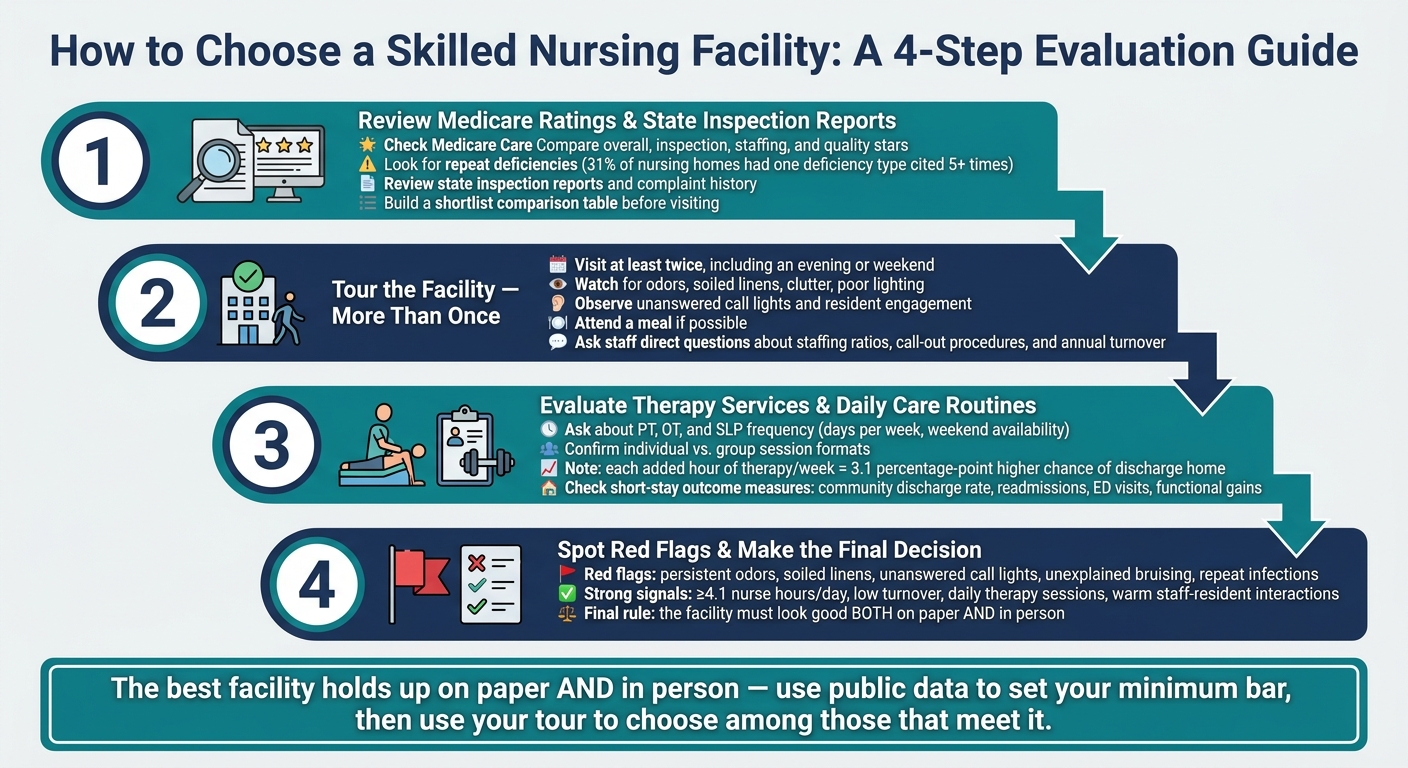
How to Choose a Skilled Nursing Facility: 4-Step Evaluation Guide
Step 1: Review Medicare Ratings and State Inspection Reports
Before you tour any facility, check the public data first. Medicare Care Compare lists every Medicare- and Medicaid-certified nursing home's overall star rating, along with separate scores for inspections, staffing, and quality measures. Start with the headline ratings. Then look under the hood to see what’s driving them.
How to Read Medicare Care Compare Results
The overall star rating is a starting point, not the full picture. CMS bases the overall score first on health inspections, then adjusts it using staffing and quality measures. If a facility has a 1-star health inspection score, that score puts a cap on the overall rating. So don’t stop at the big number. Check each of the three domain scores on its own.
For a short-term rehab stay, focus on the short-stay quality measures that matter most: discharge to community, hospital readmissions, and functional improvement. If a facility posts weak discharge or readmission scores, that should matter more than anything in a brochure.
Check State Reports for Deficiencies and Complaint History
Medicare ratings give you the summary. State inspection reports give you the detail behind it. About 31% of nursing homes had at least one deficiency type cited five or more times over a review period. That kind of repeat pattern can point to poor management or weak follow-through after problems are found.
In Florida, the Agency for Health Care Administration (AHCA) posts inspection reports and Statements of Deficiencies online for licensed nursing homes, including facilities near South Walton and the 30A corridor. Compare AHCA records with Care Compare data to see whether a facility’s recent survey history looks clean or shows a pattern of cited problems. Florida AHCA reports usually appear 30–45 days after an inspection. If a recent survey isn’t posted yet, check again later.
Build a Facility Comparison Table Before Visiting
Once you’ve reviewed ratings and reports, make a shortlist of places that seem worth a visit. Put your top options into a comparison table before you tour.
| Facility | Overall Stars | Staffing Stars | Major Inspection Issues | Short-Stay Rehab Outcomes | State Report Notes |
|---|---|---|---|---|---|
| Facility A | - | - | - | - | - |
| Facility B | - | - | - | - | - |
| Facility C | - | - | - | - | - |
A facility with repeated citations, unresolved complaints, or a low staffing score paired with a mediocre inspection rating should stand out right away. Use the table to narrow your list before visiting. Then see if the care you observe lines up with what the reports show.
sbb-itb-d06eda6
Step 2: Tour the Facility and Ask Staff Direct Questions
Online ratings show what inspectors found. A tour shows what daily life feels like for residents.
Once you have a shortlist, visit each top facility more than once. Try to include a meal, plus one evening or weekend visit. That gives you a better read on whether the staffing and care patterns from the reports show up in day-to-day life.
What to Look for During the Tour
Start with the smell. If you notice urine, feces, mildew, or strong deodorizer odors in hallways or common areas that stick around, that's a red flag. It can point to weak housekeeping or poor incontinence care. A short-lived odor near one room can happen. A smell that follows you through the building shouldn't.
Walk through resident rooms, bathrooms, dining areas, and therapy spaces. Look for clear hallways, sturdy handrails, good lighting, non-skid floors, call bells residents can reach, residents who are clean and dressed for the season, and staff who greet residents by name.
What you see should line up with what staff tell you.
Watch a meal if you can. Pay attention to whether residents who need help eating actually get help, whether special diets are served the right way, and whether the room stays calm instead of rushed or chaotic.
Questions to Ask About Staffing, Response Times, and Turnover
A polished tour can only tell you so much, so ask direct questions.
Ask for the nurse-to-resident and CNA-to-resident ratios by shift, including evenings, nights, weekends, and holidays. Then ask what happens when someone calls out. Does the facility use an on-call pool, or does it depend a lot on agency staff?
You should also ask about call lights. Find out the target response time, how the facility tracks actual response times, and what staff do when a call goes unanswered. Then ask about annual turnover for CNAs, nurses, and leadership. It also helps to ask how long the director of nursing and the administrator have been in their jobs.
Use a Tour Notes Table to Compare Facilities
Write down your notes right after each visit so the details don't blend together.
Be specific. Instead of writing seemed clean, write no odors in hallways. Instead of looked fine, write some clutter near the therapy gym. Those small details are what make side-by-side comparisons much more useful later.
| Category | Facility A | Facility B | Facility C |
|---|---|---|---|
| Environment (odors, lighting, clutter) | - | - | - |
| Staff interaction with residents | - | - | - |
| Dining (diet accommodations, assistance) | - | - | - |
| Resident appearance and engagement | - | - | - |
| Safety features (handrails, call bells, lighting) | - | - | - |
| Overall concerns or red flags | - | - | - |
After that, compare your tour notes with the ratings and state reports. Then check whether the therapy program and daily routine fit the resident's needs.
Step 3: Evaluate Therapy Services and Daily Care Routines
After the tour, compare the therapy program with what you actually saw on the floor. The main thing to check is simple: do therapy and daily care fit the reason for placement? That could mean short-term rehab or longer skilled nursing care. Either way, the setup should support measurable recovery, not just basic comfort.
How to Assess Physical, Occupational, and Speech Therapy Access
Ask this plainly: How many days per week will the resident receive physical therapy (PT), occupational therapy (OT), and speech therapy (SLP)? Are sessions offered on weekends? For Medicare-covered skilled care, services generally need to be needed daily.
You should also ask how therapy is delivered. Are sessions individual, shared, or group sessions? When does the facility use each format? Who builds the therapy plan? How often are goals checked again? How often does staff update family members? And what happens if the resident's condition shifts, like more fatigue or a new medication that affects balance?
That last part matters more than it may seem. A therapy plan can look fine on paper but fall apart if staff don't adjust it when the resident's needs change.
Research points in the same direction: one study found that each additional hour of therapy per week was tied to a 3.1-percentage-point increase in the chance that a patient would be discharged home or back to the community. If the goal is a safe return home, that's not a small detail.
What a Strong Daily Routine Looks Like
A strong recovery-focused daily care routine means residents get timely help with bathing, dressing, toileting, transfers, and walking based on their needs, not just when staff happen to be available. CMS guidance says residents should be able to keep their own schedules for waking, meals, bathing, and bedtime when possible.
This is where it helps to watch the day in motion. Are residents being walked between therapy sessions? Do meal times line up with therapy and hydration needs? Does the activity schedule match what people are actually doing, or does it just look nice on paper?
One sign stands out fast: if a resident is left sitting in a wheelchair for long stretches without repositioning or mobility help, that's a warning that the routine is not focused on recovery.
Compare Rehab Programs in a Simple Table
Use the same comparison format for rehab details. Fill in each row with what each facility tells you during your tour or pre-admission call. Use specifics, not gut feelings.
| Evaluation Area | Facility A | Facility B | Facility C |
|---|---|---|---|
| PT/OT/SLP frequency (days per week) | - | - | - |
| Weekend therapy availability | - | - | - |
| Session format (individual/shared/group) | - | - | - |
| Condition-specific rehab support | - | - | - |
| Family update process and frequency | - | - | - |
| Short-stay outcome measures (community discharge, readmissions, ED visits, and functional gains) | - | - | - |
Once you fill it in, compare those answers with what CMS tracks for short-stay residents: community discharge, readmissions, ED visits, and functional gains during the stay. Those measures help show whether the rehab program leads to actual discharge results. If the numbers and daily routines look weak here, the same problems usually show up again in the red flags.
Step 4: Spot Red Flags and Make the Final Choice
Red Flags That Point to Poor Care or Neglect
After you review records, tour the building, and look at therapy, it’s time for one last filter: rule out any place that still misses the basics. This is where you compare what the facility reports with what you saw with your own eyes.
Some warning signs show up right away. Red flags include persistent urine or fecal odor, soiled linens, unanswered call lights, poor grooming, fearful or distressed residents, unexplained bruising, repeated falls, and recurring infections.
Watch the residents closely. Do they look clean, calm, and cared for? Or do they seem withdrawn, upset, or ignored? Unexplained bruising, repeated falls with vague explanations, or a pattern of repeat UTIs and other infections should set off alarm bells. If you see that, check the facility’s Medicare Care Compare quality measures and state inspection history to see if the same problems show up there too.
If you notice several red flags at once, move on. That alone is enough to cross a facility off your list.
Final Decision Checklist
Now pull together your notes from Steps 1 to 3 and compare each facility side by side. Look at records, staffing, therapy, cleanliness, communication, and resident dignity.
| Decision Area | What to Look For | Strong Signal | Concerning Signal |
|---|---|---|---|
| Medicare & state records | Inspection stars, deficiency counts, abuse flags | Few deficiencies, no abuse icon | Repeated citations, abuse flag present |
| Staffing stability | Nurse hours/day, turnover rate, agency reliance | ≥4.1 hours/day, low turnover | Below average hours, high agency use |
| Rehab results | PT/OT/SLP frequency, individual sessions, outcomes | Daily sessions, clear discharge goals | Group-only, vague progress tracking |
| Basic care quality | Odors, linens, grooming, call-light response | Clean, prompt response, well-groomed residents | Odors, soiled linens, unanswered lights |
| Communication | Staff transparency, care conferences, family updates | Direct answers, documented policies | Deflection, vague responses, no clear process |
| Resident dignity | Tone, engagement, resident mood | Warm interactions, residents appear engaged | Dismissive staff, withdrawn or fearful residents |
Use this table to pick the facility that looks strongest across records, staffing, therapy, and day-to-day care.
Conclusion: Choose the Facility That Matches on Paper and in Person
Pick the facility that holds up both on paper and in person. Start with public data to set your minimum quality bar. Then use what you saw during the tour to decide among the places that meet that bar.
FAQs
How many tours should I do?
There’s no set number, but you should visit more than once if you want a clear picture of the facility.
Make a few visits at different times, including unannounced ones. That gives you a better chance to see how staff treat residents, what the food is like, and how the place feels during a normal day. More than one tour can also help you notice care patterns - or spot problems - that a scheduled visit might not show.
Which staffing questions matter most?
Ask about staff-to-resident ratios across every shift, especially nights and weekends, when staffing may be thinner.
It also helps to ask whether the facility depends on temporary agency workers or mainly permanent, full-time employees. High turnover can interrupt care and make day-to-day support less steady.
And pay close attention to how staff answer. If they seem vague or rude, treat that as a red flag.
What red flags should rule out a facility?
Rule out a facility if you notice signs of neglect or poor upkeep. That can include unwashed hair, soiled clothing, unexplained injuries, bedsores, weight loss, bad odors, dirt, clutter, or dim lighting.
You should also walk away if the staff seem rude, stretched too thin, or inattentive. The same goes if they dodge your questions, ignore call lights, or if residents seem isolated and disengaged. Repeated problems with safety, cleanliness, or outbreaks are another bad sign.
And if your gut says something’s off, listen to it.