Real Estate Trends in 30A Neighborhoods 2026
Buyers gain leverage on 30A as inventory rises; luxury leads recovery while mid-range holds—prioritize move-in-ready, long-term value.
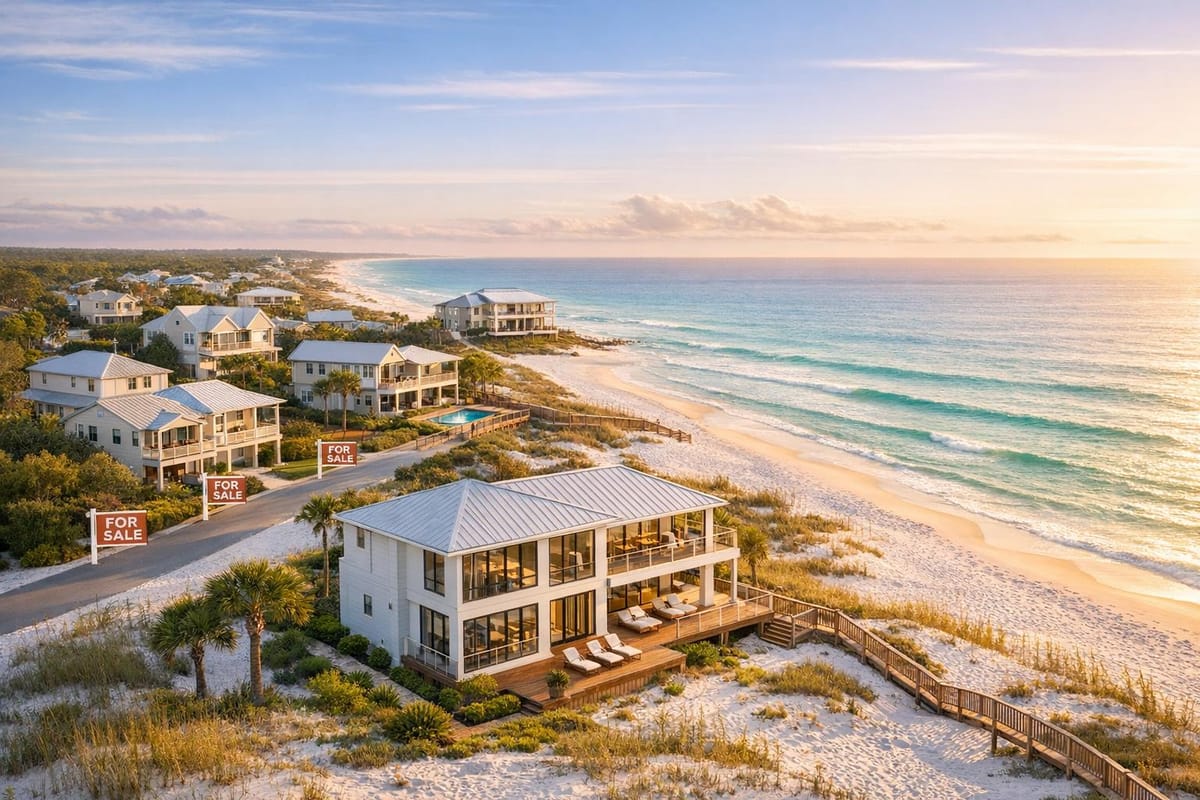
The 30A real estate market is shifting in 2026, offering opportunities for buyers amidst stabilizing prices and growing inventory. Here's what you need to know:
- Market Shift: Homes are spending more time on the market (107–136 days), with buyers gaining leverage as inventory levels rise.
- Price Trends: Median sold prices in 30A East dropped 30.6% year-over-year in December 2025 but showed slight recovery in early 2026. Luxury properties are appreciating, while mid-range homes remain steady, while mid-range homes remain steady.
- Buyer Conditions: Santa Rosa Beach and 30A West offer negotiation power with higher inventory and homes selling at around 92–93% of list price.
- Lifestyle Appeal: Remote work continues to drive demand, with buyers prioritizing coastal living and community-focused neighborhoods.
- Challenges: Rising construction and insurance costs are pushing buyers toward updated, move-in-ready properties.
Key Takeaway: The market is favoring long-term investments over quick flips. Buyers should focus on well-priced homes in desirable neighborhoods or those with potential for future value growth.
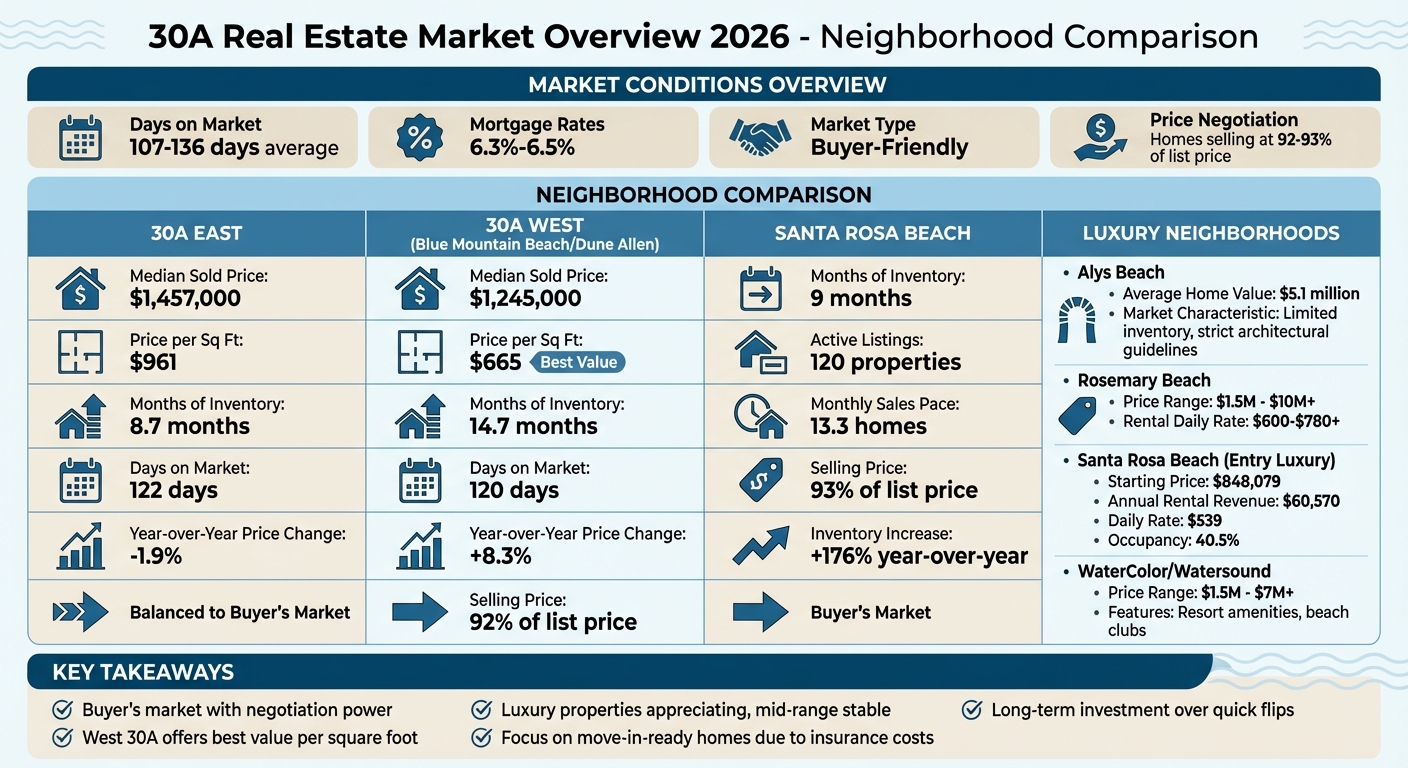
30A Real Estate Market Snapshot 2026: Key Neighborhoods Comparison
30A Real Estate Market Update 2026 - Inventory Surge but Buyers Are Still Closing
Market Overview and Growth Factors
By 2026, the 30A real estate market has settled into a more balanced and deliberate phase, a stark contrast to the frenzied bidding wars of the early 2020s. Homes now spend an average of 107 to 136 days on the market, signaling a shift toward a buyer-friendly environment where long-term value takes priority. Buyers are no longer rushing to secure properties for quick gains; instead, they're focusing on quality and community. This change has brought a sense of stability to the market. As Smith Burke puts it:
The 2026 market isn't about 'timing the bottom' - it's about securing the right asset with less competition.
This steadying trend aligns with an increasing emphasis on lifestyle factors that influence how to choose a 30A neighborhood along the coastal corridor.
Lifestyle Appeal and Remote Work Migration
The ongoing flexibility of remote work continues to attract buyers to 30A communities, with many seeking permanent or semi-permanent coastal living options. The market has evolved from being driven by short-term investment buzz to one where quality of life takes center stage. Buyers now prioritize neighborhoods with thoughtful planning, cohesive architectural styles, and a welcoming community atmosphere. This lifestyle-driven migration has reshaped demand, making 30A a key destination for those seeking a slower, more fulfilling pace of life.
Mortgage Rates and Buyer Activity
Mortgage rates have leveled off in the low 6% range (6.3%–6.5%). While these rates are higher than the historically low 3% seen earlier in the decade, their current stability has created what some call an "unlock effect." This environment allows luxury and second-home buyers to confidently plan for the long term without the volatility that characterized the 2022 market. Additionally, improvements in the insurance market - thanks to new providers and legislative changes - have further reduced uncertainty, making it easier for buyers to move forward with their plans.
Inventory Levels and Market Conditions
In 2026, inventory levels across 30A have climbed beyond what’s considered a balanced market. For instance, properties in the 30A East area are now spending an average of 122 days on the market as of January 2026 - an increase of 15.1% compared to the previous year. These shifts highlight varying market conditions across 30A neighborhoods.
Rising Inventory and Longer Listing Periods
The 30A East market currently holds 8.7 months of inventory, exceeding the 6-month threshold that typically signals a balanced market. This surplus has brought a sense of stability. As local real estate agent Candice KausHagen puts it:
"This isn't chaos. It's normalization."
Santa Rosa Beach, in particular, has seen a dramatic 176% increase in available homes, now holding about 9 months of inventory. This figure is based on 120 active listings and a monthly sales pace of 13.3. Despite the growing inventory, there’s still activity - pending contracts in 30A East jumped 17.7% between December 2025 and January 2026. Buyers, however, are being more selective, reflecting a shift in dynamics that presents unique opportunities in certain areas.
Buyer-Friendly Conditions in Select Areas
Santa Rosa Beach stands out as a buyer-friendly market in 2026. While new listings have slowed, the area continues to work through a backlog of existing inventory. Homes in this region are selling at 93% of their list price, giving buyers a 7% advantage in negotiations.
Meanwhile, Destin and Miramar Beach are also experiencing higher inventory levels compared to the core 30A neighborhoods. These conditions offer opportunities for buyers who are open to exploring a broader range of options. The market hasn’t collapsed - it’s simply adjusted to a pace where careful planning and informed decisions take center stage.
Pricing Changes and Market Adjustments
Median Price Changes and Negotiation Power
The 30A East market in 2026 is showing mixed signals when it comes to pricing trends. In January 2026, the median sold price reached $1,457,000. This marks a slight 1.9% decrease compared to the same time last year but a 6% increase from December 2025. On the other hand, the average sold price climbed to $2,593,000 - an 8.3% rise year-over-year and a sharp 21.2% jump month-over-month. What’s happening here? Luxury properties are gaining value, while mid-range homes are holding steady.
At the same time, buyers are taking advantage of these conditions. With the price per square foot increasing to $961 - a 5.1% boost from the previous year - buyers are using the extended market exposure to their benefit. They’re taking their time, conducting inspections, and negotiating deals. Real estate agent Candice KausHagen describes this as a "measured, normal negotiation range", emphasizing that buyers aren’t resorting to aggressive lowball offers. These pricing shifts naturally bring attention to rising costs tied to construction and insurance.
Construction and Insurance Costs Impact
Beyond pricing trends, rising construction and insurance costs are becoming major factors influencing buyer decisions. In 2026, homes with "Fortified" designations or recent mitigation upgrades are setting the bar for investments. Why? These features often translate to more competitive insurance rates. While Florida’s insurance market is stabilizing - thanks to new carriers and legislative reforms - the gap between costs for older homes and newer, upgraded properties remains substantial.
Buyers are showing a clear preference for move-in-ready homes over fixer-uppers. Properties that already include updates are seen as smarter investments, especially for those looking to minimize future insurance and maintenance costs. Long-term value is the name of the game, and buyers are prioritizing homes that help them avoid hefty renovation and upkeep expenses.
Individual Neighborhood Analysis
Let’s take a closer look at how different neighborhoods along the 30A corridor are shaping up, each offering its own trends and opportunities.
Alys Beach and Rosemary Beach
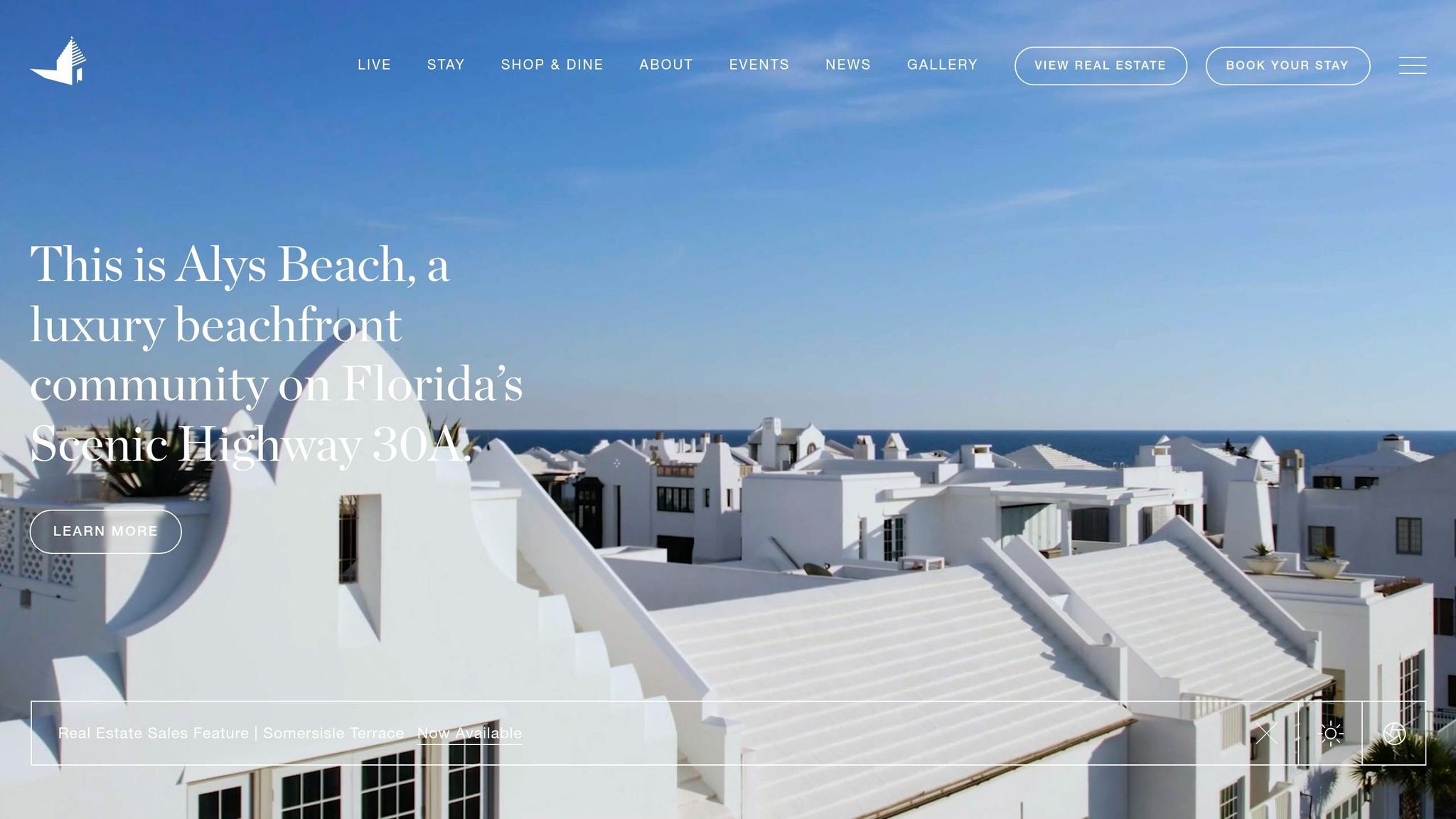
Alys Beach and Rosemary Beach are at the forefront of the high-end 30A market. Their appeal largely stems from the scarcity of land, which continues to drive demand as available lots dwindle. This scarcity ensures that properties in these neighborhoods sell faster than elsewhere along 30A, contributing significantly to regional price growth. For instance, a 2-bedroom, 2-bathroom home in Rosemary Beach, covering 1,388 square feet, is currently listed at $2,200,000.
Santa Rosa Beach
Santa Rosa Beach stands out for its variety of listings and gives buyers more room to negotiate. A prime example is a 6-bedroom, 8-bathroom home spanning 5,826 square feet, listed at $6,788,000. With a larger inventory, buyers here have the luxury of time to carefully evaluate properties and negotiate terms. While Santa Rosa Beach offers flexibility and options, Inlet Beach appeals to those prioritizing proximity to the beach.
Inlet Beach
Inlet Beach strikes a balance between affordability and convenience when compared to the premium markets of Alys and Rosemary Beach. It offers attractive pricing paired with easy beach access. For example, a 2-bedroom, 3-bathroom home with 1,395 square feet is listed at approximately $2,795,000.
Blue Mountain Beach and Dune Allen (30A West)
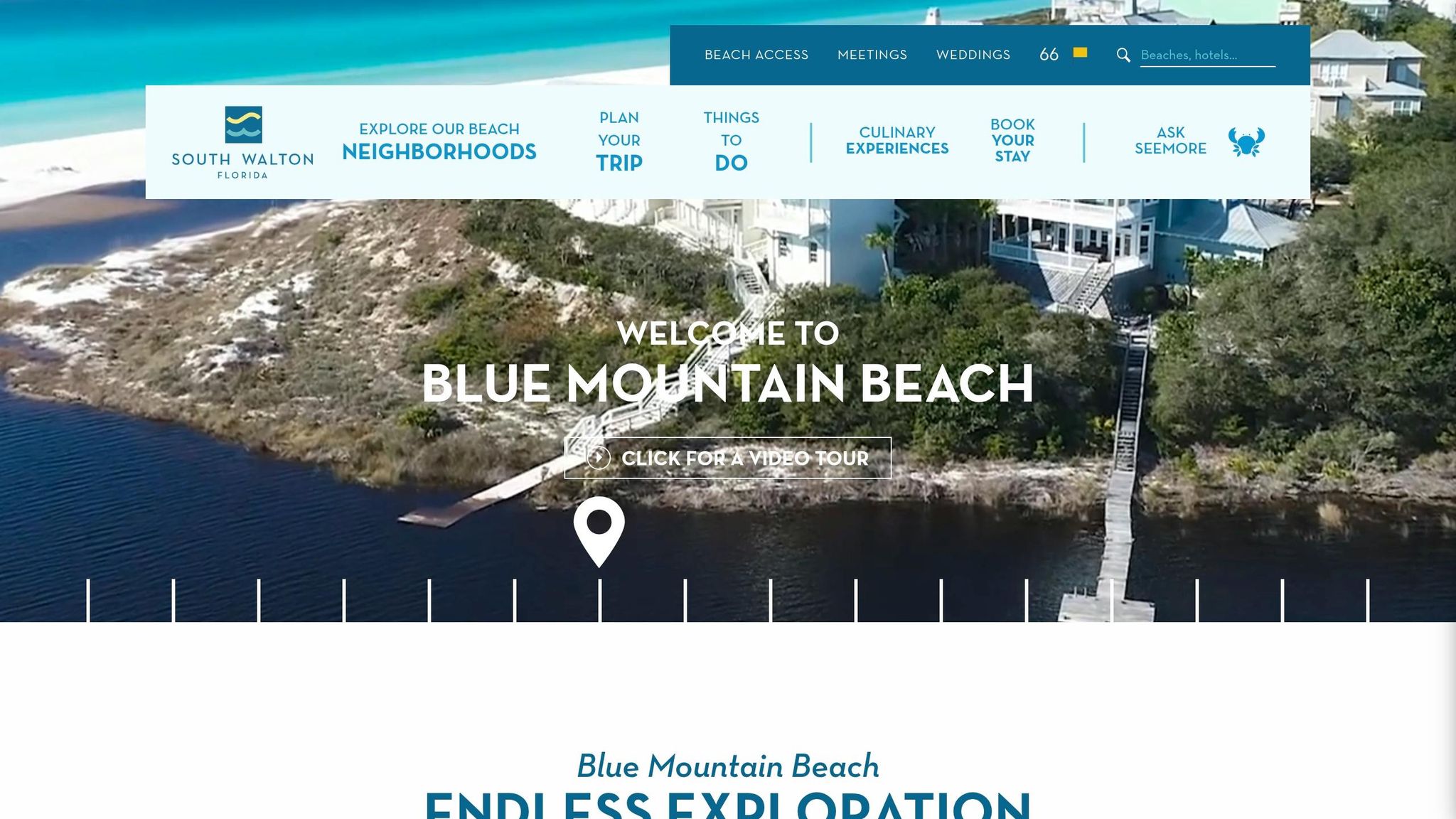
The western side of 30A, particularly Blue Mountain Beach and Dune Allen, is becoming a haven for value-conscious buyers. This area features larger lots and lower price-per-square-foot costs compared to the eastern side. In January 2026, the median sold price in 30A West reached $1,245,000, showing an 8.3% increase year-over-year. Meanwhile, the price per square foot rose by 21.1%, hitting $665. The market here currently reflects 14.7 months of closed-sale inventory, firmly placing it in buyer's market territory.
Real estate agent Candice Kaushagen sheds light on this trend:
Anything above six months signals buyer leverage. At 14.7, that leverage is meaningful.
With homes selling at 92% of their list price and pending contracts jumping 85.7% year-over-year, buyers have plenty of bargaining power. Properties are averaging 120 days on the market, giving buyers ample time to make informed decisions. For those seeking larger properties and lower costs per square foot, this area is an excellent choice along the 30A corridor. These patterns reflect a broader trend across 30A, where buyers are gaining more leverage and opportunities for strategic purchases.
Luxury Properties and Investment Potential
Luxury Neighborhood Comparison
The luxury real estate market along 30A showcases distinct opportunities based on neighborhood characteristics and investment goals. For instance, Alys Beach stands out with home values averaging around $5.1 million, bolstered by its strict architectural guidelines and limited inventory, which help maintain market stability. Meanwhile, Rosemary Beach offers a broader price range, from $1.5 million to over $10 million, with strong rental demand driving average daily rates between $600 and $780+.
For those seeking a lower entry point, Santa Rosa Beach presents an option with home values starting at approximately $848,079 and a median annual rental revenue of about $60,570. However, the average daily rate here is $539, coupled with an occupancy rate of 40.5%. On the higher end, WaterColor and Watersound feature properties ranging from $1.5 million to over $7 million, drawing buyers with resort-like amenities and exclusive beach clubs, which encourage extended guest stays.
Tourism's Role in Property Values
Tourism remains a key factor in sustaining luxury property values, with visitor numbers expected to stay strong through 2026. This consistent demand significantly impacts short-term rental destinations such as WaterColor and Seagrove, making them attractive for investors seeking reliable returns. Brad Dahler, Owner & Global Real Estate Advisor, highlights the broader appeal of luxury real estate:
Luxury real estate continues to prove its resilience, functioning not only as a lifestyle choice but also as a long-term store of value.
The market's evolution reflects a shift from speculative buying toward more strategic, long-term investments. Buyers are increasingly focused on properties with high-quality architecture and prime locations that balance personal use with rental income potential. Additionally, upgraded homes are drawing heightened interest due to competitive insurance premiums, further emphasizing the importance of thoughtful, targeted acquisitions.
2026 Market Summary and Recommendations
The 30A real estate market in 2026 leans toward long-term value investments. Demand remains strong, driven by the area's lifestyle appeal, second-home buyers, and permanent relocations. Prices are stabilizing with modest adjustments rather than significant declines, reflecting a market focused on sustained value rather than short-term gains. However, rising construction and insurance costs continue to keep home prices elevated, reinforcing this trend.
On the East 30A side, communities like Alys Beach and Rosemary Beach stand out for their appreciation potential. Limited land availability in these areas makes them attractive to buyers prioritizing lifestyle and long-term value. On the other hand, West 30A neighborhoods such as Blue Mountain Beach and Dune Allen present more buyer-friendly options. These areas offer higher inventory, lower price-per-square-foot, and larger lot sizes, appealing to those seeking value while enjoying the 30A lifestyle.
For buyers, the key strategy is targeting well-priced homes in sought-after neighborhoods. Sellers are more open to negotiating on secondary or overpriced listings, creating opportunities for serious buyers. It's essential to approach properties as long-term investments rather than short-term flips.
With construction and insurance costs climbing, focusing on existing, well-maintained homes or properties with renovation potential can be a smart move. These options often strike a balance between personal use and rental income potential. For more detailed guidance, check out sowal.co, a resource for navigating South Walton's unique communities and lifestyle.
The bottom line? Success in the 30A market comes to informed, patient buyers who see real estate here as both a lifestyle upgrade and a long-term store of value - not a quick profit opportunity.
FAQs
Which 30A neighborhoods are most buyer-friendly in 2026?
In 2026, West 30A emerges as the top choice for buyers, thanks to its combination of affordable home prices, spacious properties, and a thriving rental market. With a 14-month inventory, the area presents a strong buyer’s market, making it an appealing option for both investors and those planning a move.
How can buyers use longer days-on-market to negotiate better terms?
Buyers can take advantage of properties with longer days-on-market to negotiate better deals. When a home has been listed for an extended period, it often signals that the seller might be more flexible on price or terms. In some 30A areas, where inventory levels exceed six months, this dynamic gives buyers leverage to push for lower prices or more favorable conditions. Unsold properties lingering on the market can lead to motivated sellers, opening the door for better opportunities.
What home features can help reduce insurance costs along 30A?
Installing fire-resistant roofing, impact-resistant windows and doors, and a reinforced structure can help reduce insurance costs in the 30A area. These upgrades enhance your home's ability to withstand natural hazards, which many insurance companies recognize by offering lower premiums.