What Lives in South Walton's Dune Lakes?
South Walton's rare dune lakes alternate fresh and brackish water, hosting diverse fish, birds, reptiles and plants while requiring careful visitor stewardship.
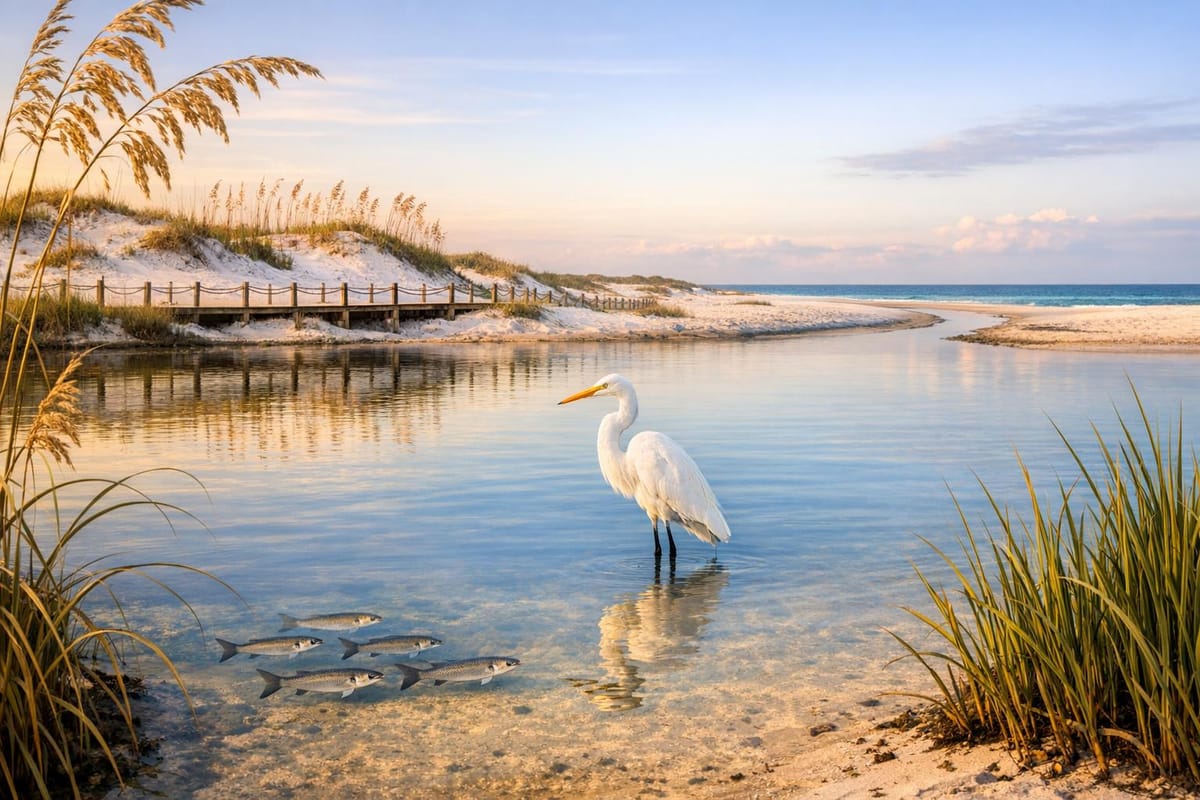
South Walton's dune lakes are rare ecosystems found in only five places worldwide, including Florida's Panhandle. These shallow, tea-colored lakes are defined by their mix of fresh and salt water, which changes due to temporary connections to the Gulf of Mexico called outfalls. This mix supports a wide variety of wildlife, including fish, birds, reptiles, and plants.
Key Highlights:
- Fish: Redfish, largemouth bass, flounder, and catfish thrive in these brackish waters.
- Birds: Over 200 species, including Bald Eagles, Snowy Plovers, and migratory waterfowl, depend on the lakes and surrounding wetlands.
- Reptiles & Amphibians: Alligators, gopher tortoises, and sea turtles nest and live near the lakes.
- Plants: Sea oats stabilize dunes, while wetland plants like cordgrass filter water and provide habitats.
Protected by state-owned land, these lakes are globally rare and ecologically important. Visitors are encouraged to use non-motorized watercraft, stick to trails, and respect the fragile habitats to ensure their preservation.
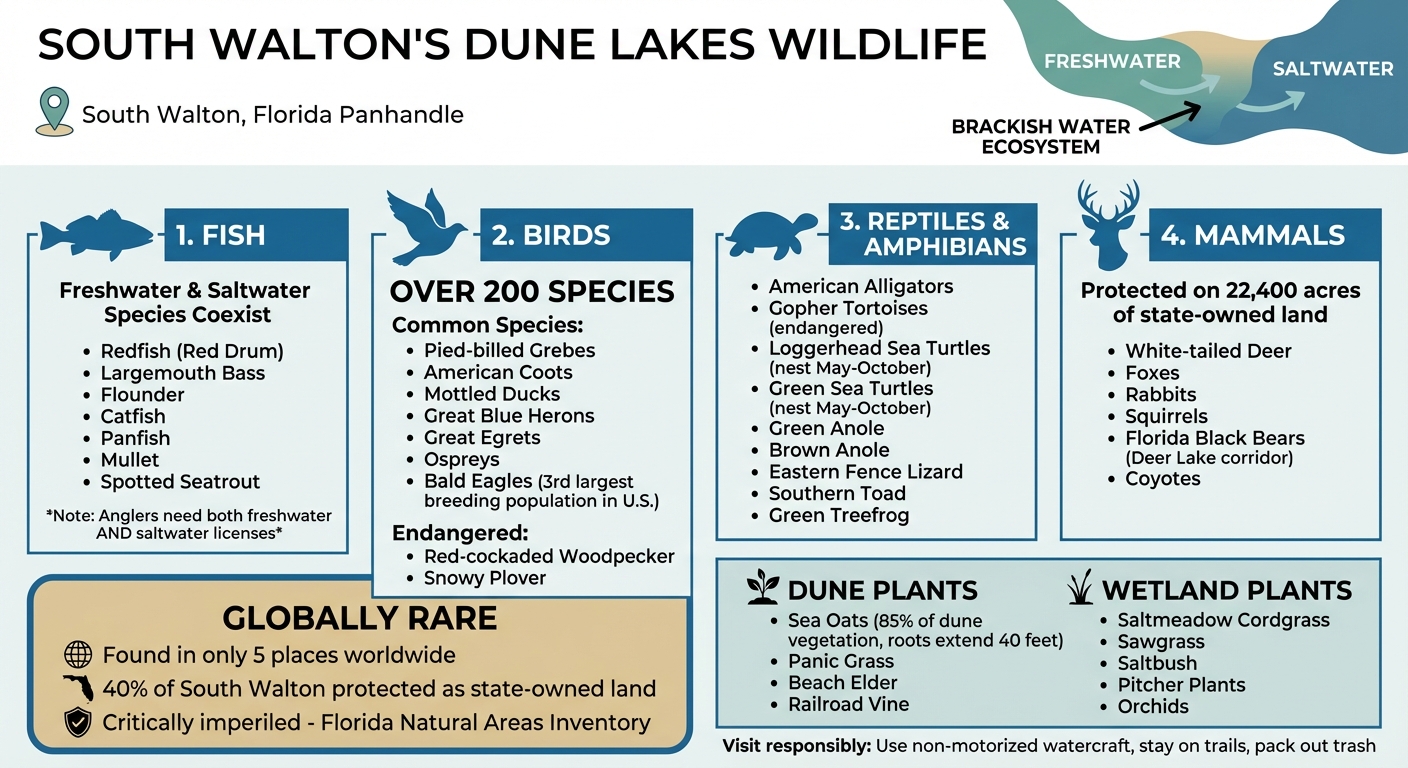
Wildlife Species Found in South Walton's Dune Lakes Ecosystem
Fish Species in South Walton's Dune Lakes
Common Fish Found in Dune Lakes
South Walton's dune lakes host an incredible mix of freshwater and saltwater fish. You'll find redfish (red drum), largemouth bass, flounder, panfish, and catfish sharing the same waters. These species adapt to salinity levels that shift dramatically, depending on rainfall and the lakes' occasional connection to the Gulf.
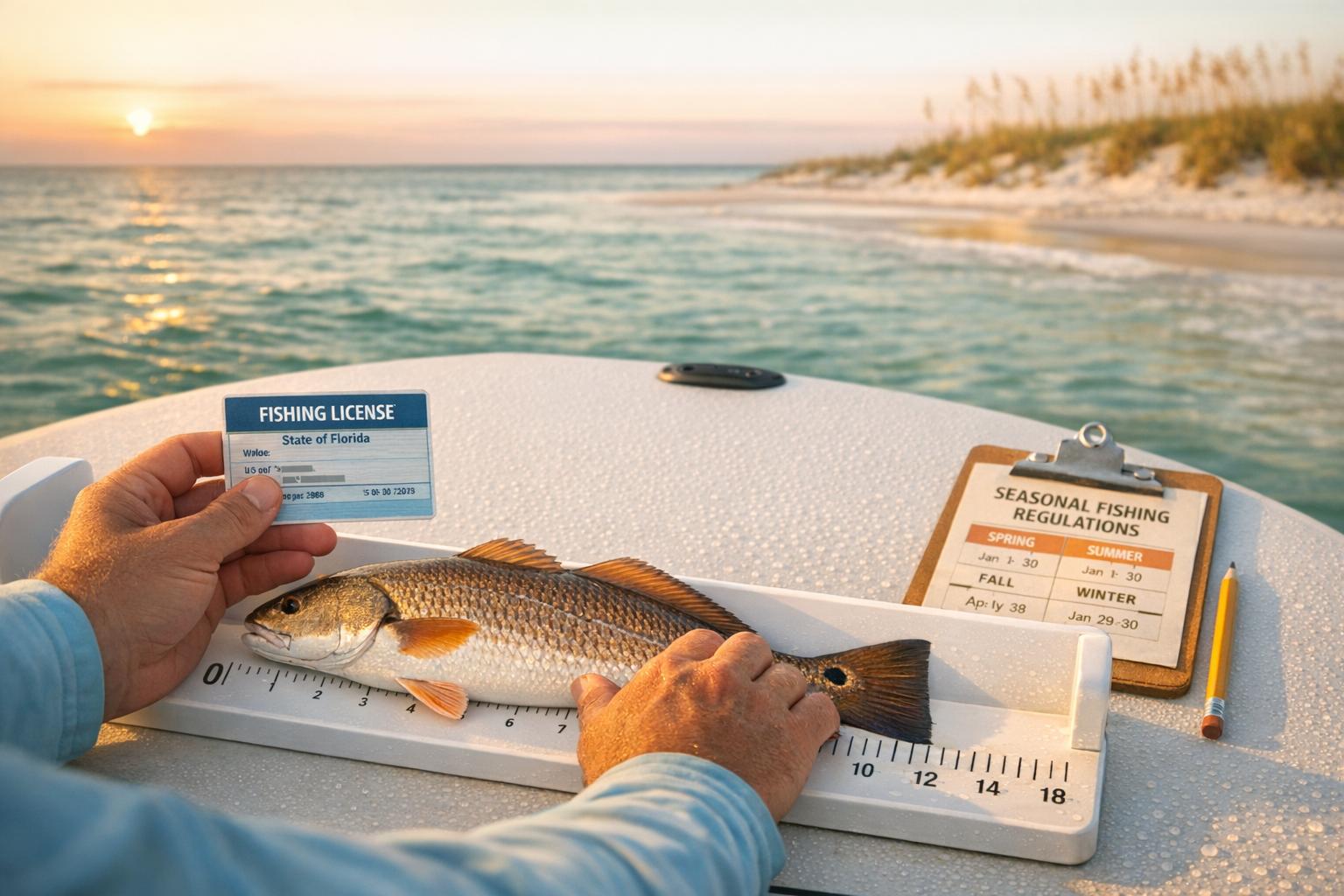
This unique coexistence is possible because the lakes are mesotrophic ecosystems, meaning they maintain a balance of algae and plant growth through active fish feeding. During freshwater phases, species like largemouth bass thrive, while redfish and flounder become more dominant when saltwater flows in. This constant adaptation creates a fascinating biodiversity. Anglers fishing here often need both freshwater and saltwater licenses due to the dual nature of these waters.
Fish Migration and Gulf Outfalls
Heavy rainfall can raise the water levels in these lakes, causing them to breach the sand berms and form temporary channels called outfalls. These outfalls act as natural estuaries, allowing fish to migrate freely between the Gulf and the lakes.
"These outfalls are a natural phenomenon, estuaries where a huge variety of shorebirds hang out, as both salt and freshwater fish swim back and forth from lake to Gulf", explains author Ginger Jackson Sinton.
This exchange plays a vital role in maintaining the lakes' health. Gulf species like mullet and spotted seatrout often enter the lakes when the outfalls are open. These channels remain active until tidal action and shifting sands close them, restoring the lakes' balance. Julie Terrell, Lakewatch Director, highlights this process, saying, "the lakes often have passes that open to the Gulf, which allow salt water and fresh water to continually exchange and flush out the lakes, creating some of the most distinct ecosystems in the world".
This dynamic interaction not only supports aquatic life but also attracts a wide variety of bird species, making the dune lakes a haven for wildlife enthusiasts.
Bird Species Around Dune Lakes
Waterfowl and Shorebirds
South Walton's dune lakes are home to an impressive variety of bird species - over 200, including migratory birds passing through. The calm waters of the lakes attract far more waterfowl than the nearby Gulf, making these areas a must-visit for bird enthusiasts. Among the regulars, you’ll find Pied-billed Grebes, American Coots, Mottled Ducks, and Black-bellied Whistling Ducks often gliding across the water [17, 19].
The shallow edges and marshy zones are perfect for wading birds like Great Blue Herons, Great Egrets, Snowy Egrets, and Tricolored Herons. Meanwhile, raptors such as Ospreys and Bald Eagles are frequently seen diving for fish. Florida boasts the third-largest Bald Eagle breeding population in the U.S., making sightings here even more special. Walt Spence from the Choctawhatchee Audubon Society notes:
Ospreys are fascinating - they circle until they spot prey and then dive in.
The dune lakes also support shorebirds like the Semipalmated Plover, which use the channels and outfalls for feeding and nesting [18, 9]. Jeff Talbert, Chairman of the Coastal Dune Lakes Advisory Board, highlights the importance of these areas:
The outfalls along the beach are also important breeding areas for nesting shorebirds using those areas to help raise their young.
These habitats not only host common species but also provide critical spaces for birds that face conservation challenges.
Endangered Bird Species
One of the standout residents of the area is the endangered Red-cockaded Woodpecker, which thrives in the longleaf pine forests surrounding the dune lakes, especially in Point Washington State Forest. These forests, now reduced to less than 5% of their original range, are essential for the survival of this woodpecker. Notably, nearly 40% of South Walton's land is protected to preserve habitats like these.
In May 2017, a significant restoration effort took place at Deer Lake State Park, involving a partnership between the Florida Park Service and the Atlanta Botanical Garden. Funded by the National Fish and Wildlife Foundation, the project rehabilitated 110 to 330 acres of degraded pine and pitcher plant bogs, improving watershed flow into Deer Lake. This restoration enhanced nesting habitats for the Snowy Plover, a shorebird that suffered heavily from the 2010 BP oil spill. The unique fresh-to-saltwater environment of the lakes creates the estuarine conditions these plovers rely on for breeding.
Reptiles, Amphibians, and Mammals
Reptiles and Amphibians
South Walton's dune lakes, where fresh and saltwater meet, create a rare environment that supports a variety of reptiles and amphibians. American alligators thrive in these brackish waters, with one lake aptly named Alligator Lake to reflect their presence. The surrounding dunes and forests are home to several lizard species, including the Green Anole, Brown Anole, Eastern Fence Lizard, and Six-lined Racerunner.
The endangered gopher tortoise finds refuge in the sandy uplands of protected areas like Topsail Hill Preserve and Point Washington State Forest. These habitats are ideal for the burrows they rely on for survival. Amphibians such as the Southern Toad and Green Treefrog are also well-adapted to the region, handling the fluctuating salinity levels with ease.
The beaches along South Walton play a vital role for Loggerhead and Green Sea Turtles, which nest here between May and October. The South Walton Turtle Watch Program works diligently to locate and protect these nests until the hatchlings emerge.
Mammals Near the Lakes
The same protected dune landscapes that support reptiles are equally important for mammals. Of South Walton's 56,000 acres, about 22,400 acres are protected state-owned land, providing a safe haven for white-tailed deer, foxes, rabbits, and squirrels. These animals are frequently seen in the forests and dunes, with the longleaf pine forests being particularly crucial. These forests offer essential food and cover for many species. As Visit South Walton highlights:
The tree [longleaf pine] is at the heart of an ecosystem that sustains woodpeckers, tortoises, deer, rabbits, and squirrels, and its preservation is considered vital to the sustainability of many native plants and animals.
The dune lakes also play a key role in supporting mammals by providing water and access to diverse habitats. These ecosystems allow mammals to coexist with the freshwater and brackish environments, creating a thriving and interconnected wildlife community.
Plant Life Around Dune Lakes
Dune-Stabilizing Plants
The plants that anchor coastal dunes play a crucial role in South Walton's ecosystem. Among them, sea oats (Uniola paniculata) are the standout species, making up over 85% of the dune vegetation. These plants are protected by law due to their importance, and for good reason - sea oats have roots that can extend up to 40 feet in all directions, forming a web-like network that stabilizes the sand. As Carrie Stevenson, Coastal Sustainability Agent at UF Escambia County Extension Office, explains:
Sea Oats' roots can grow roughly 40ft and extend in all directions in search of the scarce nutrients and water buried within the core of the dune. This root growth functions as a complex web that anchors the sand in place.
Other plants contribute to this stabilization effort. Panic grass (Panicum amarum) partners with fungi to survive harsh conditions like salt spray and drought, while beach elder (Iva imbricata), a woody shrub, traps sand to form new dunes. Ground covers such as railroad vine (Ipomoea pes-caprae) and sea purslane (Sesuvium portulacastrum) spread across the dune surface, reducing erosion. Collecting sea oats without a permit is prohibited under Florida law, underscoring their importance in protecting the coastline. Beyond the dunes, wetland plants adapt to the changing salinity, further shaping the unique lakeside environment.
Wetland and Brackish-Tolerant Plants
In the transitional zones where dune lakes meet the Gulf, specialized plants thrive in the ever-changing salinity. Closest to the water, saltmeadow cordgrass (Spartina patens) absorbs wave energy and helps stabilize the sand during saltwater intrusions. These wetland plants are arranged by their elevation and ability to tolerate salt, with smooth cordgrass occupying the lower marsh areas and black needlerush thriving in mid-marsh zones.
Jeff Talbert, Chairman of the Coastal Dune Lakes Advisory Board, highlights the significance of these wetlands:
Wetlands that surround these lakes are very important because they're some of the most biodiverse ecosystems we have here in Walton County and in the panhandle of Florida.
Other species, like sawgrass, saltbush, and duck potato, not only filter water but also provide critical habitats for wildlife, ensuring the health and diversity of the ecosystem.
Biodiversity Across Specific Dune Lakes
Eastern Lake vs. Western Lake
Western Lake, spanning about 100 acres in Grayton Beach State Park, stands out for its untouched environment. With minimal human interference, it supports a variety of wildlife, including bald eagles, ospreys, redfish, and shorebirds. On the other hand, Eastern Lake represents the most developed of the dune lakes, bordered by private residences and condominiums and allowing small motorboats. This development, coupled with regulated motorboat activity, has altered its natural habitat. Despite these differences, both lakes host a mix of freshwater species, like bass, and saltwater species, such as flounder, thanks to their occasional connections to the Gulf.
The Choctawhatchee Basin Alliance highlights how water chemistry shapes these ecosystems:
Each of Walton County's coastal dune lakes has its own personality, based on the combination of its size, watershed features, surrounding land uses, and outlet characteristics.
Western Lake benefits from frequent exchanges with the Gulf and the protection of the state park, creating an ideal environment for specialized wetland plants like pitcher plants and orchids, especially in the creeks feeding its northern end. In contrast, Eastern Lake supports vegetation that thrives in brackish conditions, adapting to fluctuating salinity caused by both natural factors and human development.
Smaller lakes further illustrate how protection status and unique conditions shape biodiversity.
Deer Lake and Other Smaller Lakes
While larger lakes like Eastern and Western highlight stark contrasts, smaller lakes also reveal remarkable ecological richness. Deer Lake, located in Deer Lake State Park, is particularly noteworthy for its rare plant communities and serves as a corridor for larger mammals like Florida black bears and coyotes - species seldom seen near more populated lakes. The area around Deer Lake is a haven for unique plants, such as Gulf Coast lupine, spoonflower, and pitcher plants, making it a favorite for botanists.
Other smaller lakes, including Campbell, Morris, and Fuller, are nestled within Topsail Hill Preserve State Park and remain largely untouched. These lakes experience less frequent outfall activity, which results in more stable salinity levels compared to the larger lakes like Western and Eastern. Outfall frequency, ranging from as few as 0.1 to as many as 19 times per year, plays a critical role in determining which species can thrive in each lake.
COASTAL DUNE LAKES JEWELS OF FLORIDA'S EMERALD COAST
Conclusion
South Walton's 15 coastal dune lakes are a rare natural treasure, found in just five places worldwide. These shallow, tea-colored lakes, averaging about 5 feet in depth, play a vital role as natural estuaries. They filter water between upland areas and the Gulf of Mexico while supporting a remarkable blend of freshwater and saltwater species.
Jeff Talbert, Chairman of the Coastal Dune Lakes Advisory Board, emphasizes their ecological importance:
Wetlands that surround these lakes are very important because they're some of the most biodiverse ecosystems we have here in Walton County and in the panhandle of Florida, which is part of a biodiversity hotspot.
The Florida Natural Areas Inventory has classified these lakes as critically imperiled. Around Deer Lake, rare plants like pitcher plants and orchids provide essential habitats for species that exist nowhere else.
Because of their delicate nature, visiting responsibly is key. Use non-motorized watercraft like kayaks or paddleboards, stick to designated trails to protect the sea oats that stabilize 85% of the dunes, and always pack out your trash. The natural outfalls connecting these lakes to the Gulf are crucial for their health - observe them from a distance and avoid disturbing these fragile channels.
Formed 4,000–5,000 years ago and protected by 40% state-owned land, these lakes depend on our respect and care to endure. By exploring thoughtfully, you help preserve their beauty and ecological value for future generations.
FAQs
Why do dune lakes switch between fresh and salty water?
South Walton's dune lakes are fascinating because they naturally alternate between fresh and salty water. Here's how it works: sand berms separate these lakes from the Gulf of Mexico. When heavy rainfall raises the water levels, the berms can breach, allowing water to flow out into the Gulf. During this process, saltwater often pushes back into the lakes, especially during high tides or storms, creating a brackish mix. Once the water exchange ends, the lakes gradually shift back to freshwater or maintain their brackish state.
When is the best time to see wildlife at the dune lakes?
The ideal time to watch wildlife around South Walton's dune lakes is early morning. During this time, animals are at their most active, offering the best chance to see different species in their natural surroundings.
What rules should visitors follow to protect dune lake habitats?
To help protect South Walton's dune lake habitats, visitors should stick to a few important guidelines. Stay off the dunes and keep at least a 15-foot distance from both the dunes and the water's edge. It's also crucial to avoid removing anything - whether it's vegetation, sand, or water - from the area. Additionally, leave glass containers at home to prevent potential harm to the environment.
By following these simple steps, you can help preserve these fragile ecosystems, ensuring they remain intact and thriving for generations to come.