Walton County Short-Term Rental Permit Guide
Clear steps to obtain and renew Walton County short-term rental certification, including required registrations, fees, documents, occupancy limits, and penalties.
If you’re planning to rent out property in Walton County for short-term stays, you’ll need a Short-Term Vacation Rental Certificate. This program, introduced in May 2023, ensures rentals meet safety standards and comply with local regulations. Without this certificate, you risk fines of $500 per day, while the annual fee is only $300. Here’s what you need to know:
- Who Needs It? Any property rented more than 3 times a year for stays under 30 days or advertised as a short-term rental.
- Key Steps: Register with state and local agencies, appoint a local responsible party, and submit documents like property sketches and compliance affidavits.
- Deadlines: Most properties follow a June 1 renewal deadline, with applications opening April 1. ZIP code 32459 follows a January 31 deadline.
- Penalties: Operating without certification or violating rules can lead to steep fines and permit suspension.
This guide will walk you through the application, renewal, and compliance process to help you meet all requirements.
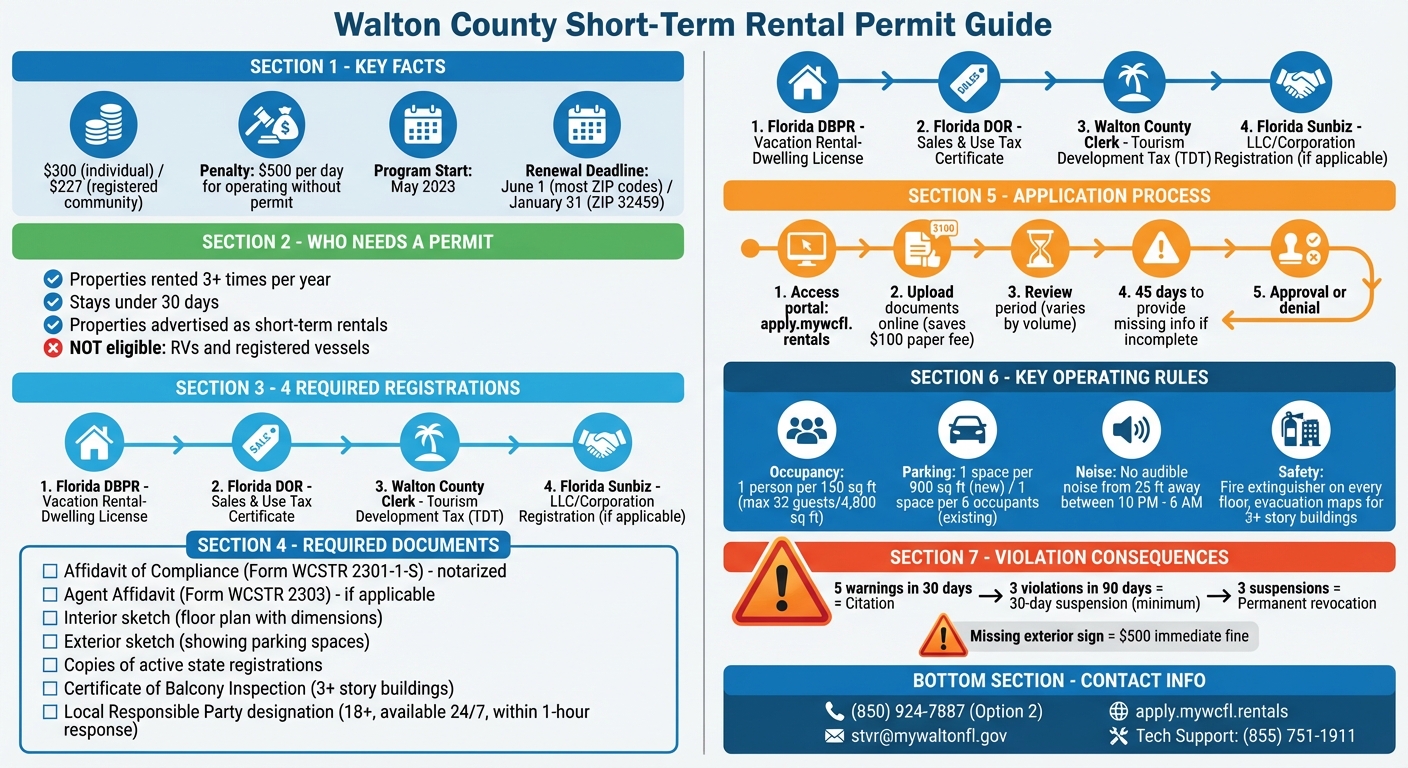
Walton County Short-Term Rental Permit Application Process
Permit Requirements
Before you can legally run a short-term rental in Walton County, there are several steps you need to take. These requirements are designed to ensure guest safety, maintain neighborhood harmony, and keep your business in line with state and local laws.
What Counts as a Short-Term Rental
If you're advertising your property as regularly available for short-term stays - even if no one has booked it yet - you'll need certification.
However, recreational vehicles and registered vessels are not eligible for short-term rental certification. Additionally, your property must remain residential. This means you cannot use or market it as a venue for events, weddings, corporate gatherings, or temporary retail spaces.
Once you've confirmed your property qualifies, the next step is completing the required registrations.
Required Registrations and Licenses
To apply for a short-term rental permit, you'll need to complete four key registrations with state and local agencies:
- Florida Department of Business and Professional Regulation (DBPR): Secure a Vacation Rental - Dwelling license, which classifies your property as a transient public lodging establishment under Florida law.
- Florida Department of Revenue (DOR): Register for a sales and use tax certificate to collect and remit state taxes on your rental income. If you exclusively use platforms like Airbnb or VRBO, you might only need to provide your listing IDs.
- Walton County Clerk of Courts: Sign up to remit the Tourism Development Tax (TDT), which funds local tourism projects.
- Florida Department of State (Sunbiz): If your property is owned by an LLC or corporation, you’ll need to register the business entity.
Additionally, you must appoint a local responsible party - an individual at least 18 years old who is available 24/7 and can physically respond to the property within an hour to address any issues.
Property and Business Documents
After completing these registrations, gather specific property and business documents to confirm compliance. These documents help streamline the permit process by showing that your property meets local safety and operational standards.
One required document is the Affidavit of Compliance (Form WCSTR 2301-1-S). This notarized form must be signed by all owners, managing agents, and the local responsible party. It confirms everyone understands and agrees to follow Walton County's short-term rental standards. If someone other than the owner is submitting the application, you'll also need an Agent Affidavit (Form WCSTR 2303).
You'll also need to provide interior and exterior sketches of your property. The interior sketch should outline the floor plan and dimensions to verify occupancy limits, while the exterior sketch must show off-street parking spaces. These sketches can be hand-drawn or sourced from official property maps.
Finally, submit copies of your active state registrations, such as your DBPR license, DOR certificate, and TDT registration number, to prove you've completed the necessary steps. If your building is three stories or taller, you'll also need a Certificate of Balcony Inspection (Form DBPR HR 7020), which must be renewed every three years.
How to Apply for Your Permit
Accessing the Online Portal
Head over to apply.mywcfl.rentals or mywaltonfl.gov to access the Vacation Rental Registration Program (VRRP) portal. If you're new to the system, click the "Go" button under the "New Users" section to set up your account.
For those with an existing property record, you'll need your 6-digit Account Number and a GovOS Activation Code to proceed. Once your account is created, email stvr@mywaltonfl.gov with your business address and account email to ensure your profile is properly linked to your property. If you run into technical issues, GovOS Support is available at blt.str.support@govos.com or by phone at (850) 751-1911.
After your account is set up, you can start uploading the required documents.
Submitting Your Documents
Use the portal to upload all necessary documents listed in the permit requirements. These include the notarized Affidavit of Compliance, state licenses, tax registrations, property sketches, and, if needed, the Agent Affidavit and Certificate of Balcony Inspection. Submitting online not only simplifies the process but also saves you the $100 paper application processing fee.
Processing Time and Approval
Once submitted, your application goes through a review process. Walton County does not provide a guaranteed timeline for approval, as processing times vary depending on the volume of applications. If any part of your application is incomplete, you’ll be notified and given 45 days to provide the missing information. Failure to respond within this timeframe will lead to an automatic denial, and fees are non-refundable.
The county typically sends reminder emails about 45 days before your registration expires, giving you ample time to prepare for renewal. While waiting for approval, make sure your state-level licenses remain active. Operating without proper registration can result in fines of $500 per day.
Fees, Renewals, and Deadlines
Permit Fees and Payment
The annual registration fee is $300 per property for individual owners, while owners in a registered community pay $227 per property. This fee ensures your certification remains active. Payments can be made using Visa, Mastercard, e-checks, or ACH transfers through the online portal. If you need to update your managing agent, there’s an additional charge of $125, and changing your local responsible party costs $25.
Renewal Deadlines by ZIP Code
Starting February 2, 2026, most properties follow a June 1 renewal deadline, with applications opening on April 1. However, properties in ZIP code 32459 (Santa Rosa Beach) still adhere to the previous cycle, expiring on January 31. It's recommended to initiate your renewal at least 60 days before expiration. While the county sends reminder emails about 45 days ahead, getting a head start is always a smart move. Properties in other ZIP codes, like 32550, 32461, and 32413, have transitioned to the unified June 1 deadline.
Penalties for Operating Without a Permit
Operating without certification can lead to $500 daily fines, and other violations come with additional penalties. For example, failing to install the required exterior building sign within 30 days of certification results in an immediate $500 fine. In May 2025, Special Magistrate Hayward Dykes, Jr. addressed cases where nine property owners in Freeport Commons were non-compliant. Six of them were given only two business days to register or face steep fines, as some had been operating illegally since 2023.
"Walton County is now fining short-term rental owners $500 per day for failing to register their properties as required by law." - Steven Saul, Mid Bay News
Repeated violations carry even harsher consequences. Accumulating three citations within 90 days results in a minimum 30-day suspension, and three suspensions can lead to permanent revocation of your permit. There’s no grace period - your property must be certified before you can list it online.
Operating Rules for Short-Term Rentals
Occupancy Limits and Parking Requirements
The maximum number of guests your property can host is determined by allowing one person per 150 square feet of conditioned living space. For example, if your home is 3,000 square feet, you can accommodate up to 20 people. However, if your property uses a septic system, the health department permit might enforce a lower cap. Walton County also applies a strict limit of 32 guests or 4,800 square feet for rentals classified as neighborhood-scale. Staying within these occupancy limits is critical to comply with county permit rules.
For parking, new constructions must provide one parking space per 900 square feet, while existing rentals need one space for every six occupants, based on available on-site parking. Garage spaces only count if they allow full access for vehicles, and using public rights-of-way for parking is prohibited. Additionally, designated spaces cannot be occupied by golf carts or RVs if it forces guest vehicles onto the street. To ensure clarity, include a parking sketch in your rental agreement and display it inside the property. These measures help maintain safety and order, setting the stage for other operational guidelines.
Noise Rules and Safety Inspections
Noise that can be heard from 25 feet away between 10:00 PM and 6:00 AM is considered a criminal offense. As the property owner, you're responsible for addressing noise complaints unless you can demonstrate that your guests caused the disturbance and you took immediate action, such as notifying law enforcement. These rules are designed to balance guest enjoyment with neighborhood peace.
For properties that are three stories or higher, Florida Statute §509.211 mandates inspections of balconies, platforms, stairways, and railings by a qualified professional every three years. Additionally, you must post an evacuation map (minimum size: 8.5" x 11") near the interior door of each third-floor bedroom or higher. Fire safety requirements include placing a 2A:10B:C portable fire extinguisher in a visible common area on every floor and ensuring emergency lighting provides at least one hour of illumination for primary exits.
HOA and Community Rules
In addition to county regulations, your property must adhere to any rules set by your Homeowners Association (HOA), Development Order, or Neighborhood Plan. These local standards may enforce stricter limits on parking, trash disposal, or noise. Always confirm these additional requirements before listing your property. Ignoring HOA rules could jeopardize your county permit and result in penalties. Staying informed ensures smooth operations and avoids unnecessary complications.
Enforcement and Violations
Walton County takes compliance seriously, building upon its permit requirements and operational rules with strict enforcement measures. Staying on top of registration and operational guidelines not only makes renewal easier but also helps you steer clear of the penalties outlined below.
When Permits Are Denied or Revoked
Applications will be denied if you fail to provide the necessary active registrations - such as DBPR, Department of Revenue, or Tourist Development Tax - within 45 days of receiving an "Incomplete Application" notice. Additionally, properties with unresolved code violations won't be certified until all issues are corrected and any related fines are fully paid.
Once you have a permit, it’s critical to avoid violations. If your property racks up three violations within a 90-day period, your permit will be suspended for at least 30 days. Three suspensions could lead to a permanent revocation. A permit may also be revoked if a county lien against the property remains unresolved for more than 60 days. Other actions that could lead to revocation include refusing inspector access or failing to complete three inspection attempts. These rules highlight the importance of keeping your registrations current and addressing violations quickly.
Fines and Warning System
Walton County has a structured warning and penalty system to encourage compliance. For first-time violations, you’ll usually receive a warning and have 15 days to correct the issue. However, if you accumulate five warnings within 30 days, a citation will follow. Operating without a valid certificate or advertising an unregistered rental can result in a $500 daily fine, with each day treated as a separate offense. Missing the 30-day deadline to install the required exterior sign after permit issuance leads to an immediate $500 fine. If your case is referred to the Special Magistrate, expect an additional administrative fee starting at $100.
"The County has treated enforcement as a time of 'education' for the last couple of years. But now that sufficient and extended notices have been issued – the enforcement must begin."
- Joshua Allen, Tourism and Livability Coordinator for Walton County
Permits Cannot Be Transferred
Short-term rental certificates are non-transferable. This means the certificate is tied to you as the owner and the specific property it covers. If you sell the property, the new owner must apply for their own certification before engaging in rental activities. This ensures that all operators meet current compliance standards and that the county’s records stay up to date. If you’re buying or selling a rental property, plan ahead to avoid interruptions in rental activity.
Final Tips and Resources
When wrapping up your permit application, here are a few key points to keep in mind. First, double-check your property's zoning eligibility on the Walton County GIS website before diving into the application process - this can save you time and effort. Also, make sure your registrations with the Florida Department of Revenue, DBPR, and the Walton County Clerk of Courts for the Tourism Development Tax are up to date.
If your property falls under the new unified renewal schedule, mark April 1 on your calendar as the start of the renewal window. For most Walton County ZIP codes, renewals are now due annually by June 1. However, if your property is in ZIP code 32459 (Santa Rosa Beach), the current renewal cycle still applies. For additional assistance, use the contact information below.
Contact Information:
- Walton County Planning and Development Services: Call (850) 924-7887 (Option 2) or email stvr@mywaltonfl.gov.
- Portal Access: Visit apply.mywcfl.rentals.
- Technical Support: Call (855) 751-1911 or email blt.str.support@govos.com.
For personalized help, you can schedule a one-on-one meeting with staff through the department's website. Additionally, don’t forget to review any local community requirements alongside county guidelines.
Even after securing county approval, take a moment to revisit your HOA rules. Homeowner associations often have stricter requirements that you’ll still need to follow. Stay on top of compliance by keeping your responsible party information updated, ensuring your signage includes Walton County’s official hotline number (mandatory starting January 1, 2026), and promptly removing your rental listing if you stop operating. This will help you avoid unnecessary compliance issues.
"To accomplish a safe and effective vacation rental program it is key that Short-Term Vacation Rental Local Responsible Parties, management companies, and property owners are responsive and responsible for continued compliance with this ordinance." - Walton County Land Development Code
FAQs
Can I apply before my DBPR and tax registrations are active?
No, you can’t apply for a short-term rental permit in Walton County unless your DBPR (Department of Business and Professional Regulation) and tax registrations are active. These are essential requirements and need to be finalized before starting the application process.
What should I do if my application is incomplete?
If your short-term rental permit application is missing information, check the list of required items provided by Walton County. Typical missing documents might include notarized affidavits, proof of Florida Department of Revenue registration, or property sketches. Make sure to collect and submit these documents as soon as possible. If you're unsure about any part of the process, reach out to Walton County’s planning or licensing department - they can guide you through completing your application.
How do I know my renewal deadline for my ZIP code?
Your short-term rental permit renewal deadline varies based on your ZIP code and Walton County's specific schedule. Beginning in 2026, renewals will follow the Florida DBPR licensing cycle, with permits due annually by June 1 and applications opening on April 1. Be sure to check whether your property is in South Walton or North Walton, as tax rates differ between the districts. For exact deadlines, reach out to Walton County's Vacation Rental Program.