Zoning Changes and Relocation to 30A
30A's 2026 zoning shake-up unlocks ADUs and faster approvals while keeping strict neighborhood protections that affect families and investors.

Thinking about moving to 30A in South Walton, Florida? Recent zoning updates are shaking things up in this sought-after area. Here’s what you need to know:
- Zoning Laws for ADUs: Easier to add accessory dwelling units (ADUs) without owner-occupancy or complex permits.
- Development Simplified: Faster approval timelines (60 days) for projects meeting clear criteria.
- Neighborhood Preservation: Stricter building regulations to maintain the area’s charm, like limits on building heights and density in places like Old Seagrove.
- Tourism & Real Estate Trends: Visitor numbers dropped 11%, and home sales fell 36% last year, but these changes might attract new residents.
These updates aim to balance new housing opportunities with preserving the local vibe, making 30A an evolving destination for families and investors alike.
1. Before the Zoning Changes
ADU Feasibility
Before 2026, adding an accessory dwelling unit (ADU) to a property on 30A was anything but straightforward. Getting approval often required discretionary permits, special exceptions, or even public hearings. On top of that, strict owner-occupancy rules excluded seasonal residents and investors from pursuing ADU projects. Local regulations also piled on extra parking requirements, which made building ADUs on smaller lots either too expensive or outright impossible to consider. These layers of red tape created a challenging and often frustrating approval process for property owners.
Development Timelines
The hurdles didn’t stop with ADUs. The broader development review process was another significant obstacle. Applications had to go through the Technical Review Committee (TRC), a group of planning, building, and engineering experts, before reaching the Planning Commission or the Board of County Commissioners. For example, in June 2025, the TRC classified a proposed 10,086 sq. ft. 1950s-themed diner in Blue Mountain as a "major development." TRC Chair Stephen Schoen raised concerns about the project, questioning its compatibility with the surrounding area:
"I have a question about the 'scale' and the 'character' of this development as it relates to the existing built environment".
The Sunliner Diner project faced even more pushback from seven homeowners associations, who argued it clashed with the neighborhood’s aesthetic. These drawn-out reviews and subjective opinions left potential residents and developers uncertain about whether their projects would ever get off the ground.
Neighborhood Character Preservation
Preserving the character of 30A neighborhoods was a hot-button issue for many community members. During the debate over the Sunliner Diner, resident Barbara Morano voiced her frustration:
"This does not fit the code – no matter what you heard – it does not fit the Code of Small Neighborhood".
Leigh Moore from Scenic Walton echoed similar concerns, saying:
"We are losing the character of 30A. It is a gem... it is 'death by a thousand cuts' if we are not careful".
The use of Euclidean Zoning at the time reinforced a low-density, single-family focus. While this approach helped preserve the area's charm, it also severely restricted affordable housing options. For families and investors looking to move to the area, these strict preservation efforts meant navigating both community resistance and a maze of regulations that could stall or even block their plans entirely.
2. After the Zoning Changes
ADU Feasibility
Recent zoning changes have completely altered the landscape for Accessory Dwelling Units (ADUs) in the 30A area. A key update legalized unpermitted ADUs built before 2020, provided they meet a health and safety checklist. This replaces the old system that outright denied many such units. Additionally, new multifamily density reforms now allow up to eight detached ADUs per lot on multifamily properties. This is a huge shift from the restrictive policies that were in place before 2026. These updates open up opportunities for property owners to make better use of underutilized spaces, like parking areas, and create new financial possibilities for both investors and families considering a move to the area. The changes strike a balance by increasing flexibility while still respecting the area's distinct charm.
Neighborhood Character Preservation
Even as the ADU reforms bring more housing options, Walton County has taken steps to preserve the character of its neighborhoods. In February 2025, the Board of County Commissioners (BCC) adopted the Old Seagrove Neighborhood Plan (Option B). This plan introduced stricter regulations, such as reducing building heights and limiting the number of bedrooms, to maintain a low-density feel. Notably, 85% of residents supported this plan. That same month, the BCC also unanimously rejected the proposed 9,824-square-foot 30A Surf Club project at the intersection of US 98 and CR 30A. Their decision was based on concerns about public safety, specifically traffic flow issues. These measures ensure that while ADU reforms provide more housing flexibility, the cherished residential atmosphere of 30A is not compromised.
BIG CHANGES Coming to Santa Rosa Beach? | Major Real Estate & Development Updates | Sept 2025
Pros and Cons
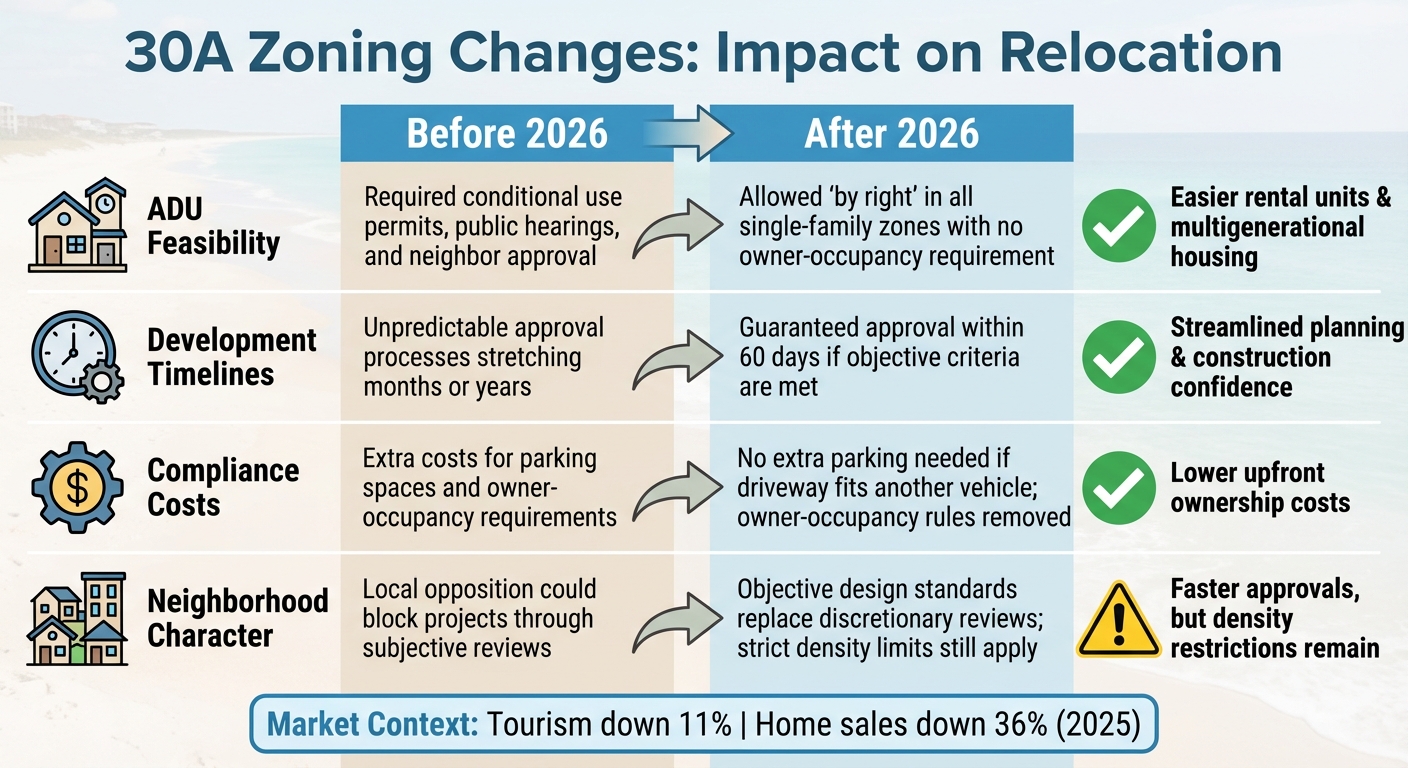
30A Zoning Changes: Before vs After 2026 Comparison
The new zoning changes bring a mix of opportunities and challenges for those eyeing a move to 30A. These updates strike a balance between opening doors to development and maintaining the character of neighborhoods, offering families and investors a clearer framework for relocation decisions.
| Factor | Before Zoning Changes (Pre-2026) | After Zoning Changes (Post-2026) | Impact on Relocation |
|---|---|---|---|
| ADU Feasibility | Required conditional use permits, public hearings, and often neighbor approval. | Allowed "by right" in all single-family zones with no owner-occupancy requirement. | Advantage: Easier to add rental units or multigenerational housing without jumping through bureaucratic hoops. |
| Development Timelines | Approval processes were unpredictable, often stretching for months or even years. | Guaranteed approval within 60 days if objective criteria are met. | Advantage: Streamlined timelines give families the confidence to plan construction without delays. |
| Compliance Costs | Extra costs for parking spaces and owner-occupancy requirements. | No extra parking needed if the driveway fits another vehicle; owner-occupancy rules removed. | Advantage: Lower upfront costs make property ownership more manageable. |
| Neighborhood Character | Local opposition could block projects through subjective reviews. | Objective design standards (height, massing) replace discretionary reviews; strict density limits still apply in areas like Old Seagrove. | Mixed: Faster approvals, but density restrictions help preserve the area's charm. |
These comparisons highlight how the changes simplify processes while keeping certain protections in place. For example, streamlined approvals now provide more predictability. As Florida Senate Amendment 408564 explains:
By right means the ability to be approved without requiring a public hearing; a variance, conditional use permit, special permit, or special exception; or other discretionary action.
For families considering a move to 30A, the certainty of a 60-day approval window makes financial planning much easier.
However, not everything is smooth sailing. ADUs (Accessory Dwelling Units) still can’t be rented for periods shorter than a month, which could deter investors aiming for short-term vacation rentals - a key market in this tourist-heavy area. Meanwhile, local plans, like those in Old Seagrove, continue to enforce strict density limits, ensuring that the neighborhood retains its established feel despite state-level efforts to simplify development.
For most families, the benefits likely outweigh the downsides. The ability to add up to two ADUs per qualified parcel offers options for rental income or extra space. The removal of strict parking mandates also lowers financial hurdles for potential buyers.
To dive deeper into relocating to 30A, check out sowal.co. These regulatory changes provide families with clearer planning tools and insight into the tradeoffs they might face.
Conclusion
The 2026 zoning changes have significantly influenced relocation trends along 30A. Thanks to the Florida Starter Homes Act, smaller lots - down to just 1,200 sq. ft. - can now accommodate duplexes, triplexes, and quadruplexes. This shift creates new possibilities for first-time homebuyers and families looking to live together across generations.
That said, balancing state-mandated higher density with local preservation efforts remains a challenge. For instance, Old Seagrove's stricter Neighborhood Plan highlights the ongoing push-and-pull between statewide goals and local priorities. With only 22% of Walton County's land available for development and strict environmental protections in place, property development remains tightly constrained.
For families, though, the addition of expanded housing options is promising. Projects like the 393 Municipal Parking Facility, which began operating on March 1, 2026, and the soon-to-open Grayton Beach Community Center (set for Summer 2026), also help address concerns about traffic and community amenities. These developments mark important steps toward accommodating growth while maintaining quality of life.
FAQs
Do these zoning changes make 30A more affordable to live in?
Recent zoning changes, such as Florida Senate Bill 102, are designed to address housing affordability by removing specific zoning restrictions and density limits for affordable housing projects. The idea is to make it easier and less costly for developers to build housing that meets the needs of lower-income residents. While this approach could lead to increased development and potentially lower housing costs, some local communities worry about how these changes might affect the character of their neighborhoods. As a result, the actual impact on affordability will depend on how these policies are put into practice.
How do I know if my property can add an ADU by right?
To find out if you can add an Accessory Dwelling Unit (ADU) to your property without needing special permits or a public hearing, you'll need to review local zoning regulations and recent laws. When something is allowed by right, it means you can move forward as long as your project meets zoning standards. Key considerations include whether your zoning district allows ADUs, the size of the unit, property setbacks, and adherence to local rules. For accurate guidance, reach out to your county or municipality’s planning department.
Do neighborhood plans like Old Seagrove override new state rules?
Neighborhood plans, like Old Seagrove, often introduce extra rules, such as larger setbacks or lower building height limits. These can work alongside state laws or add further restrictions. However, they cannot override new state regulations unless local authorities specifically grant that power.