30A ARB Approval Process Explained
Clear overview of 30A ARB approval: which boards apply, required documents, timelines, common pitfalls, and how to align ARB and county permits.
If you're planning to build or renovate a property along the 30A coastline, you'll need approval from the Architectural Review Board (ARB). This process ensures your project aligns with the design standards of the community and is separate from county building permits. Here's what you need to know:
- What ARBs Do: They review the aesthetics of visible changes like building shapes, materials, colors, and landscaping.
- Why It Matters: ARB approval helps maintain property values and community character. Skipping it can lead to fines, stop-work orders, or legal issues.
- How to Start: Identify the correct ARB for your property (e.g., private community boards or Walton County DRB) by checking your property's Covenants, Conditions, and Restrictions (CC&Rs).
- Submission Requirements: Include site plans, elevations, material samples, and other detailed documents. Missing items can delay approval.
- Timelines: Reviews typically take 2-6 weeks, but revisions or incomplete submissions can add weeks to the process.
- Final Step: Both ARB approval and county permits are required before construction can begin.
Skipping ARB approval can cause costly delays. Thorough preparation and understanding your community’s specific guidelines are key to a smooth process.
Finding the Right Review Board for Your Project
In the 30A area, review boards vary depending on where your property is located, as you choose a 30A neighborhood or lot for your project. If your home is in a private, master-planned community, you'll work with that community's Architectural Review Board (ARB). Properties outside these communities typically fall under the Walton County Design Review Board (DRB) or the Scenic Corridor Review process.
Review Boards in the 30A Area
To figure out which board has jurisdiction over your property, start by reviewing your property's Covenants, Conditions, and Restrictions (CC&Rs). Communities like Alys Beach and Rosemary Beach have ARBs with strict design standards. For instance, Alys Beach enforces a signature aesthetic focusing on white masonry and specific architectural massing. In Watersound, oversight comes from The St. Joe Company, with individual neighborhoods - such as Origins, Camp Creek, and West Beach - following their own design guidelines and using separate review contacts.
If you're working on a project in Watersound, check the neighborhood’s "Important Documents" section to download the relevant design guide, such as the "Guide for the Creation of Watersound Origins". On the other hand, areas like Grayton Beach and Blue Mountain Beach, which are less structured, fall under Walton County zoning laws and the DRB, with no additional ARB layer.
It's important to note that ARB approval is separate from county permitting. As the Morar Group explains, "Building code addresses safety and structure. The ARB regulates aesthetics and compatibility under the community's governing documents, so code compliance does not guarantee approval". To start construction, you’ll need both ARB approval and the necessary Walton County permits.
Once you’ve identified the appropriate review board, check if your project might be exempt from ARB review.
Projects That May Be Exempt
Generally, ARBs focus on exterior changes that are visible from streets or shared spaces. Interior work, like finishes or renovations, usually doesn’t require ARB approval. In some cases, routine maintenance - like repainting your home the same color - may also be exempt, but it’s always wise to confirm with your specific board before beginning any work. Even seemingly minor projects, such as installing a fence, often require ARB approval in planned communities, regardless of whether a county building permit is needed.
For properties located seaward of the Coastal Construction Control Line (CCCL), additional state-level permits from the Florida Department of Environmental Protection are required, regardless of ARB involvement.
Once you understand your review board’s requirements and know whether your project qualifies for exemptions, you’ll be ready to prepare your submission.
Preparing Your ARB Submission
To get started, make sure you have all the required documents in order. Submitting incomplete materials can lead to delays or even denial, says Nicole Bosko of the Bluefield Group. Most Architectural Review Boards (ARBs) require two sets of documents: an initial concept package and a detailed final submission.
For the concept phase, you'll need items like a site plan, massing sketches, elevations, a roof plan, material and color ideas, and a preliminary landscape concept. This step helps identify potential issues - like setbacks or massing conflicts - before committing to full architectural drawings. The final submission will be more comprehensive, including scaled site plans showing property lines, setbacks, and finished floor elevations; detailed floor plans; elevations for all four facades; a complete exterior finish schedule; color samples; a landscape plan with specific plant species and sizes; a lighting plan with fixture details; civil or drainage plans; and a construction staging plan.
Don't forget the administrative side of things. Include contractor license and insurance information, estimated project timelines, and any necessary FEMA elevation data if your property is in a flood zone. Some 30A communities also charge application fees and require an escrow deposit for site monitoring during construction. Most HOAs require ARBs to respond within 30 to 45 days, but in communities like Alys Beach, initial reviews can take 2 to 6 weeks once your application is complete.
Required Documentation
The format of your submission is critical. Many 30A communities offer standardized PDF forms tailored to different project types, such as "New Construction Applications" or "Exterior Modification Applications". All plans must be scaled drawings, including site plans, elevations for each facade, and detailed roof plans. For materials and colors, you'll need a "Color Board" or an "Exterior Materials and Finish Schedule" featuring samples or manufacturer color chips.
You'll also need manufacturer cut sheets for items like windows, doors, exterior lighting fixtures, solar panels, and HVAC equipment to ensure they meet aesthetic and compliance standards. Landscape plans must stick to approved plant lists and provide dimensions for driveways, patios, and garage bays. Be sure to confirm whether your submission should be digital or in hard copy format.
"An Architectural Review Board... exists to preserve a community's planned character and protect property values." - The Morar Group
It’s a good idea to schedule a pre-application consultation to discuss massing and orientation concepts before diving into detailed drawings. This can help identify constraints early and save you time down the line. Partnering with local professionals who have experience navigating 30A community guidelines is also a smart move - they’ll already understand the nuances of design rules and submission processes.
Once your documents are ready, cross-check them with your community's design guidelines to ensure everything aligns.
Design Standards and Guidelines
After compiling your submission, take the time to review your community’s specific design standards. Each 30A neighborhood has unique requirements, and understanding them upfront can prevent setbacks. For example, Watersound uses a "Pattern Book" to outline its design vision, covering materials, massing styles, and overall intent for the neighborhood. ARBs focus on how your project fits the lot and its visibility from streets or common areas, including proper screening for mechanical equipment.
Watersound’s guidelines often cap building heights around 50 feet, require porches with a minimum depth of 8 feet, and enforce setbacks of about 15 feet in the front and 10 feet in the rear. In Sandestin, ARBs typically issue decisions within 5 to 10 business days after a meeting, though they have up to 60 days to finalize. Be sure to check for "Supplemental Guidelines" in your neighborhood, which may add or override general rules - areas like Burnt Pine and Villa Lago in Sandestin have additional standards.
"ARB approval does not replace county permits. Final construction typically cannot start until you hold both ARB approval and required county and state permits." - The Morar Group
Make sure your initial design includes permanent screening for HVAC units, trash bins, and pool equipment to avoid rejection. Even if you're replacing materials with similar ones, double-check "like-for-like" rules, as small changes in color or size can trigger a full review. Finally, align your ARB plans with Walton County permit requirements early , especially if you plan to apply for a short-term rental permit to avoid conflicts that could delay your project.
The ARB Approval Process: Step by Step
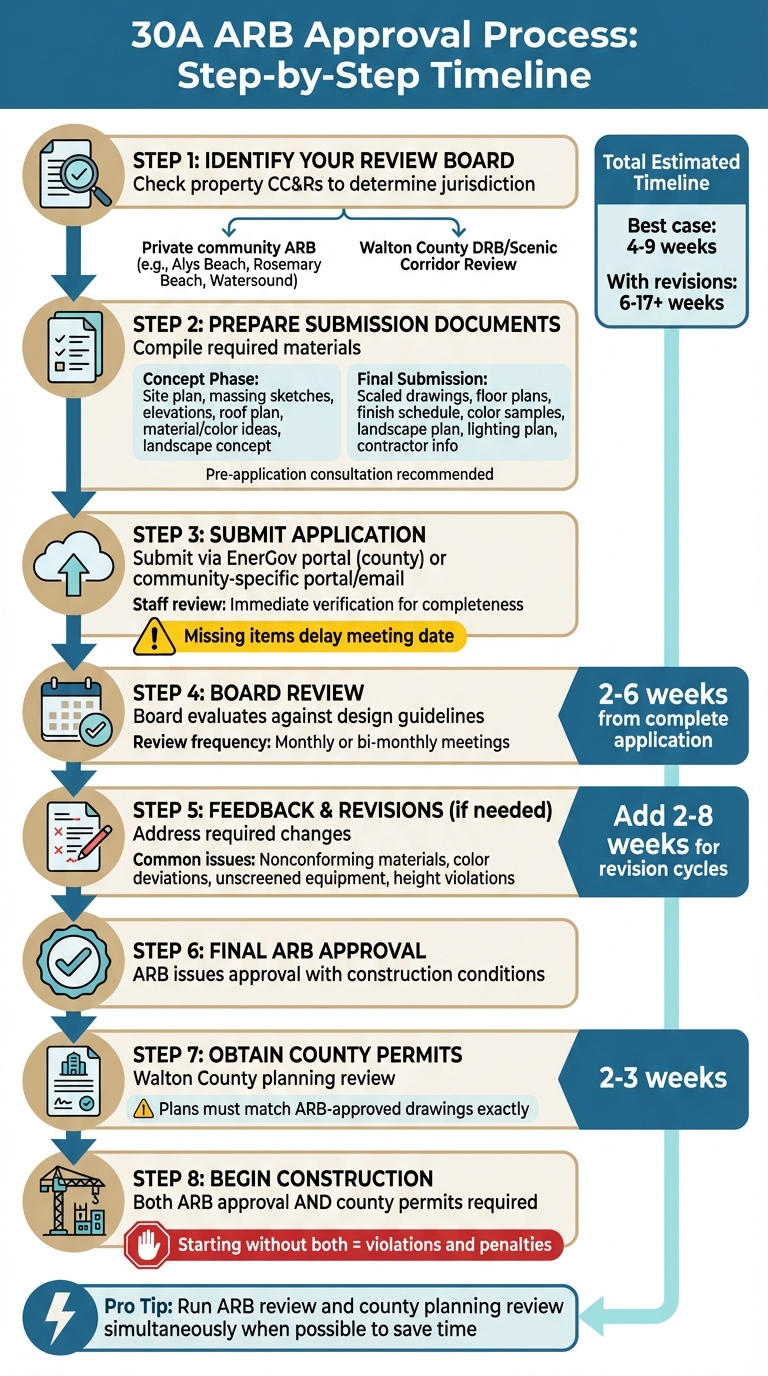
30A ARB Approval Process Timeline and Steps
Submitting Your Application
To begin, submit your application through the Planning Online Portal (EnerGov) for Walton County Scenic Corridor properties. For private communities, such as Watersound Origins, use the designated email or member portal (e.g., DesignReview@joe.com).
Once submitted, staff will immediately review your application to ensure all necessary plans, material samples, and fees are included. Missing items can delay your meeting date, so double-check your submission. For major projects, scheduling a pre-application consultation can help clarify any constraints or requirements. After your submission is verified as complete, the board will initiate its review process.
Review and Feedback Stages
With a complete application, the board evaluates your project based on community design guidelines and scenic corridor standards. These reviews occur during scheduled monthly or bi-monthly meetings. Typically, the initial review process takes about 2 to 6 weeks from the time your application is deemed complete.
After this review, the board provides feedback, which may include comments or required changes. Common issues flagged during this stage include nonconforming materials, visible color deviations, poorly screened mechanical equipment (like HVAC units or generators), and building massing that exceeds height limits. If revisions are needed, you’ll receive a detailed list of changes to address. Depending on the complexity of the revisions, this process can add an additional 2 to 8 weeks. Once all revisions are submitted and approved, your project moves closer to final approval.
Final Approval and Next Steps
When all revisions are resolved, the board will issue final approval, often with specific construction conditions. However, you’ll also need Walton County permits before beginning construction. The Walton County planning review process, which covers elements like stormwater management, buffers, and setbacks, usually takes about 2 to 3 weeks.
Construction can only begin after obtaining both ARB approval and county permits. Starting work without these approvals could lead to violations and penalties. To streamline the process, consider running the ARB review and Walton County planning review simultaneously, if possible.
Avoiding Common Problems and Staying Compliant
Common Mistakes to Avoid
Incomplete submissions can stall your ARB (Architectural Review Board) process. Make sure you include everything required: plans, physical samples, manufacturer cut sheets, and fees. Double-checking these details before submitting ensures your project gets on the meeting agenda without delays.
Design conflicts are another frequent issue. These often happen when applicants propose visible color changes, nonconforming materials, or large blank walls facing public areas. Another oversight? Forgetting to include permanent screening for HVAC units, meters, and generators in the initial design. To stay ahead, obtain the recorded plat and engineer’s finished floor elevation early. This helps you design within setback limits and avoid flood zone violations.
Permit misalignment is also a common snag. This occurs when ARB-approved plans don’t match the drawings submitted for county permits. Make sure all ARB conditions are reflected in your county submission. If you’re in a master-planned area like Watersound, use the correct guidelines for your specific phase. Rules can differ between neighborhoods like Watersound Origins and Camp Creek.
Avoiding these mistakes helps keep your ARB approval process on track.
Tips for a Successful ARB Approval
Start with a pre-application consultation with ARB staff before diving into full architectural drawings. This early step can save time and effort later. Consider hiring architects and landscape designers familiar with 30A communities like Alys Beach or Watersound. Their experience with local guidelines can make the process smoother.
During construction, keep your site clean and organized to meet community standards. Regularly clean the area and manage fencing and dumpsters properly to avoid fines or losing your deposit. Many 30A communities conduct site inspections during construction to ensure compliance with approved designs. If your property is near a Coastal Dune Lake Protection Zone or wetland buffers, check for specific permits before altering landscaping. Violations in these areas can result in hefty fines.
Once construction is complete, submit as-built drawings and final permits. This ensures your structure matches the approved design and clears up any title issues that could complicate future resale.
Following these steps alongside your county permit preparations ensures consistency and smooths the path to approval.
Conclusion
Navigating the ARB approval process in 30A demands careful planning and attention to detail. Common delays often arise from incomplete submissions, designs that conflict with community guidelines, or mismatches between ARB requirements and county permits. Each revision cycle can add anywhere from 2 to 8 weeks to your timeline. To minimize these delays, start with a detailed pre-submittal review to identify potential issues early, before committing to full architectural plans.
Working with local architects and designers familiar with 30A communities - like Alys Beach or Watersound - can simplify the process and help you avoid expensive redesigns. These professionals ensure your plans comply with both ARB and county requirements. It's critical that the ARB-approved plans match your Walton County submission exactly, as discrepancies can lead to stop-work orders and fines. Both approvals are generally required before construction can begin.
Properties along scenic corridors such as CR 30A face additional design standards that go beyond the usual requirements. Keeping well-organized records of all approvals, permits, and as-built drawings not only protects your investment but also simplifies the resale process.
FAQs
Who is my ARB or review board?
Your ARB (Architectural Review Board) is usually made up of a mix of members such as homeowners, a consulting architect, and a landscape architect. Together, they assess and approve proposed property improvements. In some communities, like Sandestin, the ARB may also include roles like an administrator, a compliance officer, and support staff to help manage the review process efficiently.
Do I need ARB approval for small exterior changes?
Yes, in the 30A area, most exterior modifications usually need Architectural Review Board (ARB) approval. This applies to projects like painting, re-roofing, updating doors or windows, or making changes to landscaping. Be sure to review the specific guidelines for your community before kicking off any work.
Can I apply for ARB approval and county permits at the same time?
Yes, it’s possible to apply for ARB approval and county permits at the same time. The ARB primarily reviews the exterior design to ensure it fits with the neighborhood's aesthetic, while county permits focus on building code compliance and site development requirements. Aligning these efforts can help make the process more efficient.