30A Luxury Home Investment: Ultimate Guide 2026
Practical 2026 guide to buying, financing, renting, and exiting luxury homes on 30A—community, costs, and rental rules.
If I were buying on 30A in 2026, I’d treat it as a lifestyle buy first and a numbers buy second. Prices are still high, with average sold pricing around $2.37 million and supply near 10.9 months, which means I may have room to negotiate on many listings, but not much leverage on prime Gulf-front homes or top new builds.
Here’s the short version:
- I’m paying up for scarcity, strict design rules, and beach access
- I need to compare communities based on walkability, rental rules, privacy, and resale depth
- I should expect jumbo financing on many purchases, with 20%–30% down common at this price level
- I need to budget for more than the mortgage: taxes, insurance, HOA dues, maintenance, pool service, and management
- If I plan to rent, I need to confirm Walton County registration, DBPR licensing, occupancy limits, and HOA limits
- I should decide my exit path early: resale, long hold, refinance, 1031 exchange, or estate transfer
A few numbers shape the whole decision. In Walton County, the median sale price sits near $549,900, far below core 30A pricing. Rosemary Beach is around $1,108 per square foot, while Alys Beach is near $1,915 per square foot. That tells me 30A is not one market. It’s a set of small, very different submarkets.
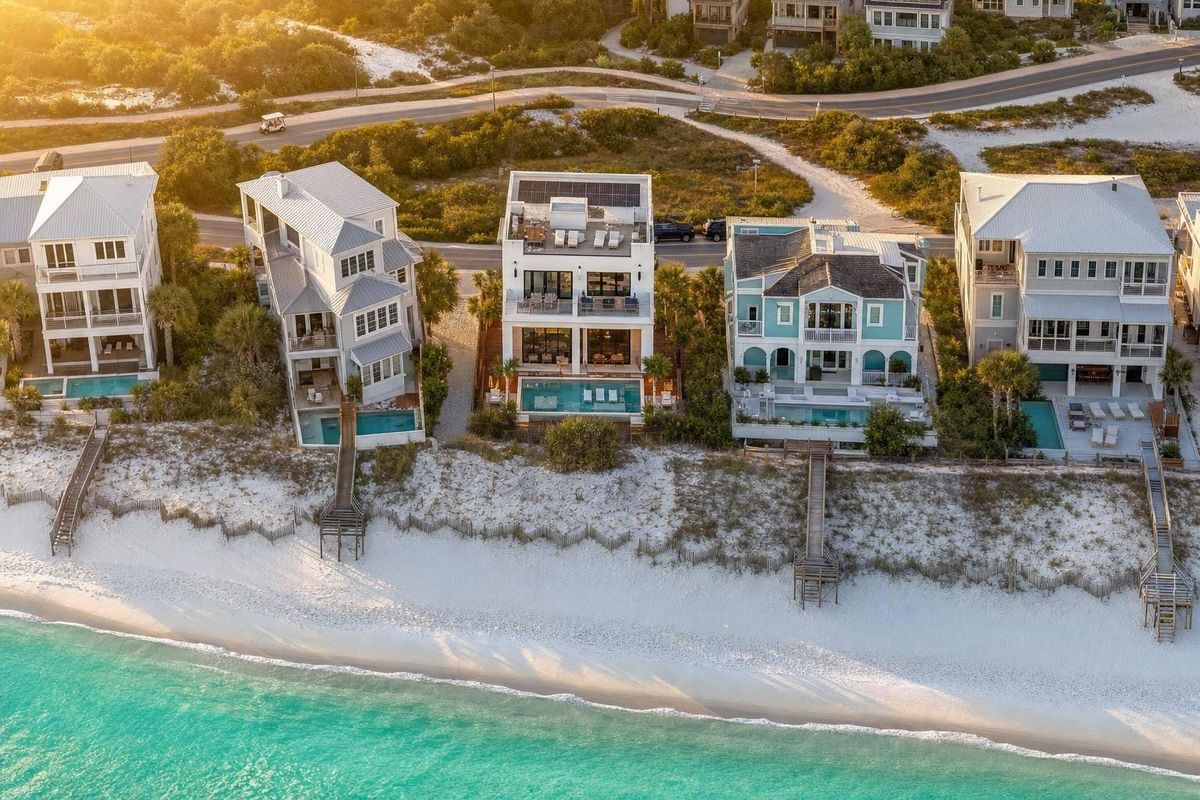
INSIDE A $2.3M Inlet Beach Florida Luxury Home | 30A Real Estate
Quick comparison
| Focus area | What I’d check first | Why it matters |
|---|---|---|
| Market | Price per square foot, supply, days on market | Shows pricing power and room to negotiate |
| Community | Beach access, walkability, privacy, design rules | Shapes daily use and resale appeal |
| Financing | Jumbo vs. DSCR vs. cash | Changes down payment, reserves, and rate |
| Carrying costs | Insurance, taxes, HOA, upkeep | Decides how ownership feels year to year |
| Rentals | County, state, and HOA rules | Affects income and buyer options later |
| Exit | Hold period and sale path | Helps avoid buying the wrong property for my goal |
Bottom line: if I want a 30A luxury home in 2026, I’m not just buying square footage near the beach. I’m buying into a specific community, a rule set, a cost structure, and a resale story. This guide helps me check those four things before I commit.
30A luxury market overview for 2026
Price trends, inventory, and buyer demand
The 30A luxury market in 2026 looks selective and steady, with most of the strength clustered around the best homes. In May 2025, the average sold price along 30A was $2.37 million, the median was $2.15 million, and the average price per square foot came in at $888. That gap tells you a lot. In 2026, where you buy matters more than broad county numbers.
The market is splitting into two clear bands. The entry-luxury tier, from $1 million to $5 million, is seeing prices settle while buyer activity continues. Homes above $10 million are also trading more often, and per-home pricing is still holding up. But this top end doesn’t move like the rest of the market. There are fewer direct comps, marketing periods tend to run longer, and buyers pay close attention to things like the view, lot placement, and design quality. In new communities, lot location, build quality, and design rules often matter more than broad market numbers.
Inventory is still on the high side, but the best-located pockets are starting to tighten. In May 2025, 30A had 10.9 months of supply, average days on market were 91, and homes sold for about 93% of asking price. That gives buyers room to negotiate. Still, it doesn’t wipe out the premium attached to rare Gulf-front homes or new builds. Well-priced new construction and Gulf-front listings still tend to pull interest faster.
At the neighborhood level, the differences get even sharper. Rosemary Beach averages just under $3.8 million with a price per square foot of $1,108, up about 1% year over year. Alys Beach sits even higher, with a 12-month average price per square foot of $1,915. Limited supply and strict architectural rules help keep pricing firm in both places, even with more inventory across the market.
How 30A compares with Walton County and the Florida Panhandle
For buyers, the big difference isn’t just price. It’s also supply, design control, and the type of buyer in the market. Walton County is broader and more rate-sensitive. 30A luxury buyers are often paying for scarcity and long-term appeal. As of mid-2026, the countywide median sale price in Walton County is $549,900, with about 3,155 homes for sale and 6.4 months of supply. The tiers below make that contrast easier to see.
| Market | Typical Price Range | Avg. Price/Sq. Ft. | Months of Supply | Main Buyer Type | Key Advantage |
|---|---|---|---|---|---|
| 30A beachfront luxury | Multimillion-dollar; top homes exceed $10 million | Highest in the market | Elevated in recent reports | Lifestyle | Scarcity, design standards, Gulf access |
| Inland Walton County | Around the county median and generally lower than beachfront 30A | Lower than beachfront 30A | About 6.4 months | Primary-home | More square footage, lower entry price |
| Florida Panhandle luxury | Varies widely by submarket | Varies by submarket | Higher variability | Mixed | Wider supply, broader price range |
Buyers also stack 30A up against Destin and Panama City Beach. Those markets usually have more inventory and more investor-driven pricing. 30A, by contrast, gets a premium because of controlled design, walkable village planning, and limited land left to build on. That’s why community-level due diligence matters more than just chasing the lowest list price.
sbb-itb-d06eda6
How to choose the right 30A community and new development
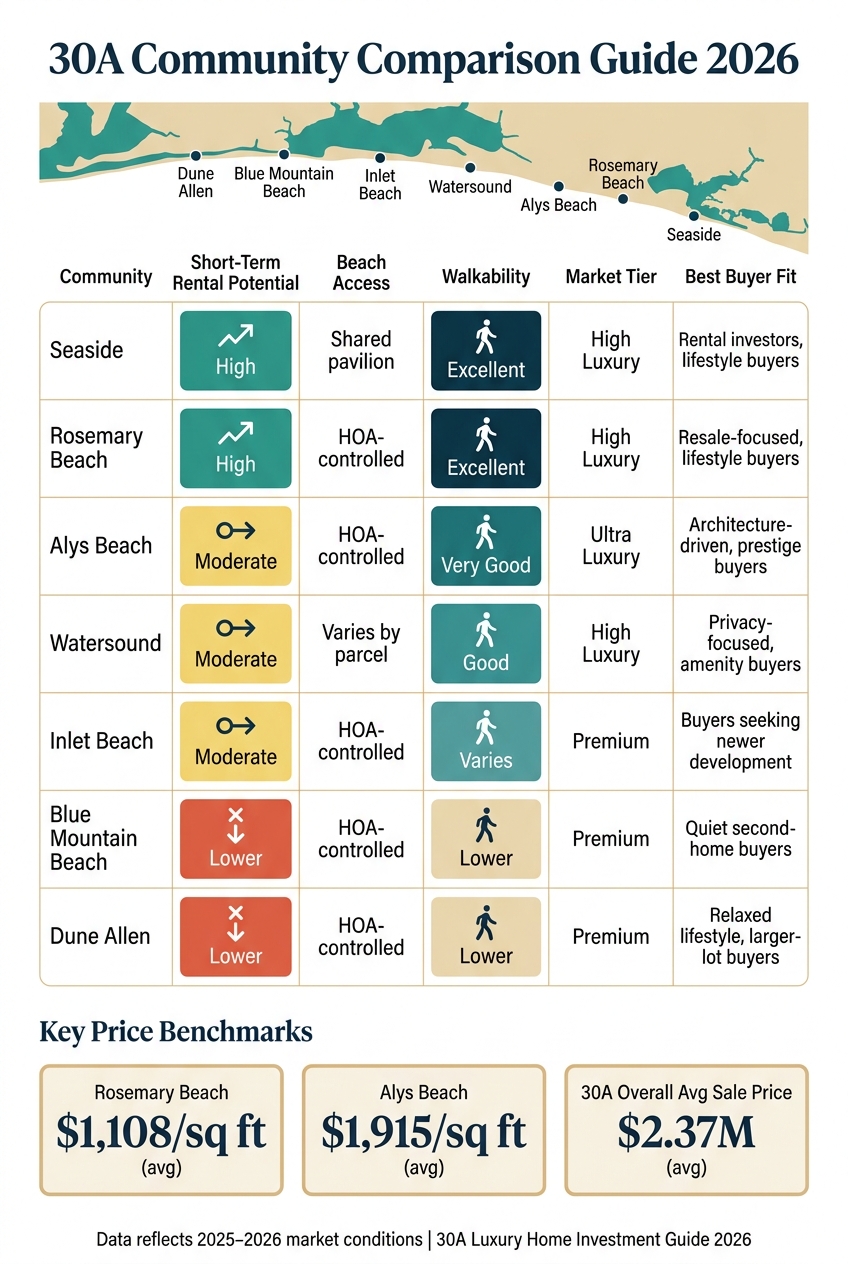
30A Luxury Real Estate: Community Comparison Guide 2026
How Seaside, Rosemary Beach, Alys Beach, Watersound, Blue Mountain, Dune Allen, and Inlet Beach compare
On 30A, prices and buyer demand can change fast from one neighborhood to the next. That’s why picking the right community matters just as much as your budget. A home that works well for rental income may not be the best fit for personal use, and the areas with the strongest resale appeal aren’t always the same ones with the highest booking volume.
Seaside and Rosemary Beach tend to draw buyers who want strong walkability and a village feel people recognize right away. Alys Beach sits at the top end of the market and fits buyers who care deeply about architecture, strict design standards, and privacy more than top rental output. Watersound works well for people who want newer homes, more space between properties, and resort-style amenities. Inlet Beach often appeals to buyers who want to stay near the Rosemary Beach corridor while getting exposure to newer projects. Blue Mountain Beach and Dune Allen usually make more sense for buyers who want a quieter setting, less crowding, and a slower beach routine.
Here’s a simple side-by-side look at the tradeoffs:
| Community | Short-term rental potential | Beach Access | Walkability | Market tier | Best Buyer Fit |
|---|---|---|---|---|---|
| Seaside | High | Shared pavilion access | Excellent | High luxury | Rental investors, lifestyle buyers |
| Rosemary Beach | High | HOA-controlled | Excellent | High luxury | Resale-focused, lifestyle buyers |
| Alys Beach | Moderate | HOA-controlled | Very good | Ultra luxury | Architecture-driven, prestige buyers |
| Watersound | Moderate | Varies by parcel | Good | High luxury | Privacy-focused, amenity buyers |
| Inlet Beach | Moderate | HOA-controlled | Varies | Premium | Buyers seeking newer development potential |
| Blue Mountain Beach | Lower | HOA-controlled | Lower | Premium | Quiet second-home buyers |
| Dune Allen | Lower | HOA-controlled | Lower | Premium | Relaxed lifestyle, larger-lot buyers |
Beach access is one of those details that can catch buyers off guard. The rules often vary more than expected, even between nearby communities. Before moving ahead, confirm exactly how access works and whether peak-season limits apply.
What to review before buying in a new luxury development
Before you buy in a new luxury development, look closely at the developer’s track record, the CC&Rs, and the flood-zone and elevation details. Those items shape how the property works day to day and what it may look like as an investment.
Some communities add another layer of rules at the parcel level. For example, Watersound Origins restricts short-term rentals in certain areas, which pushes the property more toward owner-occupancy and changes the investment math in a big way.
Phased construction matters too. Buying early can mean months or even years of construction noise, unfinished amenities, and a neighborhood that still feels like a work in progress. It’s also smart to check drive times to groceries, restaurants, and medical care. A map can make a place look close to everything, but the actual trip can feel very different.
After you’ve reviewed the rules and priced in construction risk, the next thing to study is whether the neighborhood has pull beyond peak vacation season.
How local lifestyle signs can help measure long-term demand
Areas with year-round activity - steady dining traffic, walkable streets, and active event calendars - often hold resale interest better than places that only feel lively during the summer rush.
Small signs tell you a lot. Look for coffee shops that stay busy outside summer, bike paths people use in the off-season, farmers markets, and community events that continue beyond June, July, and August. Those details help show whether a neighborhood brings back repeat visitors and long-term owners, or mostly seasonal traffic.
Walton County drew more than 4.7 million visitors and generated over $4.1 billion in direct visitor spending in 2024, with about 3.6 million paid room nights recorded that year. That creates a strong base level of demand. But that demand doesn’t spread evenly across 30A. Neighborhoods with better lifestyle infrastructure tend to take a larger share of it.
For local dining, hidden beaches, and community events, sowal.co can help buyers get a feel for neighborhood fit before they commit.
Financing, ownership costs, and rental income planning
Jumbo loans, cash purchases, and second-home vs. investment-property rules
Once you've narrowed down the community, the next step is financing and the cost to carry the home. Most 30A luxury homes sit above Florida's $766,550 conforming loan limit, so jumbo financing is usually part of the deal.
Jumbo loans tend to come with stricter rules. In many cases, lenders want a 700+ credit score, 20%–30% down, a debt-to-income (DTI) ratio of 43%–45% or less, and 6–12 months of principal, interest, taxes, and insurance (PITI) in reserves. On some higher-end loans, reserve needs can stretch to 18–24 months. Cash buyers skip underwriting, which is a big reason some people go that route first. Later, they may refinance or tap a HELOC to pull cash back out.
The second-home vs. investment-property label matters more than many buyers expect. A second-home loan can come with a slightly lower down payment and a better rate. But there's a catch: lenders usually won't use projected short-term rental income to help you qualify. If you expect heavy rental use and need that income to stay inside DTI limits, an investment-property loan or DSCR loan may make more sense, even if the down payment is bigger and the rate is higher.
Some non-QM DSCR programs size income using the lowest of 80% of appraiser rent, 80% of AirDNA gross rents, or 80% of actual rents. That can be helpful, but it's also a reminder to run the math with a margin of safety.
| Financing Type | Typical Down Payment | Reserve Expectation | STR Income for Qualifying | Best For |
|---|---|---|---|---|
| Jumbo second-home loan | 10%–20% | 6–12 months of PITI | Generally not allowed | Buyers with strong non-rental income |
| Jumbo investment-property loan | 25%–30% | Higher reserve demand | Allowed with documentation | Buyers prioritizing rental income treatment |
| DSCR / non-QM loan | 20%–30% | Varies by lender | Yes, based on market-rent data | Investors qualifying primarily on rental income |
| All-cash purchase | N/A | Self-managed liquidity | N/A | High-net-worth buyers |
Yearly ownership costs for a 30A luxury home
New construction can lower repair risk, but it can also mean higher HOA and amenity fees. Walton County is often cited as having one of Florida's lower effective property tax rates, at about 0.45% to 0.74%. Even so, luxury pricing changes the picture fast. A lower tax rate doesn't always mean a small tax bill when the home itself costs a lot.
Insurance is often one of the biggest line items. On the coast, wind and hail coverage can get expensive. Flood insurance may also be required based on the FEMA flood zone and the home's elevation. Then come the day-to-day costs: HOA or condo dues, utilities, pool service, landscaping, routine maintenance, and property management. If the home is a rental, management alone often runs 20%–30% of gross rental revenue.
Here's the simple way to think about it: the purchase price gets the attention, but the yearly carrying costs decide how comfortable ownership feels.
| Cost Category | Budget Note |
|---|---|
| Property taxes | Lower than many coastal markets, but higher in absolute dollars on luxury homes |
| Insurance | Wind and hail exposure can make this a major line item |
| Flood insurance | May be required depending on flood zone and elevation |
| HOA / condo dues | Vary by community and amenities |
| Utilities | Ongoing operating expense |
| Pool service / landscaping | Routine upkeep expense |
| Maintenance / reserves | Set aside cash for repairs and replacements |
Short-term rental rules and income estimates in Walton County
If you plan to rent the home, Walton County has rules you need to handle up front. The county requires annual short-term vacation rental registration. Any property rented to guests must have an annual Short-Term Vacation Rental Certificate, which costs $300 per year and must be in place before the property is advertised. Operating without one can bring fines of up to $500 per day.
Florida's Department of Business and Professional Regulation (DBPR) also requires a state vacation rental license for homes rented more than three times per year for stays under 30 days. Before applying, owners must register for Florida sales tax and Walton County tourist development tax.
There are also operating rules once the home is live. Walton County caps occupancy at about one person per 150 square feet and requires a 24/7 local responsible party who can get to the property within one hour. In plain English, you can't just list the place and disappear.
Rental income varies a lot by location and product type. Beachfront homes usually get the top nightly rates and often book first. Luxury condos in walkable communities can do well in the shoulder season because guests like easy access to dining, shops, and the beach without needing a car for every errand. Inland amenity-rich homes often post lower peak rates, but they may pull in longer stays and more off-season demand.
| Property Type | Peak Season | Shoulder Season | Off-Season |
|---|---|---|---|
| Beachfront single-family | Highest rates | Strong | Lower, but still premium |
| Luxury condo / townhome in a walkable community | Strong | Very strong | Steadier |
| Inland amenity-rich home | Lower than beachfront | Moderate | Can attract longer stays |
When you model income, be conservative. Back out management, platform, cleaning, and operating costs before you get too attached to the gross revenue number. Fannie Mae allows 75% of documented average monthly STR income to count toward qualifying income on investment properties with at least one year of history. That's a useful stress test when you're checking whether the deal still works if bookings come in a bit softer than hoped.
Those numbers feed straight into exit planning, where resale strategy and hold period matter just as much as starting yield.
Exit planning and your final buying checklist
Exit options for 30A luxury homeowners
The best 30A buyers think about the exit before they buy. That’s how long-term wealth usually works: you don’t just plan the purchase, you plan how you’ll get out.
For most 30A luxury owners, there are five main paths:
- Sell into the luxury resale market
- Hold for the long haul while renting
- Refinance and pull out equity
- Use a 1031 exchange
- Pass the property to heirs through estate planning
Each one lines up with a different time horizon and money goal.
Recent 30A numbers show that you can sell, but you may not sell fast. In one South Walton luxury update, high-end single-family homes were taking about 82 days to sell, up from 57 days the year before, with just 30 closings out of 434 listings. If you expect a short hold, keep a close eye on days on market and list-to-sale ratios for the exact community you’re buying in. A house in one pocket of 30A can move very differently than a house a few miles away.
Those market patterns shape the main exit routes below.
A 1031 exchange only applies to investment or business-use property, not a personal-use second home. So if you may want that route later, the way you use the home from day one matters. Your records matter too. And if you take depreciation, be ready for recapture when you sell.
| Exit Strategy | Typical Holding Period | General Tax Points | Best-Fit Buyer Goals |
|---|---|---|---|
| Sell into resale market | 3–7 years | Triggers capital gains and potential depreciation recapture | Maximize profit, reallocate capital |
| Hold + short-term rent | 7–15+ years | Depreciation benefits ongoing; taxes due at eventual sale | Long-term wealth building plus vacation use |
| Refinance | 3–10 years after purchase | No immediate capital gains tax; future sale taxes unchanged | Access cash while keeping the property |
| 1031 exchange | After meaningful appreciation (often 5+ years) | Defers capital gains and depreciation recapture; strict IRS deadlines | Reposition investment portfolio tax-efficiently |
| Heir transfer | 10+ year horizon | Potential step-up in basis at death; estate planning required | Legacy, family beach base, intergenerational wealth |
What to check before you buy in 2026
Use this checklist before you commit.
Start with the submarket. Does this exact community fit what you care about most - beach access, walkability, dining, and long-term resale demand? That gap between a core 30A address and a less-established stretch can show up in a big way when it’s time to sell.
Then look hard at new-development risk. Check the builder’s track record. Get amenity completion promises in writing. Make sure you know whether later phases could add competing inventory at lower price points. That kind of thing can put pressure on resale.
Next, stress-test your ownership costs under at least three cases: a base rental case, a 20%–30% occupancy drop, and pure second-home use with no rental income. This is where a lot of buyers either get comfortable or get a wake-up call. If the downside case feels tight, fix the issue before closing by changing your price point or loan setup.
Also, verify rental rules before you close. Get written proof of county, HOA, and any municipal rules. Rental policy can vary a lot, and it can shape resale value. Resources like sowal.co can help you get a street-level sense of which South Walton areas lean pro-rental and which feel more residential.
Finally, write your exit plan before you buy. Put down your target holding period, your preferred exit route, and how much liquidity you may need at different stages of life. Then review that plan with a CPA and an estate attorney. Buy for the use case - and the exit timeline - you actually want.
FAQs
Which 30A community fits my goals best?
The right 30A community comes down to what matters most to you: privacy, rental income, or day-to-day lifestyle.
Each area has its own feel, and that difference matters more than many buyers expect. Some places lean into prestige and design. Others are built around walkability, family time, or a quieter pace. And some simply give you more space for the money.
Here’s the quick breakdown:
- Alys Beach: prestige and design-focused long-term holds
- Rosemary Beach and Seaside: walkable village living and strong rental demand
- WaterColor: family-friendly amenities and club access
- WaterSound Beach: gated privacy and lower density
- Blue Mountain Beach and Dune Allen: more land, a quieter pace, or better value per square foot
If you want a polished, high-end community with a strong design identity, Alys Beach often stands out. If your focus is foot traffic, village energy, and steady vacation appeal, Rosemary Beach and Seaside usually get the most attention. WaterColor tends to draw buyers who want easy access to amenities and a setup that works well for families. WaterSound Beach fits people who want more separation and less crowding. And if space, a calmer setting, or price per square foot matters more, Blue Mountain Beach and Dune Allen are often worth a close look.
How much cash do I really need to buy on 30A?
It depends on how you buy and what it costs to keep the home year after year.
If you’re financing the purchase, plan for a 20%–30% down payment. For some rental-focused purchases, that can climb to 30%–40%. On top of that, closing costs usually add another 2%–5%, and you may need extra cash if the appraisal comes in low.
Then there are the annual carrying costs. A good rule of thumb is to set aside:
- 1%–2% of the home’s value for maintenance
- About 0.7%–1.0% for property taxes
- $10,000–$20,000 for insurance
- $35,000–$70,000 for furnishings
That last part trips people up all the time. Buying the place is one thing. Paying to maintain it, insure it, and outfit it is where the full price starts to show.
Can I rent out a 30A luxury home year-round?
Yes, but year-round rentals depend on local, county, and community rules.
You’ll need a Walton County Vacation Rental Certificate and must meet zoning, occupancy, and safety rules.
Before you buy, check HOA and neighborhood limits too. Some communities set minimum stay rules, annual rental caps, or outright short-term rental bans.
It’s also smart to confirm that your financing allows investment-level rental use. That part can trip people up if you assume any loan will work for a full-time rental plan.