30A Luxury Home Outlook: Prices, Demand, Supply
Mid-2026: sales +45% and listings -25%. Beachfront scarcity supports prices while near-beach and inland tiers grow more selective.
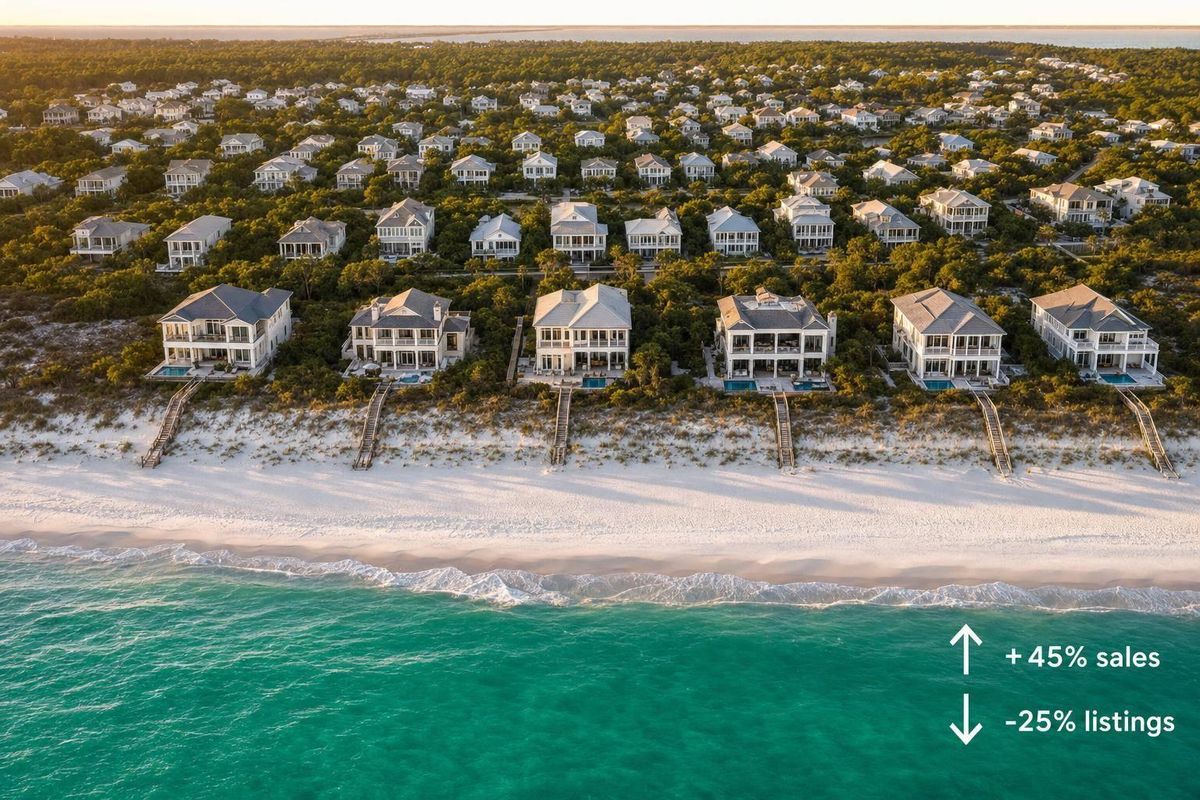
30A luxury prices look more stable than soft right now. I see a market where sales are up 45.2%, active listings are down 25.1%, and the tightest coastal enclaves still have the strongest price support.
If you want the short version, it’s this:
- Beachfront homes have the strongest floor because supply is limited
- Near-beach homes still sell, but buyers are pickier
- Inland luxury homes show the most price spread based on condition and location
- Days on market are up, which tells me buyers are moving more slowly
- Cash buyers still shape the top end, especially above $3 million and $5 million
That leads to a simple takeaway: scarcity is still doing most of the work. Homes closest to the Gulf, especially in places like Alys Beach, Rosemary Beach, and Seaside, should hold up better over the next 12 to 18 months than homes with more direct competition.
Quick comparison
| Segment | Typical price range | What I’d watch most |
|---|---|---|
| Beachfront | $5 million to $15 million+ | Scarcity and direct Gulf access |
| Near-beach | $1.5 million to $3.5 million | Walkability, updates, rental appeal |
| Broader 30A luxury | $800,000 to $1.5 million+ | Condition, lot quality, community |
For me, the big read is simple: 30A is not one market. If you want to judge pricing well, you have to split it by tier, distance to the beach, and community.
Inside a $7.99 Million Gulf-Front Home on 30A
sbb-itb-d06eda6
Current market snapshot: Demand holds, supply stays tight
Mid-2026 numbers show a market with steady demand and less inventory. Year-to-date closed sales along the 30A corridor hit 540, up from 372 during the same stretch a year earlier - a 45.2% increase. Meanwhile, active listings dropped to 947 in May 2026, down 25.1% from 1,265 in May 2025.
Put simply: more homes are selling while fewer are on the market. That tends to support pricing, even when buyers take a bit more time to make a move.
Key indicators to watch now
Five metrics offer the clearest picture of where the 30A luxury market stands right now:
| Metric | Recent figure | What it signals |
|---|---|---|
| Active listings | 947 (May 2026) vs. 1,265 (May 2025) | Supply is down year over year |
| Months of supply | About 6 months (mid-2026) vs. roughly 13 months (end-2025) | Market is moving toward balance |
| Average sold price | $2.29M (Q3 2025) | Upper-tier pricing is holding |
| Price per square foot | $754 (Q3 2025, +4% YoY) | Per-foot values are still firm |
| Median days on market | 80 days (May 2026) vs. 46 days (May 2025) | Buyers are slower, not gone |
That mix matters. Inventory has come down fast, months of supply has narrowed, and pricing at the upper end is still holding up. At the same time, the jump in median days on market shows buyers are taking a more measured approach. They're still active - just not rushing in.
Why cash buyers still shape the top end
At the top of the market, low inventory gives cash buyers more pull. Cash still leads in the $3M+ and $5M+ tiers on 30A, and it has the most impact in the $10M+ bracket, where buyers can close fast and avoid financing contingencies.
That changes the tone of the deal. These buyers are less tied to mortgage-rate changes, so they often focus more on scarcity and long-term upside. In places like Alys Beach and Rosemary Beach, where Gulf-front inventory is limited, that kind of fast decision-making can shape who wins a property and how pricing holds.
Where tight supply shows up most
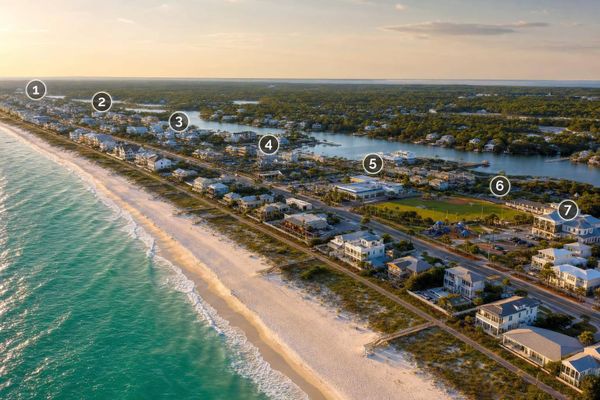
Inventory pressure isn't spread evenly across 30A. The tightest conditions are in coastal communities like Alys Beach, Rosemary Beach, Seaside, WaterColor, and WaterSound - especially for beachfront homes vs. gulf-view properties.
The reason is pretty simple: land supply is fixed, and Gulf access is limited. That keeps price pressure highest in those pockets. Beachfront land is scarce, which makes new inventory tough to bring to market. Beyond the purchase price, buyers must also account for the hidden costs of Gulf-front properties like specialized insurance and maintenance. That gap becomes even clearer in the price split that follows.
Prices by segment: Beachfront, near-beach, and the broader corridor
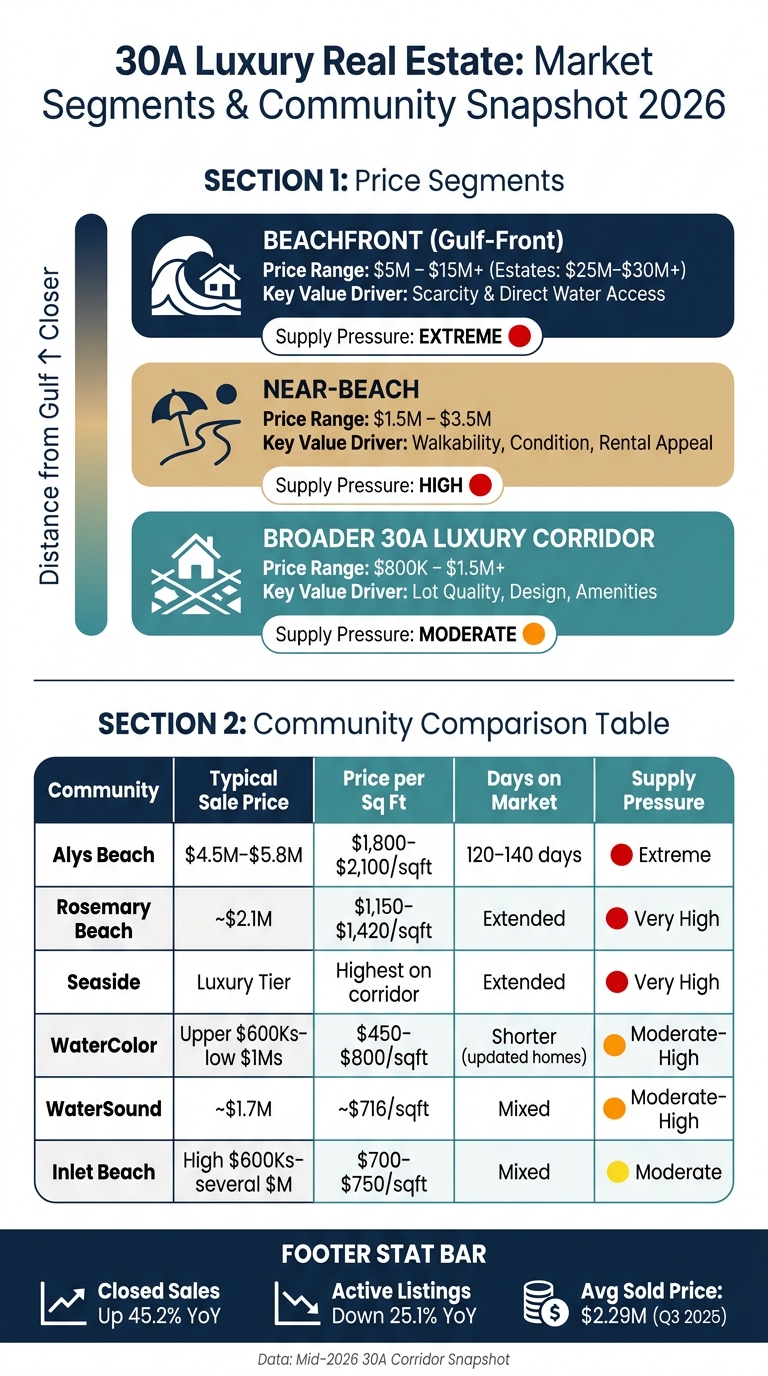
30A Luxury Real Estate Market: Segment & Community Comparison 2026
On 30A, price isn't just about how nice a house is. Location does the heavy lifting. Beachfront, near-beach, and inland homes act like three different micro-markets.
The supply crunch from the last section doesn't land evenly, either. It's strongest right on the Gulf, then loosens as you move inland. And that price spread grows fast.
Beachfront homes: Least supply, strongest price floor
Beachfront homes often start around $5M and can climb past $15M, with top-tier estates reaching $25M to $30M+. Recent Gulf-front listings have posted median prices above $11M and price-per-foot figures near $2,552.
That makes sense. There are only so many homes sitting right on the water.
On 30A, beachfront scarcity gives this segment the strongest price floor. Cash buyers also tend to move fastest here, which helps sellers hold firm on asking price. You can feel the difference once you step down to the next tier.
Near-beach homes: Broad demand but faster price cuts
Homes within walking distance of the beach, but not directly on the Gulf, usually trade in the $1.5M to $3.5M range.
This slice of the market pulls in a broad mix of buyers:
- second-home buyers
- rental-focused buyers
- people chasing the 30A lifestyle without paying Gulf-front numbers
Buyers tend to be more selective here. Homes that are turnkey, easy to get to the beach from, and well-positioned for rentals usually move faster. Dated homes, or listings priced too high, are often the first ones to trim price.
Broader 30A luxury market: More variation by condition and location
Move farther inland, or outside the best-known enclaves, and pricing gets less uniform. Luxury homes in this part of the corridor often begin around $800,000 to $1.5M and go higher based on lot quality, architecture, amenities, and presentation.
Here, value depends less on direct Gulf access and more on the full package. A well-designed inland home in a strong community can still earn a premium. A dated property without a clear draw has less room to hide and is more exposed to pricing pressure.
If you want the fastest way to read pricing on 30A, it's simple: check the distance to the water.
| Segment | Typical price range | Key value driver |
|---|---|---|
| Beachfront (Gulf-front) | $5M–$15M+ (estates $25M–$30M+) | Scarcity, direct water access |
| Near-beach | $1.5M–$3.5M | Walkability, condition, rental appeal |
| Broader 30A luxury corridor | $800K–$1.5M+ | Lot quality, design, amenities |
These gaps stand out even more when you line up one community against another. That's where the pricing pressure gets easier to see.
Community comparison: Where luxury supply pressure is highest
Supply pressure looks very different from one community to the next, and those differences will likely shape near-term pricing. If you're trying to figure out where values may hold up best, community-level supply is the clearest signal.
| Community | Typical sale price | Price per sq ft | Days on market | Supply pressure |
|---|---|---|---|---|
| Alys Beach | $4.5M–$5.8M | $1,800–$2,100 | 120–140 days | Extreme |
| Rosemary Beach | About $2.1M | About $1,150–$1,420 | Extended | Very high |
| Seaside | Luxury tier | Among the highest in the corridor | Extended | Very high |
| WaterColor | Upper $600Ks–low $1Ms | About $450–$800 | Shorter for updated homes | Moderate to high |
| WaterSound | About $1.7M (ZIP median) | About $716 | Mixed | Moderate to high |
| Inlet Beach | High six figures to several million | About $700–$750 | Mixed | Moderate |
Representative snapshots, not appraisals.
The core enclaves are still the tightest. On the east end, conditions vary more from one pocket to another.
Alys Beach, Rosemary Beach, and Seaside
The heaviest pressure starts in the most built-out communities, where adding new supply is hard.
Alys Beach is tightly controlled and already built out, so inventory doesn't expand easily. A mid-2025 summary showed that only 18 homes sold over six months, down from 26 a year earlier, while active listings reached 33 and the sold-to-list ratio slipped from 99% to 96%. Over the prior 12 months, average price per square foot was about $1,915, and days on market sat around 123 to 124.
Rosemary Beach pulls in a broader buyer mix, from families to buyers focused on rental income. Median pricing is around $2.1 million, with price per square foot near $1,150 to $1,420. Even with pressure building, updated homes in prime spots still get the most interest.
Seaside, the original New Urbanist community on 30A, stays tightly constrained because it's fully built out. That helps keep its price-per-square-foot levels among the highest on 30A.
WaterColor, WaterSound, and Inlet Beach
Farther east, supply pressure starts to loosen because the housing stock and location mix are less uniform.
WaterColor tends to be more price-sensitive than the core enclaves. Homes that are updated, close to the Gulf, and backed by strong rental histories move faster. Older homes, or ones with less convenient access, usually take longer.
WaterSound is a split story. WaterSound Beach faces higher inventory pressure near the Gulf, while WaterSound Origins trades on newer construction and larger lots at a lower price per square foot. In ZIP code 32461, the median sale price is about $1.7 million, with median price per square foot near $716.
Inlet Beach is the most mixed of the group. Price per square foot runs about $700 to $750, with demand strongest for newer homes near public vs. private beach access. Older cottages, or homes set farther from the water, are seeing slower absorption.
Outlook: What to expect over the next 12 to 18 months
Community-level supply gaps are set to shape the next 12 to 18 months. In plain terms, the 30A luxury market should stay split in two: scarce beachfront and top-tier enclaves should hold up better, while near-beach and broader corridor homes should stay more price-sensitive.
That pecking order looks pretty clear. Beachfront scarcity should protect values first, then near-beach homes, and then the broader corridor. And this gap should grow more pronounced by tier, not fade.
Most likely base case
The base case is a stable-to-firmer market, with the scarcest beachfront areas and built-out enclaves leading the way. Beachfront and fully built-out enclaves should keep the strongest price support.
The ultra-luxury end is holding up too. Within the $5M+ category, year-to-date closed sales jumped 47.5%, with 59 estates sold compared to 40 in the same period a year earlier.
So the pattern looks like this:
- Beachfront homes should lead
- Near-beach homes should stay selective
- The broader corridor should show the most pricing variation
Near-beach and broader corridor homes should face more selective pricing. Buyers in these segments have more choices, and many will sit back and wait if a listing feels overpriced. Homes that are updated, rental-ready, and in the right spot should still move. Others may take longer to sell or need price cuts to get across the finish line.
Key points to keep in mind
Pricing power should stay strongest where inventory is tightest. Cash buyers should remain the main force at the top end. They still account for about 40% to 60% of transactions in the corridor, especially at the Gulf-front and high-end tiers, and they continue to set the tone for top-end sales.
That’s why broad county averages matter less than enclave-level supply. Countywide numbers don’t explain these luxury submarkets very well. Alys Beach and Seaside still trade on scarcity, not the county median. For both buyers and sellers, location and condition should matter more than the headline average.
FAQs
Why is 30A split into different luxury micro-markets?
30A breaks into luxury micro-markets because buyers want very different things depending on where they land along the coast.
On the east end, places like Alys Beach, Rosemary Beach, and Seaside tend to fetch top-dollar prices. The draw is pretty clear: walkable layouts, design-led communities, tight land supply, and built-in amenities all push demand higher.
On the west end, areas like Blue Mountain Beach and Dune Allen speak to a different kind of buyer. People often look there for larger lots, more privacy, and better value per square foot.
Same stretch of coast. Very different priorities.
What makes beachfront homes more resilient than inland luxury homes?
Beachfront homes on 30A tend to hold up better than many other property types. The big reason is simple: there just isn't much land left. Inventory is tight, and demand from affluent buyers stays steady. That mix helps support prices, even when the market gets choppy.
Many newer beachfront luxury homes also use Fortified Gold standards and eco-friendly design. Those features can help lower coastal risks like hurricanes and erosion, which may help protect long-term value.
How should buyers read rising days on market on 30A?
Rising days on market on 30A often point to a move away from a frantic seller’s market and toward one that feels more balanced and less rushed. For buyers, that usually means more time to do proper due diligence, from inspections to a close look at long-term insurance costs, without the same pressure to jump into a bidding war right away.
It can also give buyers more leverage in negotiations, especially with homes that are overpriced or not presented well. There may be more room to ask for better terms, seller credits, or longer inspection periods. That said, turnkey homes in walkable, high-demand areas can still move fast.