5 Ways Walton Funds Road And Drainage Work
How Walton County mixes county budgets, SWIF/TIF, impact and mobility fees, grants and reserves to fund roads and drainage.
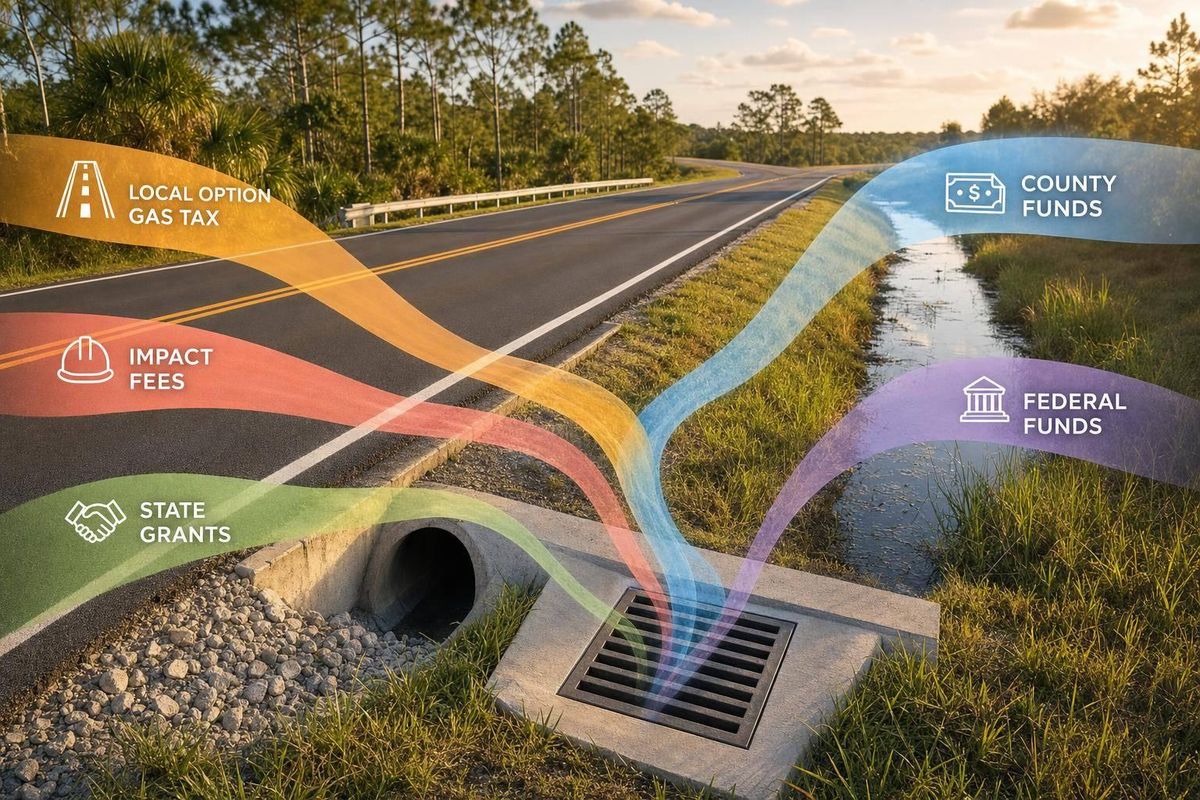
Walton County pays for road and drainage work by mixing five money sources, not one. In plain terms, that means county budget dollars, South Walton Infrastructure Fund (SWIF) money, impact or mobility fees, state and federal grants, and reserves spread across multiple years all help cover the bill.
If you want the short answer, here it is:
- County budget dollars pay for many day-to-day road and drainage needs inside county rights-of-way.
- SWIF puts tax growth from South Walton back into South Walton projects.
- Impact and mobility fees come from new development and can only fund growth-related capital work.
- Grants bring in outside money for large jobs like road, bridge, and stormwater work.
- Reserves and phased funding help the county pay for projects that are too big for a single year.
A few numbers show the scale:
- More than $33 million was budgeted for infrastructure in 2024
- More than $84 million was set aside over five years for South Walton districts
- SWIF ranged from $0 in 2020 to $7 million in 2021
- One U.S. 98 state project totals $15.7 million
- A SCOP grant for Rock Hill Road was about $797,000
The main point is simple: each funding source has rules. Some money can pay for drainage, roads, sidewalks, and bridges. Some can only pay for work tied to new growth. Some money arrives only if the county wins a grant. And large projects often move in stages because the money also comes in stages.
Quick Comparison
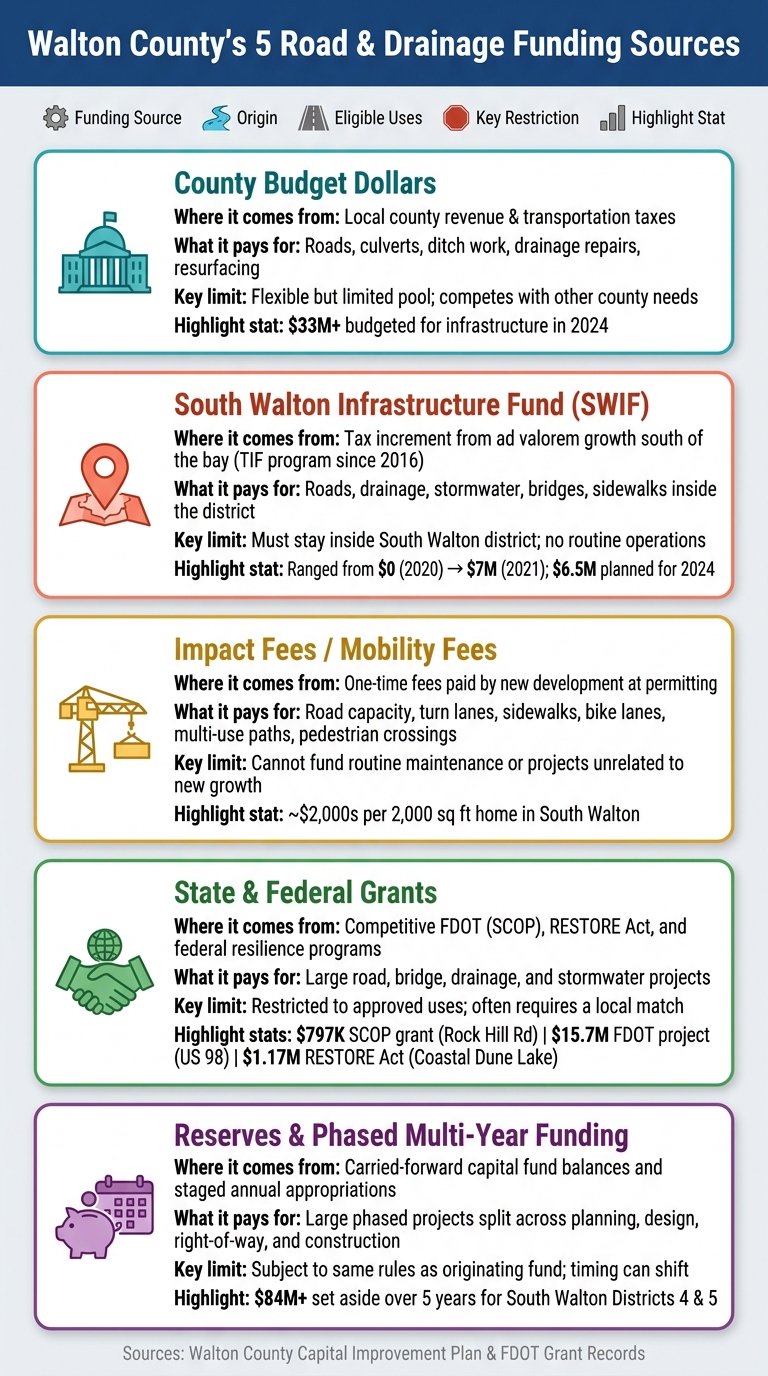
Walton County's 5 Road & Drainage Funding Sources Compared
| Funding source | Where it comes from | What it can pay for | Main limit |
|---|---|---|---|
| County budget dollars | Local county revenue | Roads, culverts, ditch work, drainage repairs | Limited pool; must compete with other county needs |
| SWIF | Tax growth from South Walton | Major South Walton road, drainage, bridge, stormwater, and sidewalk work | Must stay inside the district and cannot cover routine work |
| Impact / mobility fees | One-time fees from new development | Growth-related road capacity, turn lanes, sidewalks, paths, crossings | Cannot pay for routine upkeep or older problems not tied to growth |
| State and federal grants | Outside grant programs | Large road, bridge, drainage, and stormwater jobs | Restricted to approved project uses and often need a local match |
| Reserves / multi-year funding | Saved capital funds and future budget years | Large phased projects | Work may take longer if later-year money is not yet in place |
So when you see a road project move fast, it often has local money ready. When you see one sit in the plan for years, it often needs a mix of fees, grants, and later-year funding before work can start.
sbb-itb-d06eda6
Why South Walton Uses A Mix Of Funding Sources
South Walton uses a mix of funding sources because each source comes with its own rules, limits, and timing. A neighborhood drainage fix is not the same as a CR 30A corridor upgrade. The costs are different. The legal rules are different. The timeline is different too. So the county doesn’t rely on one pot of money for everything.
Legal restrictions matter a lot here. Some funds are flexible and can cover almost any road or drainage need. Others are locked to specific uses under state law. Impact fees and mobility fees, for example, can only pay for improvements tied to new growth - added turn lanes, upgraded culverts, or multimodal paths that link newer neighborhoods. They cannot legally pay to fix a pothole or replace a pipe that simply wore out over time. That one rule alone changes which source can cover which job.
Then there’s timing. Grant programs open on set application windows, and the county has to balance road work against parks, public safety, and other needs in the budget. Mobility fee revenue also shifts with local construction activity. So these funds don’t all come in at once. To avoid shortfalls, the county blends sources - and many projects move in phases because the money shows up in phases.
That’s why the county often starts with budget dollars, then adds fees, grants, and reserves. Next up: the county’s own budget dollars.
1. County Budget Dollars
County budget dollars are the most flexible funding source Walton County has for road and drainage work. The county can put this money toward resurfacing, ditch clearing, culvert replacement, or emergency drainage repairs. That kind of flexibility matters, because Florida law allows local transportation funds to pay for roads and drainage inside county rights-of-way.
Put simply, Florida law treats roads and drainage in county rights-of-way as eligible local transportation spending.
Walton County’s infrastructure plans make the scale clear. In 2024, more than $33 million was budgeted for infrastructure, and $84 million in improvements was set aside over five years for Districts 4 and 5, which cover the South Walton area. At the same time, county dollars still compete with other local needs.
Because this pool of money is limited, the county ranks projects based on factors like:
- Flooding risk
- Traffic
- Road condition
- Grant leverage
In South Walton, county dollars often pay for the fastest fixes first, while bigger projects wait for added funding. If a project costs more than the county can handle on its own, Walton usually combines county money with other sources.
2. South Walton Infrastructure Funds And TIF Revenue
When regular county dollars don’t cover the full bill, Walton has another pot of money to lean on: South Walton Infrastructure Fund (SWIF). It comes from a Tax Increment Financing program approved in 2014 and put in place in 2016. The idea is pretty simple: take the new tax revenue generated by growth south of the bay and put it back into local transportation projects in that same area.
The county later moved away from a percentage-based setup and shifted to fixed yearly allocations. That funding has varied a lot from year to year. SWIF provided $0 in 2020, then jumped to $7 million in 2021. It was set at $4 million in both 2022 and 2023, with $6.5 million planned for 2024.
There’s a catch, though. SWIF can only pay for major construction work inside the tax district. That includes roads, drainage, stormwater facilities, bridges, and sidewalks. It can’t be used for day-to-day operations, and it can’t pay for projects outside that boundary.
You can see how this plays out in corridor projects that bundle road, drainage, and pedestrian work together. The CR 395/30A Drainage Improvements (Thyme Street to CR 395) project received $83,105 in SWIF money. Bigger efforts are often spread across several fiscal years. For example, the Alderberry Connector Rd Extension has $600,000 programmed in FY 2027.
This setup gives the county room to mix funding sources based on the kind of work being done. On Forest Shore Road, Walton used SWIF for drainage upgrades, while a separate $400,000 in sidewalk funding paid for pedestrian work along the same corridor. In practice, that means the county can spread dollars across more projects and phase construction over time, with SWIF working alongside county funds and other sources instead of carrying the whole load by itself.
3. Impact Fees And Mobility Fees
SWIF isn't the only way Walton pays for growth-related projects. The county also leans on fees charged to new development. In South Walton, more growth means more traffic. It also means more fee revenue to help pay for the roads, sidewalks, and paths that added growth calls for. These are one-time charges paid when a new project gets permitted.
Walton County replaced its older proportionate-fair-share program with a mobility fee system linked to the 2040 Mobility Plan. South Walton is one of the county's assessment areas, and its rates are usually higher because travel demand is heavier there. A typical 2,000-square-foot home in South Walton owes about the low-to-mid $2,000s before permits. Bigger vacation complexes and retail centers along 30A pay more, based on the amount of travel demand they create.
Mobility fees cover more ground than transportation impact fees. The county can use mobility fee revenue for:
- Road capacity projects
- Turn lanes
- Sidewalks
- Multi-use paths
- Bike lanes
- Safer pedestrian crossings
Traditional transportation impact fees are narrower. They generally apply to roadway capacity work and related drainage built with new construction.
There are still hard guardrails on both fee types. These dollars pay for capital projects tied to the growth that produced them, not routine maintenance, daily operations, or county work that has nothing to do with that growth. And in South Walton, fees collected there should stay there.
Developers can also earn credits by building eligible public improvements listed in the county's Mobility Plan or Capital Improvements Program.
In practice, Walton often mixes mobility fees with county funds and TIF dollars so a single corridor project can cover roadway, drainage, and pedestrian work at the same time. That helps the county move ahead with more complete corridor projects without as much delay. If the fees don't cover the full bill, the county looks to grants and reserves.
4. State And Federal Grants
When county dollars and fee revenue still don't cover the bill, Walton County looks to state and federal grants for bigger road and drainage jobs.
FDOT programs like SCOP help pay for resurfacing, reconstruction, bridge work, and road-related drainage, and they are open to smaller counties. Rock Hill Road shows how that plays out on the ground. Walton County secured a SCOP grant of about $797,000 for roadway work, and separate federal relief funding of $3,843,544.94 paid for design plus construction engineering and inspection for Phase I.
Federal grants play a similar part in drainage and stormwater work. RESTORE Act Direct Component grants have backed South Walton drainage and stormwater projects in sensitive areas. Walton County received $436,045.05 on September 25, 2018, for the Western Lake Drainage Improvement Project and $1,175,396.16 on February 8, 2022, for the Coastal Dune Lake Hydrologic Restoration Project.
There is a catch: grant money is tied to the job it was awarded for. It can't be shifted over to unrelated paving or other county work. On top of that, grants come with tight rules on project eligibility, reporting, and how the money is spent.
Many awards also require a local match. So even when outside money comes in, the county often has to add local funds, such as SWIF or TIF, to pay the full project cost.
A state-funded U.S. 98 project between Mack Bayou Road and CR 30A gives a clear example. FDOT's $15.7 million widening and improvement project covers 1.8 miles and includes drainage and ADA upgrades. If the grant doesn't pay for everything, Walton covers the rest with reserves and phased funding.
5. Reserves And Phased Multi-Year Funding
When a project costs too much to fit into a single budget year, Walton County usually leans on capital reserves and phased multi-year funding. Capital reserves are funds set aside for future road, drainage, and stormwater work, which gives the county a way to help pay for projects that are simply too large for one year’s budget. That said, not every reserve dollar is open for any project. Some funds are limited by county policy, accounting rules, and the legal purpose tied to that fund.
Phased funding works a lot like building a house in steps instead of paying for the whole thing on day one. The county can split a large project into stages such as planning, right-of-way, design, and construction, then fund each part as money becomes available. Walton County’s five-year Capital Improvement Plan (CIP) maps this out by phase and by funding source, so residents can see when money is assigned and where it comes from.
There’s another reason this setup matters: it can cut down on risk. If the county finishes design and permitting before putting up all construction dollars, it has room to adjust. Costs can change if right-of-way issues pop up, utilities are in the way, or drainage work turns out to be more involved than first expected. In plain terms, the county doesn’t have to write the biggest check until it has a better read on the job.
You can already see this pattern in South Walton projects in the county plan. Projects there often combine reserves with other funding sources, which spreads both cost and risk across several years. The Alderberry Connector Road Extension and CR 393 North drainage improvements, for example, show up in county work plans with funding spread across multiple fiscal years. That’s the kind of project setup that usually won’t fit inside one annual budget cycle.
The trade-off is pretty simple: time. A project may get approved now but still have to wait for later-year appropriations before construction starts. And if revenue growth doesn’t keep up, inflation can push final bids above early estimates. County plans also treat these allocations as projections, which means timing and total amounts can still move around.
Quick Comparison Of The 5 Funding Methods
After looking at each funding source on its own, it helps to see them side by side.
| Funding Method | Where the Money Comes From | Limits | Why Walton County Uses It |
|---|---|---|---|
| County Budget Dollars | County revenue and transportation taxes | Flexible, but transportation-related | Baseline county funding and gap filler |
| South Walton Infrastructure Fund (SWIF) | Growth in ad valorem taxes south of the bay | Yes - earmarked for South Walton infrastructure | Reinvests South Walton growth locally |
| Impact Fees / Mobility Fees | One-time fees paid by new development at permitting | Yes - tied to capital and mobility plan improvements | Pays growth-related capacity costs |
| State and Federal Grants | Competitive FDOT and environmental or resilience programs | Yes - depends on grant terms and eligible project types | Brings in outside money for big jobs |
| Reserves and Phased Multi-Year Funding | Carried-forward fund balances and staged annual appropriations | Depends on source; subject to the same rules as the originating fund | Spreads large costs over time |
That mix helps explain why some projects roll out in phases, while others have to wait until the next funding cycle.
What This Means For South Walton Residents And Visitors
County dollars cover the routine work that keeps roads passable after storms. South Walton district funds help push bigger road and drainage jobs ahead, and the county’s five-year plan sets aside more than $84 million for South Walton districts. New development fees and outside grants also help pay for added capacity tied to growth. That mix of funding shapes what gets built first and what has to wait.
On the ground, that shows up in very practical ways. It can mean fewer flooded roads. It can also mean detours and lane closures while work is underway. For residents and visitors, the trade-off is pretty clear: less peak-season congestion and safer intersections, but also temporary construction headaches near places like Seagrove Beach and the CR 393 North corridor.
Large projects also move in phases as funding comes together. So when a corridor job appears in the plan years before crews show up, that’s usually the reason.
Conclusion
These five funding methods show how Walton keeps South Walton road and drainage work moving. Walton County doesn't depend on just one source to maintain South Walton's roads and drainage systems. It mixes local dollars, district funds, fees, grants, and reserves because no single source pays for every road and drainage need, with each one covering a different shortfall.
That layered setup also helps explain why project timelines can look all over the map. A simple road repair paid for with local dollars that are already set aside can move fast. A bigger drainage upgrade may sit for years while grant money, matching funds, and approvals come together.
That’s why projects often show up in plans long before crews actually break ground.
For residents and visitors, who can use a South Walton itinerary generator to plan their trips, this mix shapes when roads get repaved, when flooded intersections are fixed, and when sidewalks or multi-use paths open along 30A.
FAQs
Why can’t one fund pay for every road project?
No single fund can cover every road project. Each funding source comes with legal limits and rules about what the money can be used for. State laws like HB 399 and SB 208 add more guardrails by limiting some fees to actual review costs, not the value of the project itself.
Grants have their own strings attached too. Many only apply to certain project types, and they often require matching funds. That’s why Walton County has to piece funding together from several sources, including the Tourist Development Tax, mobility fees, and local allocations.
How does the county decide which projects get funded first?
Walton County relies on long-range planning documents, including the 2045 Long Range Transportation Plan, to rank infrastructure projects across multiple years.
The Board of County Commissioners approves those projects and often links development approvals to available infrastructure capacity. In plain terms, if the roads, utilities, or public systems can’t handle more growth yet, that can affect what gets approved and when.
Project priorities usually focus on a few main factors:
- Environmental impact
- Traffic congestion
- Maintenance needs
- Public input
That process helps the county decide which projects move up the list first and which ones may need to wait.
Why do some approved projects take years to start?
Approved projects in South Walton often take years to get off the ground. One big reason is funding: money is often spread across multiple fiscal years, and some projects also rely on grant cycles before work can move ahead.
Delays can come from other places too. Property rights disputes, permitting, and environmental standards can all slow the process. On top of that, officials have to weigh infrastructure needs against conservation priorities before construction starts.