How Local Restaurants Help Restore Oyster Reefs
Restaurants recycle oyster shells to rebuild reefs, improve water quality, and protect shorelines.
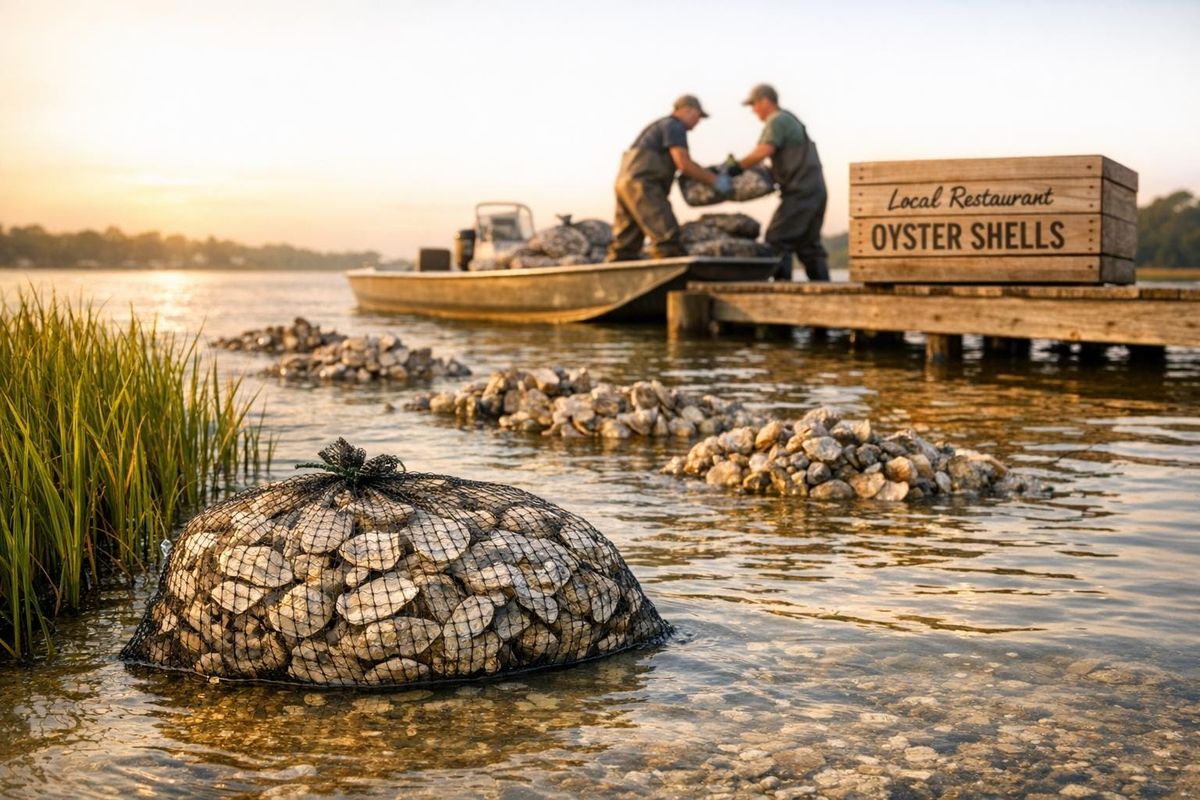
Local restaurants in South Walton and along 30A are playing a key role in restoring oyster reefs, which are vital for filtering water, protecting shorelines, and providing habitats for marine life. Through the O.Y.S.T.E.R. program, managed by the Choctawhatchee Basin Alliance (CBA), restaurants like Acme Oyster House, Surf Hut, and Shunk Gulley Oyster Bar recycle discarded oyster shells to create new reef structures. Since 2010, over 475 tons of shells have been repurposed.
Here’s how the process works:
- Restaurants collect oyster shells during food preparation and from diners’ plates.
- CBA collects the shells 2–3 times per week and cures them for six months to remove bacteria and organic material.
- Volunteers bag the shells, which are then used to build reefs in local bayous and estuaries.
This initiative not only improves water quality and marine habitats but also reduces waste disposal costs for restaurants. Diners can support these efforts by eating at participating restaurants or volunteering in shell bagging and reef-building events. Together, these efforts are helping to restore critical reef ecosystems along Florida’s Gulf Coast.
Oyster Reef Restoration: The American Southeast
sbb-itb-d06eda6
Oyster Reef Restoration and Its Impact
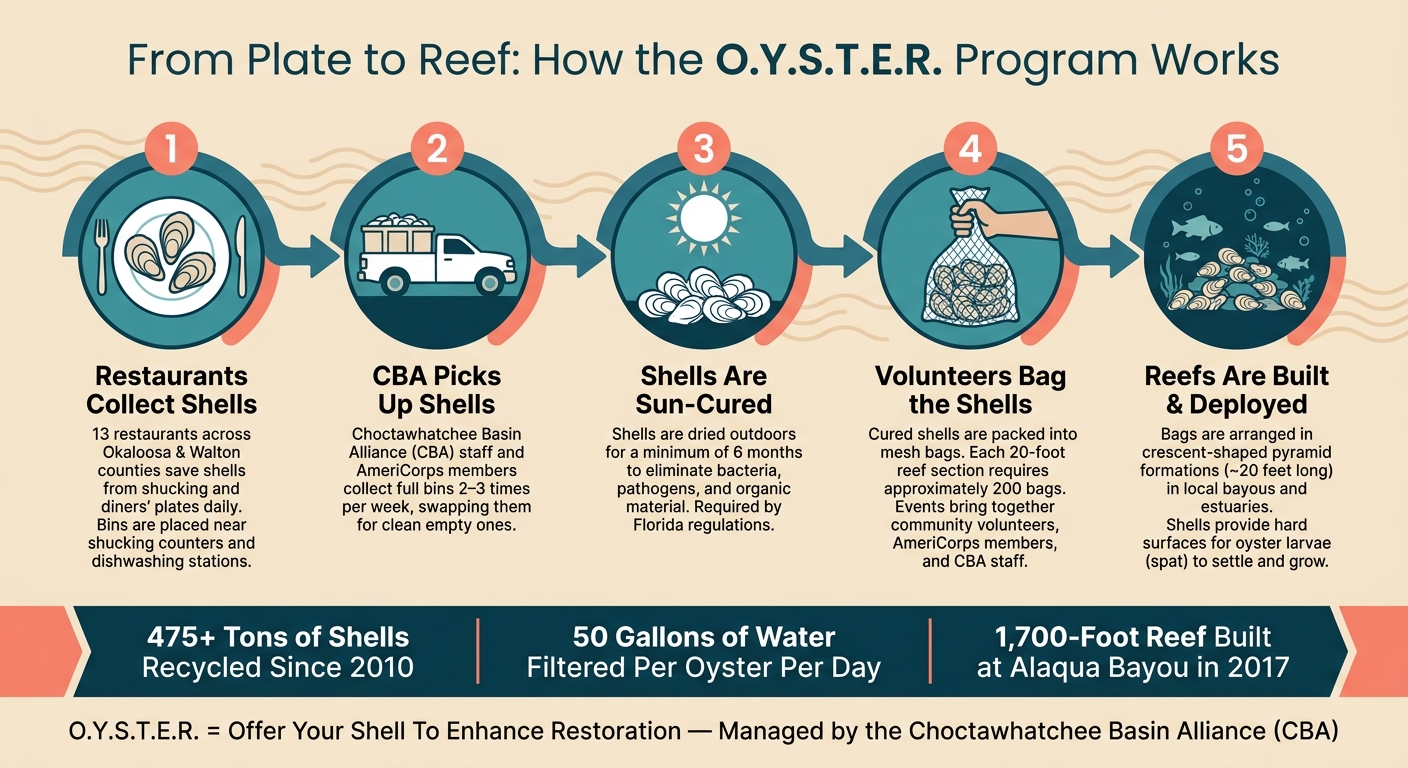
How Oyster Shells Go From Restaurant Plate to Reef: The O.Y.S.T.E.R. Program
What Are Oyster Reefs and Why Do They Matter?
Eastern oysters (Crassostrea virginica) create three-dimensional reefs when their larvae, called spat, attach to hard surfaces. These reefs form dense colonies that play a vital role in filtering water and protecting South Walton's coastline. An adult oyster can filter up to 50 gallons of water daily, removing harmful bacteria, toxins, phytoplankton, and sediment. Beyond water quality, these reefs act as natural barriers, reducing wave energy and protecting shorelines from erosion. They also serve as essential nursery habitats for various species like blue crabs, blennies, and gobies.
Despite these benefits, oyster reef habitats have suffered an alarming decline - 85% globally. In the Big Bend region of northwest Florida alone, there’s been a 66% decrease. Restoring even a portion of these lost reefs can make a meaningful difference for the local ecosystem, emphasizing the importance of restoration efforts. And it all begins with local restaurant contributions.
The Restoration Process: From Shell Collection to Reef Deployment
Local restaurants in South Walton are key players in the oyster reef restoration process, helping turn discarded shells into thriving habitats. This structured effort starts with the Choctawhatchee Basin Alliance (CBA) collecting shucked oyster shells 2 to 3 times per week. These shells are then taken to a curing site, where they are sun-dried for at least six months. This curing period is crucial - it ensures that harmful bacteria, pathogens, and any remaining organic material are eliminated before the shells are reintroduced to the water.
After curing, the shells are packed into mesh bags by volunteers and CBA staff. These bags become the building blocks for new reefs. Using recycled shells from local dining establishments, these compact structures are deployed in bayous and estuaries. The bags are arranged in crescent-shaped pyramid formations, about 20 feet long, to enhance stability and absorb wave energy effectively. The recycled shells provide the hard surfaces that free-swimming oyster larvae need to settle and grow, eventually forming fully functional reefs.
| Restoration Step | Timeframe | Purpose |
|---|---|---|
| Shell Collection | 2–3 times per week | Repurpose discarded shells |
| Curing | 6 months | Remove bacteria and organic material |
| Bagging | Assembly | Create reef building blocks |
| Deployment | Permanent placement | Build habitat and stabilize shorelines |
A great example of this process took place in 2017, when the CBA built a 1,700-foot reef structure at Alaqua Bayou on Eglin Air Force Base property. In just three hours, CBA staff, AmeriCorps members, and volunteers - including the Northwest Florida State College Raiders baseball team - bagged enough shells to fill a large trailer. These materials were then deployed in pyramid formations, designed to reduce wave energy and attract oyster larvae, kickstarting the reef's growth.
How South Walton Restaurants Support Oyster Reef Restoration
How Restaurants Set Up Shell Recycling Programs
South Walton restaurants play a key role in the O.Y.S.T.E.R. program (Offer Your Shell to Enhance Restoration), organized by the CBA. This initiative connects local eateries with efforts to restore oyster reefs. Popular spots like Acme Oyster House, Surf Hut, and Shunk Gulley Oyster Bar are among the 13 restaurants across Okaloosa and Walton counties that contribute their shells to the program.
The CBA provides everything needed to get started, including collection bins and educational materials like table tents and flyers to inform diners that their oyster consumption supports reef restoration. Training kitchen staff is a big part of the program’s success. Employees learn to save shells from both the shucking process and customers’ plates instead of throwing them away. To keep things running smoothly despite staff turnover, restaurants are encouraged to appoint a recycling coordinator.
Shell Storage and Handling at Restaurants
Once shells are collected, proper storage becomes the next priority. Most restaurants use large 30-gallon bins to handle the high volume of shells, but smaller spaces can opt for five-gallon buckets with gamma lids. These lids help seal in odors and keep flies at bay. Positioning the bins near shucking counters or dishwashing stations makes it easier for staff to incorporate recycling into their daily routine.
For restaurants with enough space, storing the bins in a walk-in refrigerator can slow the decomposition of leftover organic material, cutting down on unpleasant odors between pickups. Laminated flyers or stickers placed near workstations serve as quick reminders for staff during busy shifts, ensuring the process stays on track.
Working with Local Restoration Organizations
Once the shells are stored, local restoration teams step in to handle the next phase. The CBA coordinates pickups, with staff and AmeriCorps members visiting participating restaurants two to three times a week. They swap out full bins for clean, empty ones, keeping the process efficient.
After collection, the shells are taken to a curing site, where they are left to dry outdoors for at least six months. This curing period, required by Florida regulations, ensures that bacteria and parasites are eliminated before the shells can be used in reef restoration projects.
| Step | Who's Responsible | Frequency/Duration |
|---|---|---|
| Shell separation & storage | Restaurant staff | Daily, during service |
| Bin pickup & transport | CBA staff & AmeriCorps | 2–3 times per week |
| Outdoor curing | CBA facility | Minimum 6 months |
| Bagging & reef assembly | Volunteers & CBA staff | Periodic events |
| Reef deployment | CBA & volunteers | Based on permits & project needs |
Benefits of Restaurant Participation in Oyster Reef Restoration
Ecological Advantages
Recycled oyster shells play a key role in building reefs that directly benefit the local ecosystem.
Oysters act as nature's water filters, removing bacteria, sediments, and toxins. This leads to clearer water, healthier seagrass beds, and a more balanced marine environment. Additionally, restored reefs serve as natural wave barriers, helping to reduce shoreline erosion caused by storms and boat traffic. These three-dimensional structures also provide safe habitats for various marine species like blue crabs, gobies, blennies, and juvenile fish. Restoration Coordinator Rachel Gwin highlights their importance:
"The majority of all fish and shellfish species spend some portion of their life in an estuary, and reefs are essential to providing protection to many of these species."
Considering that oyster reef habitats have declined by 66% in Florida's Big Bend region and 85% worldwide, these restoration efforts are crucial for preserving marine ecosystems and coastal areas.
Community and Economic Benefits
Participating in the O.Y.S.T.E.R. program offers more than just ecological rewards - it also provides economic and community value.
For restaurants, the program can reduce waste disposal costs. For instance, a Miami-Dade pilot study showed that recycling 4,843 pounds of oyster shells saved $220 in disposal fees. This not only cuts costs but also aligns with eco-conscious dining trends. The Choctawhatchee Basin Alliance supports participating restaurants by providing table tents and educational materials, sparking conversations about conservation at the dinner table.
"The restaurants are proud to participate in the program. We give them educational materials that they hand out to customers, and they love letting people know that they can help support the Bay when they eat oysters." - Rachel Gwin, Restoration Coordinator, Choctawhatchee Basin Alliance
Healthy oyster reefs also bolster South Walton's fishing and tourism industries. Clear water, abundant marine life, and protected shorelines are essential for attracting visitors and supporting eco-tourism. Travelers can even use a South Walton itinerary generator to plan visits around these natural landmarks.
| Benefit | Impact |
|---|---|
| Landfill diversion | Shells are reused for reef restoration, cutting down on disposal costs |
| Water quality | Oysters naturally filter water, improving clarity and balance |
| Shoreline protection | Reefs reduce wave energy, slowing erosion |
| Marine habitat | Creates shelter for crabs, fish, and other marine species |
| Eco-tourism support | Clean waters and stable coastlines draw and retain visitors |
How Visitors and Locals Can Support Oyster Reef Restoration
Oyster reefs play a vital role in the environment and surrounding communities, and both visitors and locals have opportunities to contribute to their restoration efforts.
Support Restoration by Dining at Participating Restaurants
One of the simplest ways to get involved is by making mindful dining choices. Many restaurants in the area participate in the O.Y.S.T.E.R. program, recycling oyster shells to create new reefs. Local favorites like Acme Oyster House, Surf Hut, and Shunk Gulley Oyster Bar are among the South Walton spots that donate shells to the Choctawhatchee Basin Alliance (CBA).
When dining out, keep an eye out for the O.Y.S.T.E.R. program logo or informational table tents. You can also ask your server for a CBA brochure, which many participating restaurants provide for interested patrons. Planning a visit? Check out sowal.co to discover more restaurants along the 30A coastline that prioritize sustainability. And if dining out isn't enough, there are hands-on ways to make an even bigger impact.
Volunteer to Help
The CBA regularly organizes volunteer events, offering two ways to pitch in: shell bagging and reef building.
- Shell Bagging: Volunteers fill mesh bags with dried and cured oyster shells. Each 20-foot section of reef requires about 200 bags. At a previous event, volunteers managed to bag enough shells in just three hours to extend a reef structure significantly.
- Reef Building: This activity involves transporting and stacking shell bags into crescent-shaped pyramid structures in the water. It’s a bit more physically demanding - participants carry the bags from trailers to the water’s edge and wade in to place them. Be sure to wear closed-toe water shoes, sturdy gloves, and clothes you don’t mind getting muddy, as the bayou bottom can be messy, and the shells can be sharp.
Check the CBA website for upcoming volunteer opportunities. Since its inception in 2010, the O.Y.S.T.E.R. program has collected over 475 tons of oyster shells, and every volunteer effort helps that number grow.
Conclusion: The Lasting Impact of Restaurant Partnerships
What started as a humble shell recycling initiative has grown into a powerful driver for coastal restoration in South Walton. Since 2010, the O.Y.S.T.E.R. program has transformed thousands of tons of oyster shells into thriving reef habitats, thanks to the dedication of 13 restaurants across Okaloosa and Walton counties. This achievement highlights the community's unwavering dedication to preserving their coastline.
Oysters are more than just a culinary delight - they're environmental powerhouses. A single adult oyster can filter up to 50 gallons of water daily, and healthy reefs contribute approximately $550 per year in ecosystem services. Restaurants like Acme Oyster House and Surf Hut are now directly involved in revitalizing Choctawhatchee Bay, turning every oyster served into an opportunity for restoration.
"It definitely helps to have community support and we're lucky that the South Walton community is very respectful of the environment." - Rachel Gwin, Restoration Coordinator, Choctawhatchee Basin Alliance
This collaboration between restaurants, the Choctawhatchee Basin Alliance, and countless volunteers has led to tangible results, such as the creation of a 1,700-foot reef in Alaqua Bayou. These efforts not only protect shorelines but also nurture critical marine habitats.
As the restoration work continues, South Walton's coastal health is a shared mission. Through the combined efforts of local businesses, residents, and visitors, the community is shaping a brighter future - one oyster shell at a time.
FAQs
Why can’t oyster shells go straight back into the water?
Oyster shells need to be cured for a minimum of six months before they can be reintroduced into the water. This curing process eliminates harmful bacteria and removes leftover tissue, ensuring the shells are safe and ready for use as a base where oyster larvae can attach and grow - an essential step in restoring oyster reefs.
How long does it take a recycled-shell reef to start working?
Recycled oyster shells must be left outdoors to cure for a period of three to six months before they’re suitable for reef construction. This curing process is crucial to prepare the shells for fostering new oyster growth and aiding in reef restoration projects.
How can I volunteer for shell bagging or reef building?
You can get involved in shell bagging or reef building by participating in community events hosted by organizations like the Coastal Barrier Alliance (CBA) or the Choctawhatchee Basin Alliance. These events typically include activities such as bagging oyster shells, constructing reefs, or caring for oyster gardens. To join in these hands-on restoration efforts, reach out to local groups or program coordinators to learn about upcoming events and opportunities.