How Regulations Shape South Walton's Future
How state and local regulations affect South Walton’s growth, housing, environment and community character — and how residents can respond.
South Walton's growth is a balancing act between maintaining its charm and managing rapid development. With over 14,000 short-term rentals and rising tourism, the strain on infrastructure, housing, and natural resources is clear. Local regulations aim to address these challenges by preserving community character and protecting natural areas, but state laws often limit local control. Key issues include:
- Overcrowding and "Monster Houses": Large vacation rentals disrupt neighborhoods and increase traffic.
- Environmental Impact: Development clears woodlands and wetlands, affecting stormwater management and wildlife habitats.
- Housing Affordability: Rising property prices are pushing out local families.
- State vs. Local Control: Recent state laws reduce local authority over zoning and development approvals.
Residents can get involved through public workshops like Plan for Walton 2040 or by staying informed via resources like the South Walton Community Council. Collaboration between residents, developers, and officials is essential to ensure growth respects the area's character while addressing its challenges.
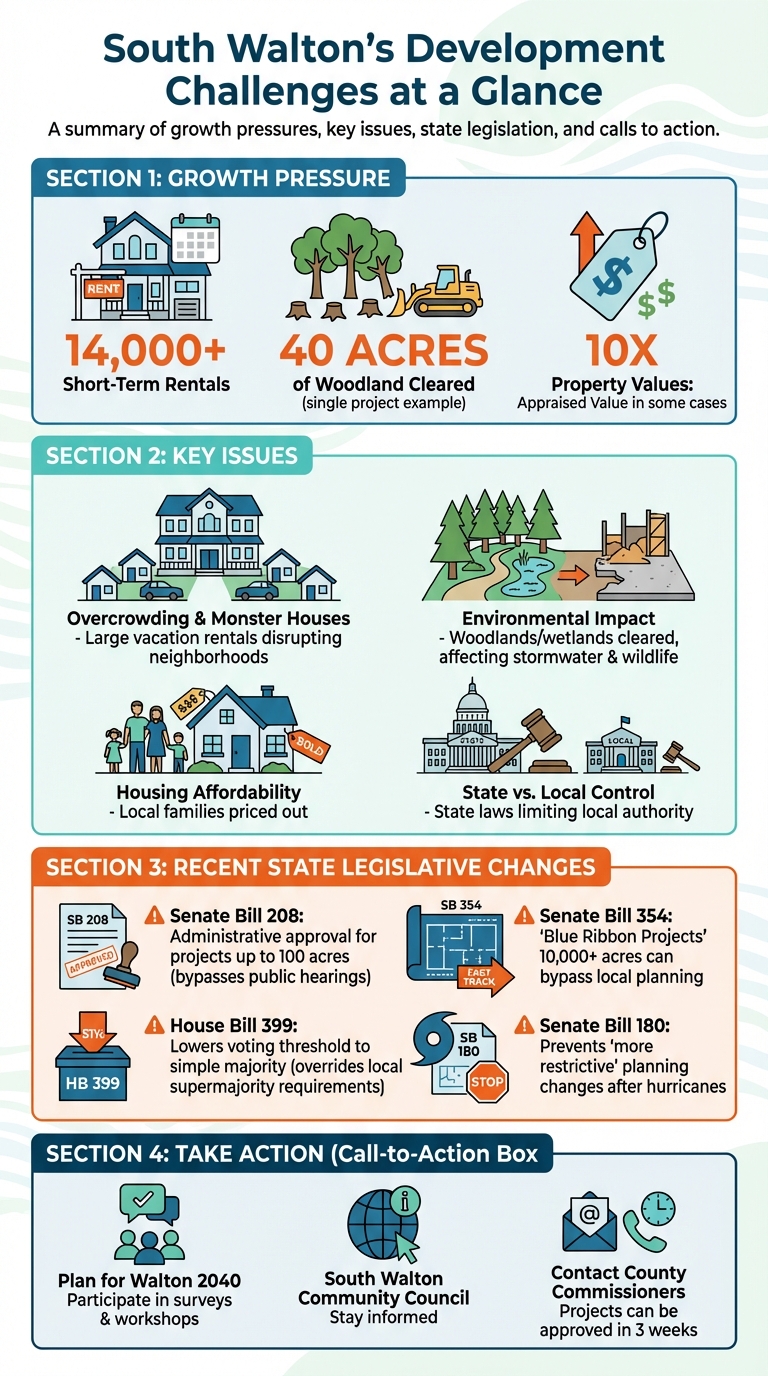
South Walton Development Impact: Key Statistics and Challenges
Problems from Rapid Development
Infrastructure and Environmental Pressures
South Walton's infrastructure is struggling to keep up with the pace of development, largely due to insufficient regulations. Daily traffic congestion has become a norm, and the area's ability to handle hurricane evacuations is severely compromised by this unchecked growth.
The environmental impact is just as alarming. For instance, DR Horton cleared nearly 40 acres of mature woodland for a development project. These woodlands, along with nearby wetlands, play a critical role in absorbing rainfall and lessening wind damage during storms. When Conservation Residential land is rezoned to Low Density Residential, these natural defenses disappear. The result? Stormwater runoff polluted with contaminants flows into the bay, degrading water quality, while animals like bears and foxes lose their habitats and are forced into residential areas. Mandy Cooper and Margaret D. Landry, residents of Santa Rosa Beach, highlighted the issue:
"Retention ponds do not and cannot provide the same protection from wind and storm water or sustain the amount of wildlife seen in wetlands".
The destruction of wooded areas also disrupts the Atlantic Flyway, a key migration route for birds. This environmental strain is further compounded by the challenges in the housing market, where rapid development is altering the fabric of the community.
Housing Costs and Community Character
The housing market in South Walton has been heavily affected by weak regulations, fueling property speculation that drives prices beyond what local families can afford. In some cases, parcels are being sold for over ten times their appraised value. Adding to the problem, oversized homes designed for short-term vacation rentals are popping up, shifting the character of neighborhoods and creating tension with long-standing residents.
Many locals fear that this rapid growth is stripping South Walton of its small beach town charm, replacing it with a more commercial, resort-like atmosphere. This concern is exacerbated by the speed at which development projects are approved. For example, some major projects, like 125-room hotels in previously quiet, wooded areas, have been greenlit with residents given just two weeks to review and respond to proposals. On top of that, state-level policies often limit local communities' ability to manage these developments, leaving residents feeling powerless to protect their neighborhoods.
How State Laws Affect Local Policies
State Override of Local Control
In Florida, state legislation has increasingly limited the authority of local governments over development decisions. One striking example is Senate Bill 208, proposed in 2026, which redefines "compatibility" in land use planning. Under this bill, residential projects cannot be rejected solely because they differ from the character of surrounding neighborhoods. As long as these projects fall within the same general land use category, they are deemed compatible by default. This effectively removes "community character" as a valid reason to deny development proposals.
The bill also mandates administrative approval for residential "infill" projects up to 100 acres, cutting out the traditional public hearing process entirely. Another measure, Senate Bill 354, introduces "Blue Ribbon Projects", allowing large-scale developments of at least 10,000 acres to bypass local comprehensive planning - provided they set aside 60% of the land for conservation or related uses. These sweeping changes have sparked frustration among local officials, as voiced by State Representative Ashley Gantt:
"When did local governments become the enemy of the people or the enemy of the House, of Tallahassee?"
Further compounding the issue, House Bill 399 lowers the voting threshold for land-use amendments to a simple majority, overriding local charters that previously required supermajority votes. For example, 73% of Orange County voters had approved stricter standards for major developments, but those protections are now undermined by the new legislation. This shift significantly reduces the influence residents have in shaping the future of their communities.
Limits on Local Funding and Zoning
State laws don’t just limit local decision-making - they also restrict the financial tools cities and counties rely on for community improvements. Both HB 399 and SB 208 prohibit local governments from basing development application fees on a project’s total value. Instead, these fees can only reflect the actual cost of reviewing applications. This change can shrink the funds available for critical infrastructure, environmental protections, and public services that new developments often require.
Timing restrictions further add to the challenges. Senate Bill 180, enacted in 2023, prevents local governments from implementing "more restrictive or burdensome" planning changes after hurricanes. This freeze on local regulations hampers efforts to update building standards, improve flood protections, or introduce environmental safeguards, even as climate risks grow. Kim Dinkins, Policy and Planning Director for 1000 Friends of Florida, highlighted the dilemma:
"The big challenge is that cities and counties can't respond to these more frequent and intense storms."
For instance, when Orange County tried to roll out its "Vision 2050" comprehensive plan - developed over eight years - it was blocked by the Florida Department of Commerce in August 2025 for violating SB 180. This illustrates how state laws can stymie local efforts to address long-term planning and resilience.
How to Navigate South Walton's Regulations
Getting Involved in Local Government
Residents in South Walton have the power to influence their community's future, even with certain state-level limitations. Engaging in local government efforts is a critical way to ensure that growth aligns with community values. One key opportunity for involvement is the Plan for Walton 2040, a comprehensive planning update conducted every seven years. Residents can participate by completing surveys, sharing feedback at PlanForWalton2040.com, or attending week-long planning workshops called charrettes. These workshops include open-studio sessions with technical experts, offering a chance for hands-on input. Marina Khoury, the Project Lead for Plan for Walton 2040, emphasized the importance of reflecting community values in future development:
"Future growth in these communities, and the intensity of that growth, should reflect those values [of unique character and community]".
Timing is crucial, as development proposals can move quickly. Keep an eye out for certified letters from developers, as some projects may progress from community meetings to final approval by the Board of County Commissioners (BCC) in as little as three weeks. If a project poses a threat to your neighborhood, it’s essential to contact your County Commissioners immediately. In some cases, neighborhoods have even hired legal representation to request delays or prepare formal responses.
Staying informed is another key step. Organizations like the South Walton Community Council (SWCC) provide updates on growth policies, transportation issues, and development proposals. Following local government Facebook pages and signing up for official email updates can also help you stay ahead. For specific questions about setbacks, wetlands, stormwater management, or neighborhood requirements, the Planning Department’s "Planner on Call" service is an excellent resource. This service is especially helpful if you’re considering purchasing land or starting a project.
Ultimately, collaboration between residents and developers plays a vital role in ensuring growth happens responsibly.
Working Together for Responsible Development
Engaging with developers early in the planning process can help balance community needs with new development. Building trust starts with open communication. For instance, the proposed Citizen Planning Bill of Rights encourages developers to host workshops with impacted property owners before formal public hearings. These workshops provide a platform to address concerns early, reducing potential conflicts and showing respect for neighborhood character. This is especially important in South Walton, where local control can sometimes be limited by state policies.
Understanding the regulatory framework is equally important to avoid costly errors. Walton County's Interactive Map is a valuable tool for checking zoning districts, FEMA flood zones, and overlay districts. Simply enter a Parcel ID or address to get detailed information. Keep in mind that properties along Route 30A, US 98, US 331, or Scenic Gulf Drive may fall under Scenic Corridor Overlays, which include stricter rules for landscaping, signage, and access. Additionally:
- For properties south of Choctawhatchee Bay, a building permit or development order is required before clearing land.
- For properties north of the bay, a separate land-clearing permit is needed.
The Planning Department offers this advice:
"The key here is to make sure you build according to your approved plans. Deviations can result in delays".
Plan ahead, as reviews typically take two to three weeks. Factoring this timeline into your schedule can help keep your project on track.
Planning Commission - Jun 12 2025
Conclusion: Balancing Growth and Preservation in South Walton
South Walton's future hinges on striking the right balance between economic development and safeguarding the qualities that make the area special. The Plan for Walton 2040 acts as a roadmap, aiming to guide growth while protecting the region's renowned beaches, historical landmarks, and conservation areas. This plan is designed to ensure that development respects the unique identity of South Walton.
Recent examples show how community engagement can effectively halt projects that don't align with local priorities. Concerns over traffic, public safety, or neighborhood character have prompted officials to reject proposals that clash with community values. These decisions highlight the power of residents' voices in shaping the area's future.
Your involvement is key to continuing this momentum. By visiting PlanForWalton2040.com, attending workshops, or participating in county meetings, you can help shape policies on zoning, transportation, and environmental protection.
The regulations discussed throughout this article - from Traditional Neighborhood Development codes to Beach Code protections and Vacation Rental Certificate requirements - are all tools to align growth with what the community values most. Whether you're a longtime resident, property owner, or someone thinking about making South Walton your home, preserving the area's character depends on active participation from everyone who loves this place.
FAQs
How do new Florida laws limit Walton County’s ability to control growth?
Recent legislation in Florida, such as Senate Bill 1622 enacted in 2025, has placed new limits on Walton County’s ability to manage local growth. These laws now require judicial approval to recognize the customary use of beaches, which directly affects beach access and complicates local planning. As a result, the county faces restrictions in addressing community needs and growth-related challenges on its own terms.
What can residents do to influence a project before it gets approved?
Residents have several ways to shape local projects and development. By attending public workshops and joining community meetings, they can engage directly in the decision-making process. Local organizations, such as the South Walton Community Council, provide additional platforms for involvement. Staying updated on development plans and speaking up for balanced growth alongside conservation efforts can make a real difference. Explore community resources to find opportunities to share your input and address any concerns.
How can I quickly check zoning, flood zones, and overlays for a property?
If you're looking to find zoning details, flood zones, or overlays for a property in South Walton, Walton County's interactive map is a fantastic resource. Simply input the Parcel ID or property address into the tool. It will display zoning districts, flood zones, and overlays, giving you a clear view of the property's status. This tool makes it easy to access detailed property information and understand local regulations.