Buying a 30A Vacation Home: Rental Demand Guide
Evaluate 30A submarkets, local rules, and peak-season revenue to predict rental income, eligibility, and resale value.

If I were buying on 30A for rental income, I would not start with the house. I would start with the submarket, the rules, and the peak-season math.
More than 5.1 million visitors came to Walton County in 2023, but that does not mean every 30A property will rent well. Some homes get strong summer bookings and high nightly rates. Others miss out because of location, HOA limits, weak beach access, poor layout, or a low rate ceiling. With listing prices often near or above $1,000,000, a bad buy can get costly fast.
Here’s the short version of what matters most:
- Summer drives the year. Peak weeks often produce 40%–50% of annual gross rent.
- Beach access and walkability matter a lot. Gulf-front, Gulf-view, and short-walk homes usually do better.
- Layout moves revenue. More bedrooms, bunk space, pool access, parking, and fast Wi-Fi can lift bookings.
- Not all 30A areas perform the same. Seaside, WaterColor, and Rosemary Beach tend to lead on rate; Seagrove, Inlet Beach, Santa Rosa Beach, and Blue Mountain Beach can offer a lower buy-in.
- Rules can kill the deal. County approval is only one step. HOA and condo rules may limit short stays, self-management, or rental use.
- You need proof, not guesses. I would check county data, STR analytics, and 2–3 years of owner statements before making an offer.
- Owner use has a cost. Blocking July 4th or spring break can mean giving up $10,000–$20,000+ in a larger home near the Gulf.
- Resale still matters. Homes with parking, beach access, clean permits, and a rental track record are often easier to sell.
Investing in 30A Rentals 2025 | Summer Performance & Where the Market’s Headed
sbb-itb-d06eda6
Quick comparison
| Area | Entry Cost | Rate Ceiling | Guest Pull | Best Fit |
|---|---|---|---|---|
| Seaside | High | Very high | Very strong | Buyers focused on brand and walkability |
| WaterColor | High | High | Strong | Families who want resort-style amenities |
| Rosemary Beach | High | Very high | Strong | Buyers targeting upscale guests |
| Seagrove | Mid | Mid-high | Solid | Buyers wanting central 30A access |
| Inlet Beach | Mid | Moderate | Growing | Lower-cost entry near Rosemary area |
| Santa Rosa Beach | Mid | Moderate | Good | Larger-family, drive-to demand |
| Blue Mountain Beach | Mid | Moderate | Solid | Value-focused beach buyers |
My bottom line: I would buy the property that still works during 30A's seasonal occupancy shifts, follows the local rules, and has a clear resale story - not just the one that looks best in July photos.
How 30A Rental Demand Works
Demand on 30A doesn't show up evenly all year. It follows a clear seasonal pattern, and summer is the main engine. From Memorial Day through mid-August, occupancy and nightly rates hit their highest point. Well-located homes often book peak weeks months in advance. Spring break, from March into early April, is the next-biggest window. After that come the shoulder seasons in late April/May and September/October, which can still perform well but tend to move around more from year to year. Winter - especially November through February - is the slowest stretch and leans more on snowbirds, remote workers, and longer stays. For buyers, the target is pretty straightforward: own the weeks people will pay the most for.
Recent tax and visitor-spending data back this up, showing that summer and spring still lead as strong revenue periods.
Those booking patterns affect more than just income. They also shape stay length, owner-use plans, and minimum-night settings.
Seasonality, Stay Lengths, and Guest Expectations
Summer bookings usually follow a Saturday-to-Saturday or Sunday-to-Sunday pattern, with families reserving full weeks far ahead of time. Spring break tends to bring 4–7 night stays. In the shoulder seasons, 3–5 night trips become more common, which can help fill calendar gaps if minimum-night rules stay flexible. Winter splits in two directions: short holiday weekends on one side, and longer stays from guests looking for lower weekly or monthly rates on the other.
Owner stays cut into peak revenue. If you block your calendar during the highest-value weeks - July 4th, Memorial Day, Labor Day, and spring break - you give up income in a very direct way. Missing a single July 4th week in a 5-bedroom home near the Gulf could mean leaving $10,000–$20,000+ in rental revenue on the table. By contrast, using the home in November or early December usually has a much smaller income hit, since those dates are tougher to fill at full rates anyway.
What Drives Higher Occupancy and Nightly Rates
After seasonality, beach access is the next big thing. Gulf-front, Gulf-view, and short-walk-to-beach homes tend to beat car-dependent options on both occupancy and nightly rate. In master-planned communities like Seaside, WaterColor, and Rosemary Beach, walkability pushes that even further. Guests can park once and get around on foot or by bike, and that's exactly the setup many families with young kids want.
At the home level, bedroom count, bunk room layout, and pool access have the biggest effect. A well-planned bunk room can increase sleeping capacity without adding formal bedrooms. That gives owners room to charge more per night while still keeping the space comfortable. Private or community pools matter even more on days when the Gulf is closed to swimmers. Parking, golf cart storage, and fast Wi-Fi also play into reviews and repeat bookings.
Updated kitchens, baths, and lighting can lift rates by 10%–20% and help with shoulder-season bookings.
Once you know which features push demand, the next step is to check which 30A areas can legally turn that demand into bookings.
Best 30A Areas for Rental Demand
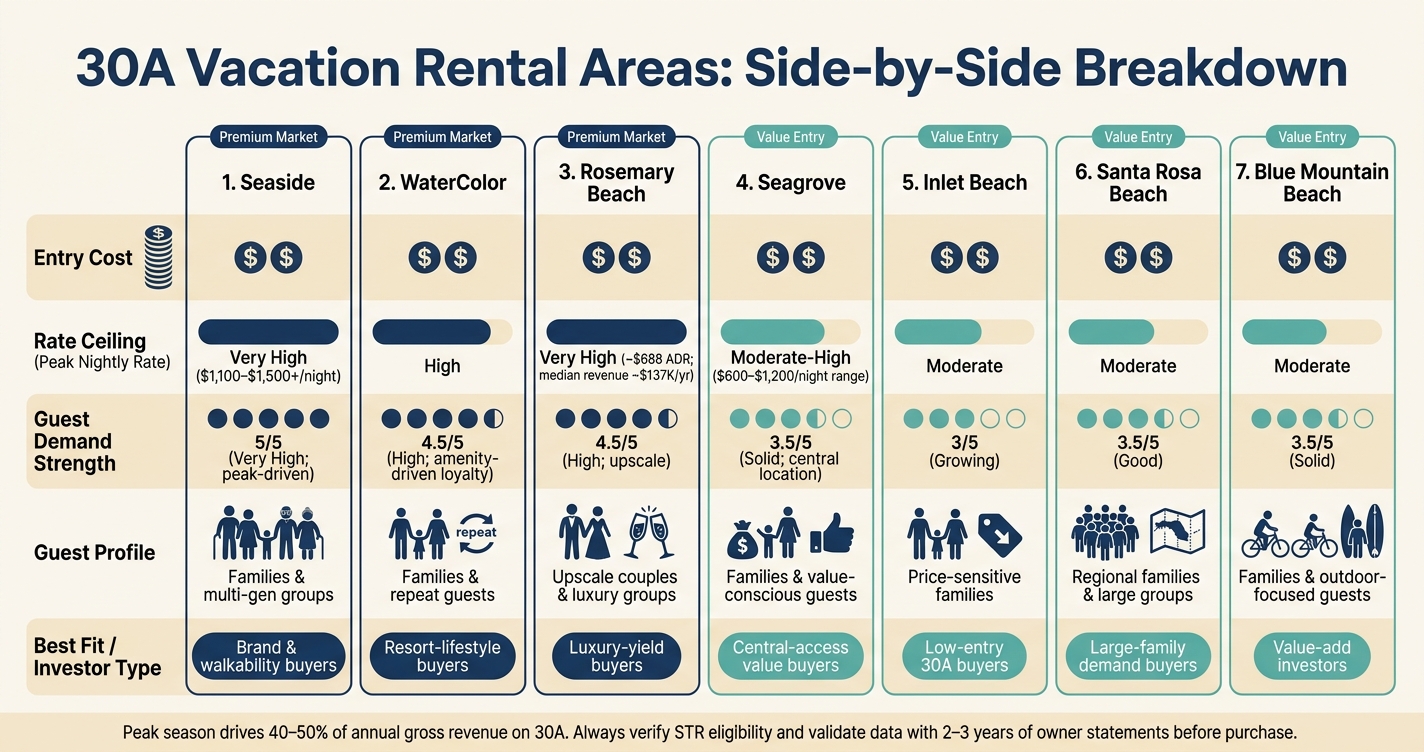
30A Vacation Rental Market Comparison: Best Areas for Rental Income
Not every 30A community works the same way as a rental buy. Location affects who books, what you can charge per night, how often the home stays occupied, and how easy it is to sell later.
Across 30A, the places that pull the most guest demand tend to share the same traits: walkability, easy beach access, strong amenities, and layouts that work well for vacation groups. Most buyers end up comparing two broad groups: premium markets with strong name recognition, and lower-entry markets where the math can work better against the purchase price.
Premium Markets: Seaside, WaterColor, and Rosemary Beach
These are the spots where name value and walkability show up most clearly in rental demand. They sit at the top of the 30A price ladder for a reason.
Seaside pulls guests with its pastel cottages, walkable town center, and a look that’s hard to find anywhere else on the Gulf Coast. One investment-focused analysis covering April 2025 through March 2026 shows Seaside with an average daily rate (ADR) of $831. Top-tier listings can hit $1,100–$1,500+ per night during peak season.
WaterColor centers around Western Lake and offers a Beach Club, multiple pools, and trail access, which gives guests a resort feel without losing the neighborhood setting. That mix is a big draw for families and repeat visitors who come back year after year.
Rosemary Beach skews more upscale. Strict architectural standards, a compact village center, and boutique dining help support some of the highest nightly rates along 30A. Short-term rental data show median annual revenue of about $137,000. June 2026 snapshots from the broader Santa Rosa/Rosemary Beach area also show ADR near $688 and occupancy near 81%.
The downside is the buy-in cost. These communities have some of the highest price-per-square-foot figures on 30A, which can squeeze net returns, especially if you’re using financing. In practice, many buyers here are lifestyle buyers. They use rental income to help cover carrying costs, or they bring more cash and focus on brand strength and long-term appreciation instead of near-term yield.
Lower-Entry Markets: Inlet Beach, Seagrove, Santa Rosa Beach, and Blue Mountain Beach
These areas give up some prestige, but they often look better on the acquisition side.
Seagrove sits in a central part of 30A, close enough to Seaside and WaterColor that guests can enjoy both without paying top-of-market rates. Inlet Beach works as a lower-cost entry into the 30A name. It sits near Rosemary Beach and the 30Avenue retail corridor, with a growing mix of condos, townhomes, and single-family homes at easier price points.
Santa Rosa Beach and Blue Mountain Beach tend to pull larger families and drive-to vacationers who want more room and solid beach access. That’s a different guest base, but still a strong one.
The tradeoff is a lower pricing ceiling. A well-updated home near the Gulf in these markets can reach $600–$1,200 per night in peak season, but most listings still trail the top Seaside or WaterColor homes. That said, this is often where value-add plans make more sense. Updating an older house, adding a pool, or changing the sleeping setup can shift income in a meaningful way without paying top-tier land prices.
| Community | Guest Profile | Demand Strength | Pricing Power | Resale Appeal |
|---|---|---|---|---|
| Seaside | Families, multi-gen groups | Very high; peak-driven | Very high | Strong brand recognition; limited inventory |
| WaterColor | Families, repeat guests | High; amenity-driven loyalty | High | Strong resort brand |
| Rosemary Beach | Upscale couples, luxury-seeking groups | High | Very high | Prestigious flagship market |
| Seagrove | Families, value-conscious guests | Solid; benefits from central location | Moderate-high | Good; central 30A position |
| Inlet Beach | Price-sensitive guests, families | Growing | Moderate | Value gateway to the 30A brand |
| Santa Rosa Beach | Regional families, larger groups | Good | Moderate | Large, diversified inventory |
| Blue Mountain Beach | Families, outdoor-focused guests | Solid | Moderate | Steady value-market appeal |
Before buying, check short-term rental rules and zoning laws for short-term rentals on 30A and compare these rate assumptions against live market data.
How to Confirm Rental Eligibility and Validate Demand Data Before You Buy
Before you underwrite income, make sure the property can legally run as a short-term rental. Then check the revenue against hard data. If the home fails either test, the income forecast doesn’t matter much.
Check County Rules, HOA Limits, and Home-Level Restrictions
In unincorporated Walton County, including much of 30A, short-term rentals are allowed. But there’s a catch: stays under 30 days need a Walton County Short-Term Vacation Rental Certificate before the home can be advertised or rented. Owners also need state and tax registrations, including a Florida DBPR vacation rental license, Florida sales tax registration, and the county tourist tax account or business tax receipt.
Operating without the certificate can lead to fines of up to $500 per day.
Walton County also sets occupancy and parking rules. Occupancy is capped at one person per 150 square feet of heated and cooled space, and that limit must be posted inside the unit. Parking rules call for at least one off-street space per six occupants. Draft updates would tighten that rule to one space per four occupants.
That said, county approval is only step one. HOAs, condo associations, and master-planned communities often add their own limits. These can include:
- Minimum stays of 7, 30, or 90 days
- Caps on how many units can join a rental program
- Limits on self-management or third-party booking platforms
Ask the HOA or condo association for the latest recorded CC&Rs, bylaws, and all amendments. Don’t rely on an old resale package or a verbal answer from an agent. It’s also smart to check county code-enforcement records for past violations tied to occupancy, parking, or unlicensed rentals.
Once you know the property can operate, the next step is simple: find out whether the income story holds up.
Data Sources to Test Revenue Assumptions
A good model pulls from three places: macro tourism data, market-level STR analytics, and property-specific history.
Walton County tourism reports give you the big-picture view. In 2023, the area logged more than 5.1 million visitors, over $60 million in Tourist Development Tax collections, an average stay of 5.9 nights, and an average party size of 5. That tells you whether demand is healthy overall and how people tend to book.
Market-level STR platforms add another layer. For example, a 2026 update for Santa Rosa Beach showed 7,710 active listings, 56% occupancy, $706 ADR, and trailing 12-month average revenue of $65,800. That’s useful for setting a range, not for taking one number at face value.
For the actual home, ask for two to three years of monthly owner statements. Compare ADR, booked nights, and net payouts with market benchmarks. If the property trails similar homes, figure out why. Sometimes it’s weak marketing. Sometimes it’s poor listing photos. Sometimes the minimum-stay settings are too strict. And sometimes the home just has a built-in ceiling.
| Source | What It Measures | Reliability | How to Use It |
|---|---|---|---|
| Walton County tourism reports | Market-wide visitors, TDT collections, seasonality | High for macro trends; no unit-level detail | Confirm overall demand health and seasonal patterns |
| STR analytics platforms (e.g., AirDNA) | ADR, occupancy, RevPAR, revenue by comp set | Good for benchmarking; can miss off-platform bookings | Set realistic ADR and occupancy ranges by bedroom count and location |
| Historical owner payout statements | Actual net income, booked nights, ADR by month | Highest for that specific property | Detect underperformance versus comps and verify seasonality |
| Property manager projections | Forward-looking revenue estimates | Variable | Use as a starting point, then verify against comps and history |
| Comparable active listings | Current market pricing and availability | Good for rate validation | Cross-check ADR assumptions and identify amenity gaps |
When you pick comps, get picky. A valid comp should line up with the subject property’s micro-location, including whether it sits north or south of 30A, how walkable it is, and what kind of beach access it offers. It should also match bedroom and bathroom count, sleeping capacity, and amenities like a private pool, Gulf views, or community beach access.
Small differences can skew projections fast. A dated interior stacked against a staged, polished comp can make the numbers look better than they should.
Lenders using DSCR or non-QM underwriting often qualify the deal based on the lower of trailing 12-month STR income or appraised market rent. Your own model should use that same standard before closing. After that, you can stress-test peak weeks, shoulder seasons, and the softer off-season months.
Reading Pricing Pressure, Seasonality, and Exit Options
Model Peak Weeks, Shoulder Seasons, and Off-Season Softness
Once a property clears the first hurdle, eligibility and comps, the next question is simple: does the deal still hold up when peak season ends?
Don’t spread July rates across the whole year. On 30A, income is tied to a short peak window and a much longer soft stretch. Peak weeks usually drive about 40%–50% of annual gross revenue, not 80%–90% like some rosy projections imply. A 2025 Walton County snapshot put summer occupancy near 69%, fall near 36%, and the slowest months closer to 28%.
A cleaner way to model the property is to break the year into three bands:
- Peak season
- Shoulder season
- Off-season
Then stress-test the deal. What happens when occupancy falls from summer levels to fall-like demand? What happens when hurricane season, which runs June through November, adds cancellation risk to late summer and early shoulder months?
This is where a lot of buyers get a wake-up call. Fixed costs don’t shrink when bookings do. Mortgage payments, insurance, HOA dues, and utilities keep coming whether the house is full or sitting empty. If the property can’t cover carrying costs during a slow quarter, that’s a problem to solve before closing, not after.
After you run the base case, run it again with owner stays stripped out. Set any July or Spring Break owner use to $0 income and rebuild the pro forma. Buyers focused on cash flow often save personal use for January, early December, or a late-September shoulder week, when the income tradeoff hurts less.
Buy With Resale in Mind, Not Just This Year's Revenue
That same mindset should carry into your exit plan.
Strong rental numbers today don’t always lead to a strong resale later. The most liquid 30A homes tend to share a few traits: walkable or short golf-cart access to the beach, a flexible bedroom setup with more than one king suite plus a bunk room, enough on-site parking, and updated interiors with durable coastal finishes.
That’s why walkability, parking, and layout matter so much at the time of purchase. Homes that fit both STR investors and second-home families tend to sell faster and hold value better when rules shift or demand cools off.
A clean rental paper trail also matters. Buyers and lenders usually want 12–24 months of itemized owner statements, active permits, and proof that state and county lodging taxes were paid the right way. In some 30A neighborhoods where short-term rental eligibility has become tighter, a property with a clean compliance record and a long operating history can sell at a premium versus a similar home with spotty records.
Choose the submarket carefully, confirm eligibility, test demand, model the full year, and think about resale before you buy. The right 30A purchase should make sense in the slow months and still look good to the next buyer.
FAQs
Which 30A area fits my budget and rental goals?
It comes down to what you want most: steady rental income or long-term price growth.
If cash flow is the main goal, Seagrove Beach is often the top pick. It has a central location, strong occupancy, and lots of public beach access points. Seaside and WaterColor also tend to perform well year after year.
If you're more focused on appreciation, take a look at Blue Mountain Beach or Dune Allen Beach. Inlet Beach stands out for long-term growth. And if you're shopping at the high end, Alys Beach is better suited to luxury buyers who care more about privacy and exclusivity than maximum rental volume.
How do I verify a home's short-term rental eligibility?
Confirm that the home meets both county and community rules before you move forward.
Check Walton County GovOS for any active violations or code enforcement issues tied to the property. You’ll also want to confirm that the home can get a Vacation Rental Certificate. In Walton County, that matters if you plan to rent the property more than three times per year and for stays of less than 30 days.
Then review state-level requirements through the Florida Department of Business and Professional Regulation. That step helps you confirm the property meets Florida licensing rules for vacation rentals.
Don’t stop at county and state checks. Go through the HOA’s covenants, conditions, and restrictions closely. Look for any limits on short-term rentals, including:
- outright bans
- occupancy caps
- minimum stay rules
This is one of those areas where a property can look fine on paper but still run into trouble once the HOA rules come into play.
What numbers should I check before making an offer?
Check the exact submarket and property type before you compare median and average sale price, price per square foot, days on market, inventory or months of supply, and sold-to-list ratio.
Those numbers can swing a lot from one pocket to another. A condo in one part of Walton County may behave very differently from a single-family home a few blocks away.
Then dig into property-level rental data. Review:
- Occupancy
- ADR
- RevPAR
- Net income versus total costs
That last part matters more than people think. Strong top-line revenue can look great on paper, but cleaning, management, insurance, maintenance, taxes, and HOA dues can eat into returns fast.
You’ll also want to confirm short-term rental compliance before moving ahead. In Walton County, that includes the Walton County Vacation Rental Certificate ($300/year), plus any local zoning limits or HOA rules.
Look closely for rules tied to:
- Minimum stay length
- Occupancy limits
- Parking
- Pets
- Insurance
If the home is in a condo building or planned community, read the governing documents line by line. A place can look STR-friendly at first glance, then hit you with rental caps, guest limits, or parking rules that change the math in a hurry.