
How to Deduct Start-Up Costs for 30A Rentals
Start-up costs for short-term rentals hinge on the placed-in-service date — use Section 195, track LLC fees, and separate capital expenses.
If you own a 30A rental, the tax split is simple: pre-opening costs may fall under Section 195, property upgrades usually go to depreciation, and post-launch costs are often deducted in the year paid.
I’d boil the article down to this:
- Your placed-in-service date controls the tax treatment. For most rentals, that is the date the home is ready and available for rent.
- You may deduct up to $5,000 of start-up costs in year one.
- That $5,000 write-off starts shrinking after $50,000 of start-up costs and is gone at $55,000.
- Any leftover start-up costs are usually amortized over 180 months.
- LLC setup costs follow separate rules and may get their own $5,000 deduction.
- Furniture, appliances, renovations, and closing costs are usually not start-up costs. They are often capital items and recovered through depreciation.
Here’s the short version in plain English: if you spent money before your rental listing went live, I’d first ask whether the cost was for launching the rental, forming the entity, or buying or improving the property. That one step clears up most of the confusion.
A fast example: if your rental was placed in service on 06/01/2026 and you had $40,000 of qualified start-up costs, you may deduct $5,000 right away and amortize the other $35,000 over 180 months, or about $194.44 per month. For 2026, that would usually mean 7 months of amortization, or about $1,361.08.
| Cost type | Usual treatment |
|---|---|
| Pre-opening marketing, listing photos, market research | Section 195 start-up cost |
| LLC filing and formation fees | Organizational cost |
| Furniture, appliances, remodels, closing costs | Capitalized and depreciated |
| Cleaning, utilities, repairs after launch | Current rental expense |
If I were setting this up, I’d keep one clean ledger, mark the placed-in-service date, and label each cost as start-up, organizational, capital, or rental expense before tax time.
How Do I Report Rental Property Start-up Costs On Schedule E? - Tax and Accounting Coach
sbb-itb-d06eda6
Step 1: Identify which early costs may qualify as start-up or organizational expenses
Start by sorting each pre-rental cost by date and purpose.
Costs that may qualify before the property is placed in service
A pre-opening cost may qualify only if it was paid before the property was placed in service and would have been a normal rental expense if you had paid it after the property opened.
For a 30A property, that often means things like:
- A market research trip to South Walton to compare nightly rates and occupancy patterns
- A pre-launch ad campaign aimed at 30A vacationers
- Professional photography and drone shots taken before the first listing went live
Once the property is available for rent, those same costs are usually treated as regular rental expenses.
Organizational costs for an LLC or other rental entity
If you set up an LLC to hold your 30A rental, keep those formation costs separate from start-up costs. Organizational costs can include the Florida Department of State filing fee, attorney fees for drafting the operating agreement, and professional tax advice about launch-year deductions.
The IRS lets you deduct up to $5,000 of organizational costs in the first year, with the same $50,000 phaseout and 180-month amortization rules applying to any amount over that limit. This is a separate rule from the one used for rental start-up costs.
What does not qualify as a start-up cost
Some early costs don't fit the start-up bucket at all.
Acquisition costs - like the purchase price, title fees, and recording fees - get added to the property's basis. Furniture, appliances, and major pre-opening work are usually capital assets or improvements, not start-up costs.
Put simply, the buckets look like this:
- Start-up costs: pre-launch marketing and research
- Organizational costs: LLC formation fees
- Capital items: acquisition costs, renovations, furniture, and appliances
Once you've sorted the costs, the next step is to pin down the date the property was ready and available for rent.
Step 2: Determine when your 30A rental is placed in service
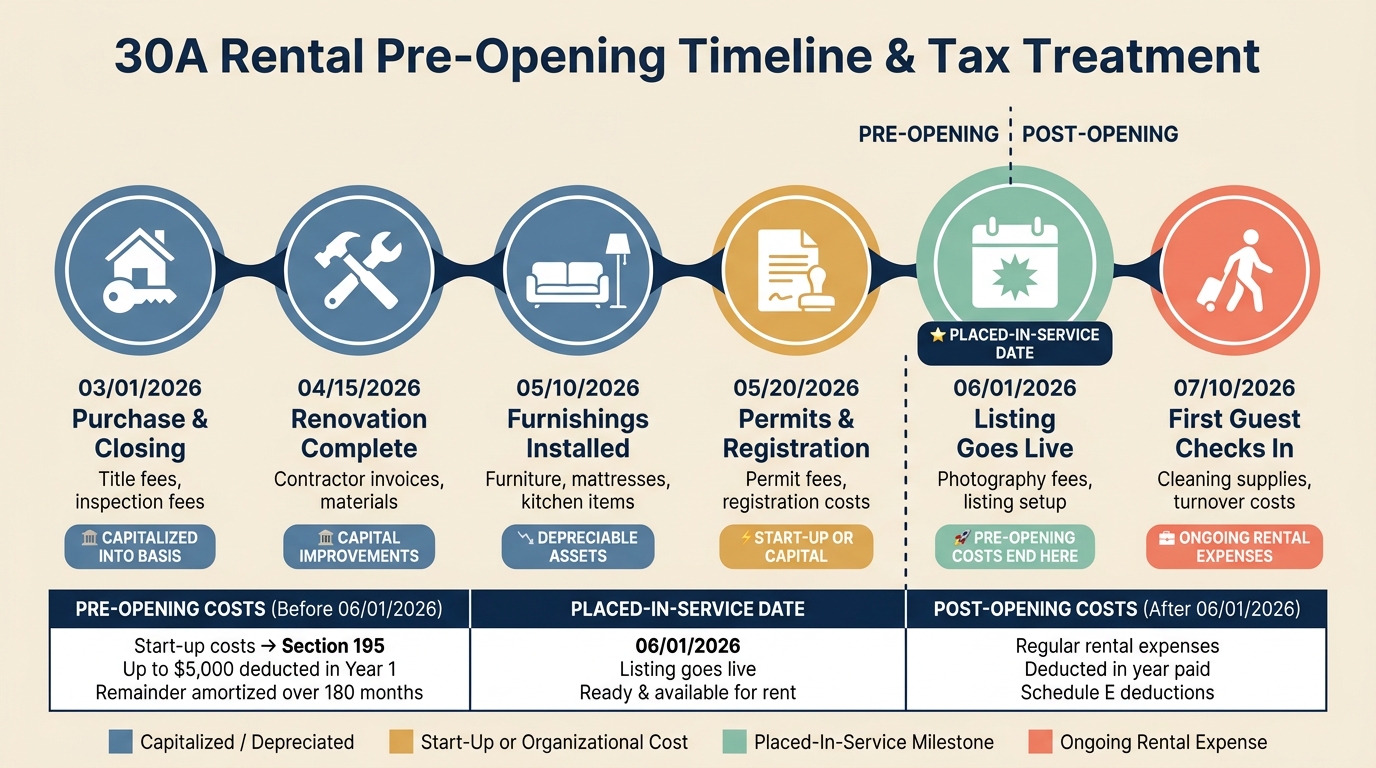
30A Rental Start-Up Cost Timeline: From Purchase to First Guest
Once you've sorted costs into buckets, the next job is to lock in the date that separates them: the placed-in-service date. That means the day the property is ready and available for rent, not the day the first guest shows up. Use that date to split pre-opening costs from rental expenses that start after launch.
Ready and available for rent versus first tenant move-in
This cutoff is what ends the pre-opening period. If you finish furnishing your Seagrove Beach cottage, get your Walton County short-term rental registration, and put up a live listing, the date that listing goes live is your placed-in-service date - even if the first booking doesn't come in until a few weeks later.
Signs a vacation rental is ready to operate
A property is generally treated as ready when all of these are true at the same time:
- All major work is done, the home is fully working, and no construction is left.
- Core appliances - stove, refrigerator, and HVAC - are installed and working.
- Required safety gear is in place, including smoke detectors, CO detectors, fire extinguishers, and GFCI outlets near water.
- Required Walton County permits, registrations, and occupancy approvals are in place.
- The property is publicly listed for rent with a live booking page or a live calendar run by a property manager.
The property must be both operational and publicly listed for rent.
Build a simple pre-opening timeline
It helps to keep a basic log of the cutoff date so you can separate start-up costs from costs that came after the rental opened. The table below shows what a 30A pre-opening timeline can look like, along with how costs at each stage are usually treated.
| Date | Milestone | Example Costs | Tax Treatment |
|---|---|---|---|
| 03/01/2026 | Purchase/closing | Title fees, inspection fees | Capitalized into property basis |
| 04/15/2026 | Renovation complete | Contractor invoices, materials | Capital improvements added to basis |
| 05/10/2026 | Furnishings installed | Furniture, mattresses, kitchen items | Depreciable assets; depreciation starts at placed-in-service date |
| 05/20/2026 | Permits and registration obtained | Permit fees, registration costs | Start-up or capital costs depending on nature |
| 06/01/2026 | Listing goes live | Photography fees, listing setup | Placed-in-service date; pre-opening costs end here |
| 07/10/2026 | First guest checks in | Cleaning supplies, turnover costs | Ongoing rental expenses |
In this example, every cost from March 1, 2026, through May 31, 2026, falls into the pre-opening period and is classified as a start-up, organizational, or capital item. Starting June 1, 2026, costs are treated as ongoing rental expenses, and depreciation begins for the home and its qualifying furnishings.
Keep dated invoices, permit records, utility confirmations, and a screenshot of the live listing together in one file.
Once that date is set, you can apply the deduction and amortization rules to the costs you recorded before it.
Step 3: Apply the deduction and amortization rules to your start-up costs
Once you've set the placed-in-service date, the next step is to apply Section 195 to each pre-opening cost.
How the $5,000 deduction and $50,000 phaseout work
Under Section 195, you can deduct up to $5,000 of qualifying start-up costs in the first tax year your 30A rental becomes active. That tax break starts to phase out when total start-up costs go over $50,000, and it goes away completely at $55,000.
The math is pretty simple: your deduction drops by $1 for every $1 over $50,000. So if your pre-opening start-up costs come to $52,000, your immediate deduction falls to $3,000. Once your costs hit $55,000 or more, you don't get a first-year Section 195 deduction at all.
If you keep qualifying start-up costs at $50,000 or less, you keep the full $5,000 first-year deduction.
Organizational costs work under separate rules. They get their own $5,000 deduction and the same 180-month amortization treatment under Sections 248 and 709.
If your costs go past the amount you can deduct right away, the rest moves into amortization.
When amortization applies instead of an immediate deduction
Any start-up costs you can't deduct up front must be amortized evenly over 180 months - that is, 15 years - starting in the month your rental becomes active.
To find the amortizable amount, subtract your allowed first-year deduction from total qualifying start-up costs. Then divide that balance by 180 to get the monthly deduction. For example, if you have $40,000 in qualifying start-up costs and take the $5,000 immediate deduction, the remaining $35,000 is amortized at about $194.44 per month ($35,000 ÷ 180).
In the first year, you count only the months the rental was active. If the property was placed in service on June 1, you would claim 7 months of amortization for that calendar year: 7 × $194.44 ≈ $1,361. After that, each full year gives you 12 months of deductions.
Costs tied to improving the property itself don't go into the Section 195 bucket.
When a cost must be capitalized and depreciated instead
If a cost creates or improves a property asset, it goes into basis instead of start-up expense. The IRS handles capital costs separately from start-up costs.
Here's the simple split: start-up costs get the business ready to operate, while capital costs improve the property itself. That means structural work, major renovations, appliances, furniture, and acquisition-related closing costs are capital expenditures. You add those amounts to the property's basis and depreciate them, usually over 27.5 years for residential rental property under MACRS.
The table below shows how common 30A rental costs are usually treated:
| Cost | Deduct Now | Amortize Over 180 Months | Capitalize and Depreciate |
|---|---|---|---|
| Pre-opening travel to scout 30A properties | ✓ | Remainder after $5,000 | - |
| Professional listing photography before launch | ✓ | Remainder after $5,000 | - |
| Pre-launch paid advertising and website setup | ✓ | Remainder after $5,000 | - |
| LLC formation legal fees and state filing fees | ✓ (separate $5,000 cap) | Remainder after $5,000 | - |
| Pre-opening tax planning consultation | ✓ | Remainder after $5,000 | - |
| Kitchen renovation or bathroom remodel | - | - | ✓ (27.5-year MACRS) |
| Title fees and closing costs at purchase | - | - | ✓ (added to basis) |
Record each cost by date and category. That makes it much easier to separate pre-opening deductions from post-launch expenses.
Step 4: Track costs before and after launch, then wrap up
Set up a ledger for pre-opening and post-opening expenses
After you've sorted each cost, keep everything in one ledger so tax season doesn't turn into a mess. Set it up before you start spending, not after. Include columns for:
- Date (MM/DD/YYYY, such as 09/20/2026)
- Vendor/Payee
- Dollar Amount ($)
- Expense Category
- Placed in Service? (Yes/No)
- Notes for the business purpose
For each line item, attach a digital receipt or a link to the receipt. That small habit can save a lot of backtracking later.
Use two tabs: Pre-opening and Post-opening. Then add a Tax Treatment column with labels like Start-up, amortized, capitalized, or operating expense. That gives your CPA cleaner records for tax filing, including Schedule E and Form 4562.
If your bookkeeping software supports it, add a class or location tag for pre-service and post-service expenses. Then you can run a filtered report to subtotal start-up costs and check whether you're getting close to the $50,000 phaseout threshold.
Use local planning notes to support your records
Those records should do more than show what you spent. They should also show why you spent it. Keep short notes on neighborhood visits, seasonal demand, guest expectations, average nightly rates, minimum stay rules, and conversations with local managers or agents.
Use sowal.co ONLY for South Walton-specific notes that back up those records.
Conclusion: Key steps to deduct start-up costs correctly
Track pre-opening costs, keep them separate from capital items and operating expenses, lock in the placed-in-service date, and apply the Section 195 deduction and amortization rules the same way each time.
FAQs
What is my placed-in-service date?
Your placed-in-service date is the day your property is ready and available to rent. That’s the date you start depreciation.
For tax purposes, the IRS uses a mid-month convention. So even if the property became available on a different day, it’s treated as placed in service in the middle of that month.
Keep records such as closing statements or improvement invoices to back up this date for your files and Form 4562.
Which pre-opening costs aren’t start-up costs?
Costs to buy the property or make improvements usually do not count as start-up costs. You generally need to capitalize those amounts instead.
That includes purchase-related fees such as closing costs, legal fees, title insurance, recording fees, and transfer taxes. It also includes bigger property work, like major renovations, large system replacements, and major landscaping.
Instead of deducting those costs right away, you recover them through depreciation over time.
How do I track expenses before my first guest arrives?
Use a dedicated bank account and credit card for the rental so your business and personal spending stay separate. It makes bookkeeping cleaner and cuts down on the mess later.
Keep an up-to-date log of costs, including closing statements, renovation invoices, and utility connection fees.
Store receipts, tax bills, and proof of payment in a digital system. For 30A properties, track placed-in-service dates and first-year compliance costs too, including Short-Term Vacation Rental certificate fees.