What Drives 30A Growth in 2026?
Tourism, second homes, rising residents, and limited land are driving 30A toward higher prices, infill redevelopment, and year-round services.
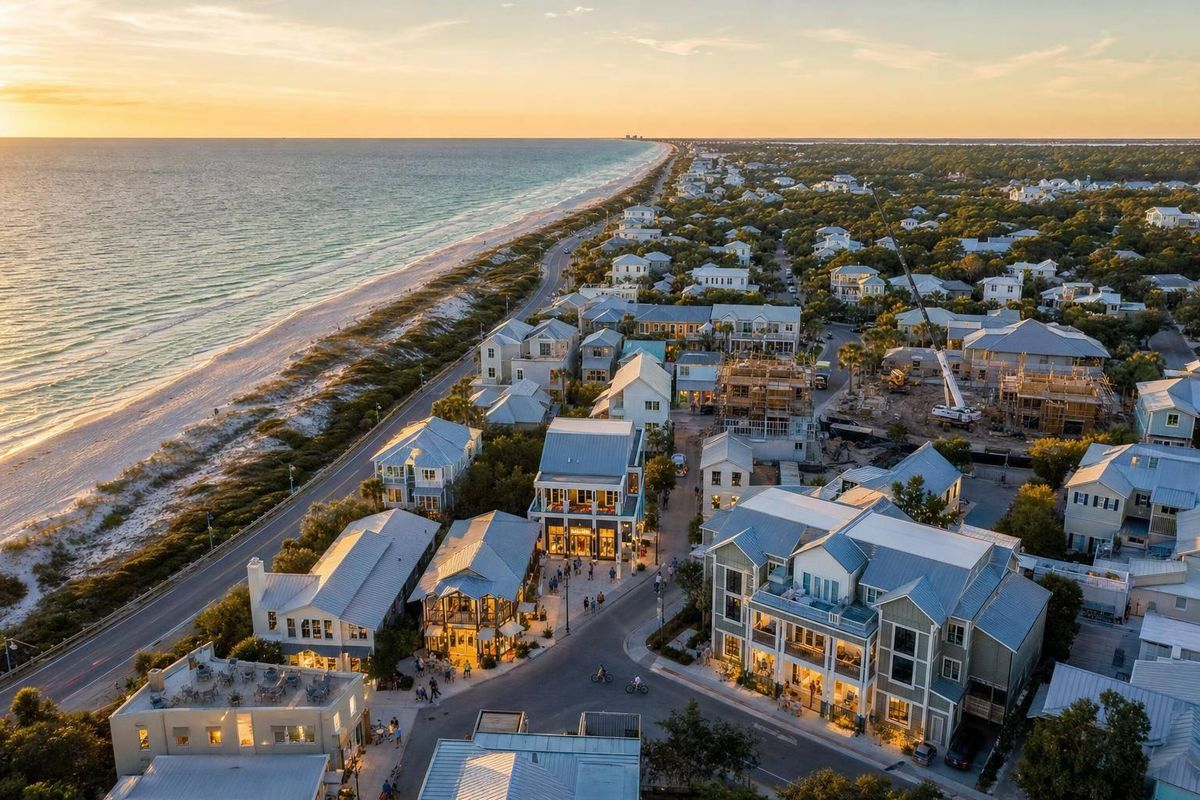
30A is growing because more money, more people, and less space are colliding at the same time.
If I had to sum it up fast, I’d say 2026 growth on 30A comes from five main forces:
- Tourism spending is still the main engine.
- Second-home buyers keep demand high.
- New full-time residents add year-round spending.
- Schools help shape where families move.
- Business growth follows both visitors and residents.
Here’s the short version in numbers:
- Spring 2026 visitor spending: more than $1.2 billion
- Spring 2026 visitors: 1,395,300
- Winter 2026 visitor spending: more than $573 million
- Median 30A sale price in 2026: about $1.6 million
- Active listings: down 25.1% year over year
- Walton County population growth: 7.0% from 2023 to 2024
- 2023 direct visitor spending: $4.7 billion
- 2023 jobs tied to tourism: 41,000+
What does that mean for you?
If you’re visiting, expect a busier area that stays active longer past summer.
If you’re buying, expect tight inventory, high prices, and more competition.
If you’re moving, expect more year-round services, but also more traffic, school pressure, and cost strain.
The big idea is simple: 30A is not just growing from vacation traffic anymore. It’s also growing because more people want to own here, live here, and build businesses here.
| Growth driver | What it does |
|---|---|
| Tourism | Brings in fast spending for hotels, rentals, food, and retail |
| Second-home demand | Pushes up home prices and keeps supply tight |
| New residents | Supports grocery, healthcare, childcare, and other daily services |
| Schools | Pull family demand toward certain neighborhoods |
| Business expansion | Adds restaurants, retail, wellness, and home services |
And there’s one more layer to watch: growth is still strong, but land, roads, parking, utilities, and insurance costs are putting limits on how much 30A can add next.
That’s why the next phase looks less like spreading out and more like infill, redevelopment, and upgrades to places that already exist.
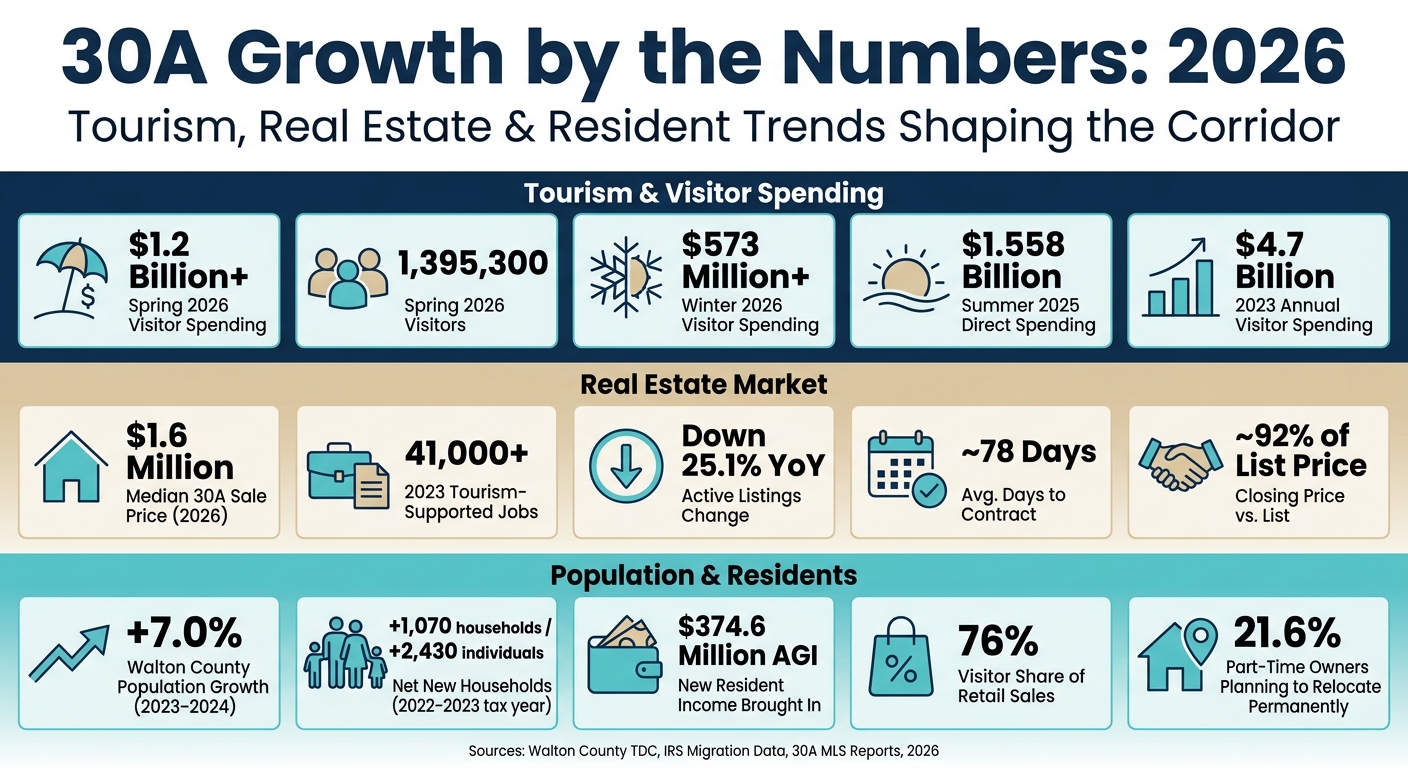
30A Growth by the Numbers: Key Stats Driving the 2026 Market
30A Florida Real Estate Market Update 2026 - 4 Key Takeaways
sbb-itb-d06eda6
How much does tourism spending drive 30A growth?
Tourism spending is the fastest-acting growth driver on 30A. In Winter 2026, direct visitor spending topped $573 million. By Spring 2026, it had climbed past $1.2 billion, with 1,395,300 visitors arriving and room nights up 3.9% year over year.
Where visitor dollars show up first
Lodging feels the impact first. In Spring 2026, the average daily rate (ADR) across Walton County hit $389.17, while revenue per available room (RevPAR) reached $220.27. Both were up from the prior spring. A big share of that money lands along 30A, where much of the beachfront inventory sits in Airbnb, VRBO, and hotel inventory.
Then the ripple moves out. When weekly guests arrive, restaurants, grocery stores, and beach service companies tend to see it right away. Boutiques and specialty shops get a lift too, especially from purchases like resort wear, local goods, and home décor people might skip back home. Short-term rental services also get a piece of the action, from cleaning and pool care to landscaping and property management. As bookings and nightly rates go up, many owners put that rental income back into the property and the local service economy.
Visitor spending accounts for more than three-quarters of Walton County retail sales. So for many local businesses, tourist dollars aren't a side boost. They're the core revenue stream.
Why seasonality still matters
Spring and summer still do most of the heavy lifting. Summer 2025 alone brought in $1.558 billion in direct spending from more than 1.9 million visitors. For many businesses, those peak months help pay fixed costs and set aside cash for slower stretches.
At the same time, fall and winter aren't just filler anymore. Fall 2025 generated $645.7 million in direct visitor spending from 767,900 visitors. Winter 2026 added more than $573 million, along with a 9.0% jump in ADR and a 2.2% increase in room nights. That's not small change. It means the off-season is starting to look a lot more like a second selling season.
Why the shift? More remote workers, retirees, and event-driven travelers are booking outside peak months. That gives 30A businesses more reason to stay open longer and keep trained staff on the schedule through the year. In plain terms, steadier demand makes year-round staffing and programming easier to support.
That steadier flow of tourism income also supports year-round jobs and housing demand, which sets up the next piece of the story: second-home buyers and new residents.
Why second-home buyers and new residents keep fueling demand
Tourism sparks the first wave. But second-home buyers and new residents are what keep demand moving all year.
When visitor demand stays high, some people stop thinking like vacationers and start buying like owners. That shift matters. These buyers don't act like weekly renters, and their presence helps explain why 30A keeps growing even when peak season fades.
Second-home demand and limited supply
The big issue is simple: there isn't much land left.
A lot of the most sought-after coastal land has already been built out. On top of that, zoning rules, height limits, and protections around dunes and wetlands restrict what can be added and how dense it can be. That squeeze shows up in pricing. By mid-2026, the median sale price across the corridor is about $1.6 million, while the average is above $2 million due to Gulf-front sales. At the same time, active listings were down 25.1% year over year. Well-priced homes are going under contract in about 78 days and closing at roughly 92% of list price.
That kind of setup changes buyer behavior. Since raw land is hard to find, more buyers and investors are turning to tear-downs and major renovations of older homes. That's one reason construction stays busy and why redevelopment is easy to spot in established places like Seaside and Grayton Beach. It also means owners looking for second homes are often competing head-to-head with full-time buyers for the same small pool of top properties.
What new residents add to the local economy
New residents don't just add headcount. They add steady spending.
Between the 2022 and 2023 tax-filing years, Walton County posted a net gain of 1,070 tax-filing households and 2,430 individuals, bringing in about $374.6 million in adjusted gross income. The county's population also grew 7.0% from 2023 to 2024.
Unlike tourists, residents spend every month, not just for a long weekend or a summer week. That money flows into housing, groceries, healthcare, childcare, and everyday services. It helps support the kinds of businesses that usually can't rely on peak-season traffic alone, such as:
- Medical offices
- Dental practices
- Fitness studios
- Childcare centers
As more owners stay for longer stretches, local demand gets less choppy. That gives employers more reason to keep permanent staff and run year-round instead of building everything around the tourist calendar.
How schools factor into family relocation decisions
For many families, the school decision comes first. Everything else follows.
South Walton is served by the Walton County School District, so families tend to weigh school quality, commute time, and neighborhood fit before they decide where to live. Communities like WaterColor, Seaside, and Rosemary Beach draw extra attention because they were built with walkable communities and shared amenities in mind. Then word-of-mouth kicks in. Families hear from other residents, compare notes, and demand starts clustering in places that feel easier for daily life.
That growing resident base is also what keeps retail, service, and neighborhood businesses expanding. More full-time population means more businesses can make the numbers work.
Where is business expansion happening on 30A?
Business growth on 30A is following two things: visitor spending and a bigger full-time population. That mix is shaping where new businesses open and what they offer.
Visitors drive 71% of all spending and 76% of all retail sales in Walton County, which helps keep more than 200 restaurants and boutiques on 30A in business. At the same time, the area isn't relying on visitors alone. 21.6% of part-time homeowners say they plan to relocate permanently. That shift changes the local playbook. As more people stay year-round, demand starts to move past beach shops and vacation meals into daily-life services.
The businesses most likely to expand first
The first wave is showing up in hospitality, retail, and resident services.
Hospitality and food service tend to move first, then lifestyle retail, followed by services built for full-time living. Restaurants, coffee bars, and fast-casual spots are often the earliest to open or expand because they can work in smaller spaces and pull from both tourist traffic and repeat local visits. Lifestyle retail, such as beachwear, home décor, and outdoor outfitters, usually comes next. These businesses often group near beach access points and town centers, where visibility is strongest and foot traffic is built in.
The next wave is centered on year-round needs. As more residents stay full time, wellness studios, med spas, physical therapy clinics, and fitness centers are opening to serve people who want the same access they'd expect in a larger city. Home services are growing too, including property management, pool maintenance, landscaping, and construction trades. That makes sense when you think about it: second-home owners still need help even when they're not in town. Professional services are also adding space, with title companies and medical offices opening second locations in town centers like Redfish Village.
Why growth clusters in certain areas
New businesses tend to gather in town centers and busy corridors where the basics are already there: foot traffic, parking, and walkability. Well-known resort and town-center areas pull in new concepts because visitors already plan to spend time there. For a new shop or restaurant, that's a strong head start.
Mixed-use zoning plays a big part as well, and land-use rules still shape where new business and residential growth can happen, making it easier to choose a 30A neighborhood. In 2026, these mixed-use centers are where growth is concentrating. Corridors with better road access, sidewalks, and bike paths are moving first.
What could slow growth, and what does 2026 point to next?
Demand is still strong. In 2026, the bigger question is how much of that demand 30A can actually handle.
Growth along 30A is strong, but it doesn't have endless room to run. Land is limited. Roads are tight. Utility capacity matters. Insurance costs keep climbing. Tourism, second-home buyers, new residents, and business growth still push demand higher, but those physical and cost limits shape how far that growth can go.
The main limits on future expansion
New development is being pushed more toward infill sites and corridors like US-331/98. At the same time, county planning links new projects to road, parking, water, sewer, and internet upgrades that have to move together.
CR 30A is tough to widen, so traffic relief has to come from sidewalks, bike paths, and other multimodal fixes. That's also one reason growth tends to cluster in town centers and mixed-use nodes instead of spreading evenly across the corridor.
Parking is another choke point. Scenic corridor rules limit surface parking, and parking garages cost a lot and are harder to add.
Water and sewer capacity also set a hard limit, since new development must connect to central systems. That means expansion depends on utility timelines, which often move slower than buyer demand. On top of that, rising property and flood insurance costs across coastal Florida are already causing some buyers to pause.
Put simply, these limits keep growth slow on purpose.
That helps explain why the next phase for 30A will likely focus less on opening new areas and more on getting more out of places that already exist.
Key takeaway for visitors, buyers, and future residents
Whether you are planning a trip or scouting the area, you can create a custom South Walton itinerary to explore these growing communities.
Tourism spending is still the near-term engine of 30A's economy. In 2023, 5.1 million visitors generated $4.7 billion in direct spending and supported more than 41,000 jobs.
Over the longer stretch, the story shifts a bit. Second-home demand, new full-time residents, pressure on school capacity, and the local business growth tied to those households are all shaping what comes next. In 2026, 30A is more likely to grow through infill, redevelopment, and mobility upgrades than through large-scale expansion.
FAQs
Why is 30A still growing so fast?
30A is growing fast for a few simple reasons: strong tourism, limited land, and a steady wave of people deciding to live there year-round. High-end tourism is still the main force behind the local economy. At the same time, remote work has made it much easier for people to relocate without changing jobs.
Land supply is also tight, and that matters a lot. With only 22% of Walton County land still available for development, scarcity keeps supporting property values. On top of that, long-term planning and zoning reforms are shaping how the area grows while trying to protect the character that drew people there in the first place.
Will 30A home prices keep rising?
Likely, but not at the fast clip seen during past speculative runs. Right now, the market looks more balanced, even as sales volume slows and the correction plays out.
Long-term price support still looks firm for a simple reason: there isn’t much land left, new building is limited, and buyers still want prime, move-in-ready homes. That demand hasn’t gone away, especially as 30A shifts closer to a year-round community.
What could limit 30A growth next?
30A’s growth is running into a simple problem: there isn’t much land left to build on. Only 22% of Walton County is available for development, and the pressure is starting to show. Traffic is getting worse, and healthcare capacity is feeling the strain too.
Growth could also slow because of stricter rules around land use, along with state laws that give local communities less say over zoning and development. That creates a tough balancing act. On one side, there’s demand for more homes and new projects. On the other, many communities want to protect the area’s character and small-town charm.